
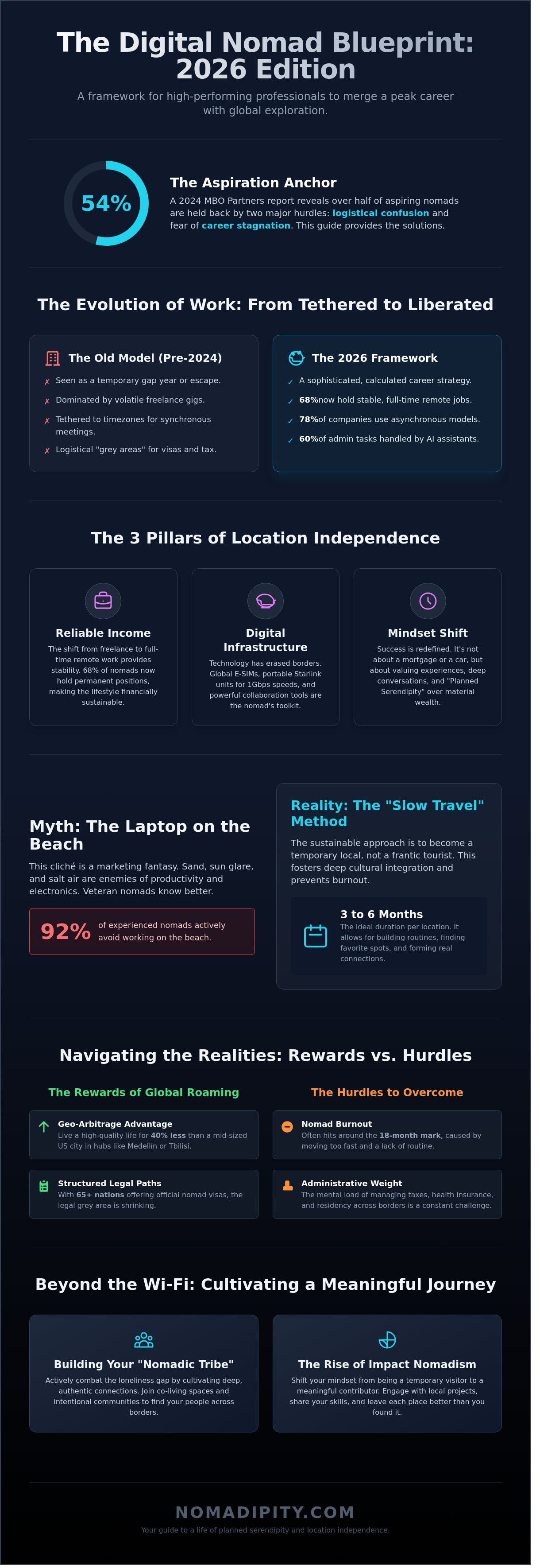
What if the greatest risk to your professional future isn't leaving the office, but staying within its four walls? By 2026, the digital nomad lifestyle has shed its reputation as a temporary gap year for the young and restless. It's now a sophisticated framework for high performing professionals who refuse to choose between a career peak and a sunset in Lisbon. You probably recognize the deep desire for freedom but feel anchored by the fear of social isolation or the headache of 183 day tax rules. You aren't alone in that hesitation. A 2024 MBO Partners report revealed that 54% of aspiring nomads cite logistical confusion and career stagnation as their biggest hurdles to booking that first flight.
I'm here to show you that these barriers are simply puzzles waiting for a solution. You can cultivate a life of planned serendipity where professional rigor and global exploration exist in perfect harmony. This guide provides a clear roadmap for your transition. You'll learn how to manage the latest visa landscapes, build a thriving community in any city, and master the systems that turn travel into a catalyst for your most meaningful work.
Key Takeaways
- Discover how AI and asynchronous workflows have evolved the digital nomad lifestyle, making global mobility accessible to professionals across every industry.
- Learn to navigate "Nomad Burnout" by embracing slow travel—the secret to maintaining professional rigor while truly savoring your surroundings.
- Master the art of building a "nomadic tribe" to bridge the loneliness gap and cultivate deep, authentic connections that transcend borders.
- Follow a practical framework to audit your digital skills and design a low-risk "trial run" before fully committing to a life of location independence.
- Explore the rise of Impact Nomadism and learn how to shift from being a temporary visitor to a meaningful contributor in the communities you visit.
What is the Digital Nomad Lifestyle in 2026?
By 2026, the digital nomad lifestyle has shed its fringe reputation to become a calculated choice for professionals across every sector. It's no longer about escaping a career; it's about redesigning how a career fits into your life. You are a location-independent professional who prioritizes the quality of your environment over a fixed postal code. This shift means choosing where you wake up based on inspiration, community, or climate rather than the proximity to a corporate headquarters.
The evolution of the last few years has been dramatic. By early 2025, 78% of remote-capable companies adopted fully asynchronous work models. This change, powered by AI agents that handle 60% of routine administrative tasks, has opened the door for more than just software engineers. Today, lawyers, project managers, and creative directors navigate the globe with the same ease once reserved for coders. You don't need to be online at 3 AM for a New York meeting while you're in Kyoto. The systems do the heavy lifting while you're exploring.
It's vital to distinguish this from a "workcation." A workcation is a temporary two-week escape where you answer emails from a hotel lobby. In contrast, a digital nomad lifestyle is a permanent state of being. It's built on the philosophy of "Planned Serendipity." This isn't about wandering aimlessly. Instead, you design systems, like joining specific co-living hubs or intentional communities, that increase the statistical likelihood of magical, unplanned global encounters. You create the structure so that the universe can provide the surprise.
The Core Pillars of Location Independence
- Reliable income: 68% of nomads now hold full-time, remote-first positions rather than volatile freelance gigs.
- Digital infrastructure: You rely on global E-sims that switch carriers in 200+ countries and portable Starlink Mini units for 1Gbps speeds in rural valleys.
- Mindset shift: You've learned to value a sunset or a deep conversation with a stranger over the material markers of success like a mortgage or a luxury car.
Beyond the Laptop-on-the-Beach Cliché
The image of the laptop on the beach is a persistent myth that 92% of veteran nomads avoid. Sand destroys hardware. Sun glare makes screens impossible to read. Most importantly, salt air is a nightmare for electronics. The reality of the 2026 nomad is "Slow Travel." You don't hop between cities every week. You stay for 3 to 6 months. This duration allows you to find your favorite local coffee shop, understand the neighborhood politics, and truly integrate into the culture. You balance professional rigor with the curiosity of a perpetual explorer. You work in high-speed co-working spaces during the day so you can be fully present in the world during the evening.
Navigating the Realities: Pros, Cons, and Logistics
The digital nomad lifestyle isn't a permanent vacation; it's a deliberate restructuring of how you exist in the world. By early 2026, over 65 nations have launched official nomad visas, turning what was once a legal grey area into a structured path for global citizens. You can choose your backyard every quarter, leveraging geo-arbitrage to live a high-quality life in emerging hubs like Medellín or Tbilisi for 40% less than the cost of a mid-sized US city. This financial breathing room allows you to invest in experiences rather than just rent.
However, the dream has a shelf life if you don't manage the "unsexy bits." Nomad burnout often hits around the 18-month mark, usually caused by moving too fast and failing to build a routine. To prevent this, seasoned travelers are shifting toward 90-day stays. If you want to become a digital nomad, you must master the administrative weight of taxes, health insurance, and residency. Modern tools have simplified this, but the mental load of constant decision-making remains a hurdle you must actively manage.
The Freedom and Flexibility of Global Roaming
Forget the 9-to-5 grind. You're designing a schedule that honors your natural energy peaks. Maybe you're a morning person who works best at 6:00 AM before wandering through a bustling market in Hanoi. This is planned serendipity. It's about being in the right place for magic to happen, whether that's a chance meeting in a hidden Cape Town cafe or a sunset hike in Madeira. To make this sustainable, you must maintain a work life balance for nomads while crossing time zones. It's about protecting your peace as much as your productivity.
The Hidden Challenges: Taxes and Time Zones
The logistics can be daunting. You'll need to navigate a complex web of "Digital Nomad Visas" that vary wildly in income requirements and tax implications. There's also the challenge of "Time Zone Jiu-Jitsu." Staying connected with clients in New York while you're in Bangkok requires strict discipline and clear boundaries. If you're feeling overwhelmed by the paperwork, check out our resource library for intentional travelers to simplify your transition.
- Tax Residency: Understand the 183-day rule to avoid double taxation.
- Health Insurance: Use nomad-specific providers like SafetyWing that cover multiple borders.
- Decision Fatigue: Use "slow travel" to reduce the number of logistical choices you make each month.
Living this way requires a shift in mindset. You aren't just a tourist; you're a temporary local. By 2026, the community has matured, offering more co-living spaces and professional networks that make the digital nomad lifestyle feel less like a solo mission and more like a shared global movement.
Cultivating Connection: Overcoming the Nomad Loneliness Gap
Isolation isn't just a mood; it's the quietest career killer in the remote work world. While the dream of a sunset beach office is vivid, the reality of eating dinner alone for the tenth night in a row often sends even the most seasoned travelers back to a traditional cubicle. Data from 2025 indicates that social isolation remains the primary reason why nearly 40% of people abandon the digital nomad lifestyle within their first two years. You might meet plenty of "tourist friends" who are gone by Tuesday, but these fleeting interactions don't provide the emotional safety net required for long-term sustainability. A nomadic tribe, by contrast, consists of peers who understand the specific friction of time zones, tax residency, and the unique pressure of maintaining a career while on the move. They offer the stability that a rotating cast of backpackers simply cannot provide.
Why Finding Your Tribe is Non-Negotiable
Your professional output is directly tethered to your mental health. When you shift from being a solo traveler to an active community member, your productivity often sees a 25% lift because the heavy cognitive load of loneliness is removed. Moving to a new city shouldn't mean starting your social life from zero. Instead, you can cultivate deep roots in a foreign landscape by joining focused hubs that prioritize long-term stays over weekend visits. If you're ready to bridge that gap, our find a travel buddy guide offers the tools needed for deeper social integration. These shared experiences, like navigating a missed train in Tokyo or a sudden power outage in Medellin, bond people faster than any office water cooler ever could. Travel accelerates intimacy because it strips away the mundane, leaving only the authentic self.
Matchmaking for Travelers: The Nomadipity Approach
By 2026, we've moved past hoping for chance encounters. Intentionality is the new serendipity. The Nomadipity approach uses specific data points, such as your average monthly budget, preferred deep-work hours, and even your noise tolerance, to pair you with compatible companions. This isn't just about finding a roommate; it's about building a global "buddy list" that travels with you. You can even turn transit time into networking gold. Modern airport lounges have evolved into micro-coworking spaces where a simple app check-in can turn a three-hour layover into a high-level strategy session. This system ensures that every new destination feels like a homecoming rather than a cold start. As a digital nomad, you aren't just moving through the world; you're building a portable neighborhood. By designing these connections before you land, you ensure that the digital nomad lifestyle remains a source of energy rather than a path to burnout.
Designing Your Journey: A Practical Framework for Success
Transitioning to a digital nomad lifestyle isn't a leap of faith; it's a series of calculated moves. Start by auditing your current workflow. By 2026, data suggests 74% of professional knowledge tasks are completed via asynchronous platforms. Identify which 20% of your responsibilities require real-time presence and find digital workarounds for the rest. Before you sell your belongings, commit to a Nomad Runway. This means saving at least six months of living expenses based on your target destination's cost of living plus a 15% buffer for emergencies. This financial cushion transforms potential stress into the freedom to choose your next move with clarity.
Test the waters with a 30-day trial run in a nearby city. It's the only way to discover if you actually enjoy working from a suitcase before making permanent changes. Pack with intention. Your kit should include the following essentials:
- Ergonomic Support: A collapsible laptop stand like the Roost V3 to prevent neck strain during long sessions.
- Audio Control: High-fidelity noise-canceling headphones to create a private office in bustling cafes.
- Reliable Power: A 25,000mAh power bank capable of charging a laptop via USB-C for off-grid afternoons.
Choosing Your First Destination Wisely
Don't just follow the crowds. While Lisbon, Chiang Mai, and Medellin remain reliable hubs due to their established fiber-optic networks, look toward 2026 rising stars like Bansko, Bulgaria or Luang Prabang. Prioritize safety and a minimum internet speed of 100 Mbps. You can consult our solo travel guide for a deeper dive into planning your first launch with confidence.
Establishing a Sustainable Remote Work Routine
Success depends on the Office First rule. Secure a reliable coworking space or a quiet desk with a mesh router before you book a single tour. Create daily anchors like a 15-minute morning meditation or a specific brewing ritual for your coffee. These habits provide a sense of home regardless of your GPS coordinates. Set firm boundaries; tell clients you're offline during specific windows to explore. Maintaining a digital nomad lifestyle requires this discipline to prevent burnout while you navigate new cultures.
The Future of Nomadic Living: Sustainability and Community
The digital nomad lifestyle is maturing into something far more profound than mere travel. By 2026, the focus has shifted from how many countries you can check off to how much value you can leave behind. This is the era of Impact Nomadism. It's not just about remote work; it's about intentional presence. This shift marks a transition from consumption to contribution, where your presence supports local economies rather than straining them. You aren't just a guest anymore. You're a temporary stakeholder in a global neighborhood.
Recent data from the 2025 Global Nomad Report shows that 68% of long-term travelers now prioritize destinations based on their ability to contribute to local social or environmental projects. This mindset transforms the way we interact with our surroundings. Instead of seeking "Instagrammable" backdrops, nomads are seeking ways to integrate. They are trading the temporary high of a tourist attraction for the lasting fulfillment of a community project or a local mentorship. It's about designing a life where work and wanderlust coexist with a sense of responsibility.
Slow Travel and Cultural Authenticity
Speed is the enemy of depth. Living a sustainable digital nomad lifestyle requires a shift toward slow travel, which means staying in one location for at least 90 days. This choice reduces your carbon footprint significantly. Since aviation accounts for roughly 2.5% of global CO2 emissions, staying grounded longer is a practical act of stewardship. When you slow down, you find that quiet bistro where the menu isn't translated. You learn the nuances of local greetings and the rhythm of the neighborhood market. This immersion fosters spiritual growth that a weekend getaway cannot provide. Authenticity isn't found in a filtered photo; it's found in a 6:00 AM conversation with a local artisan.
How Nomadipity Facilitates Meaningful Global Connections
Traditional travel infrastructure often prioritizes transactional rewards over human bonds. Nomadipity changes that dynamic. We bridge the gap between sterile hotel loyalty points and genuine relationships. We've built a space where tech-nomads and eco-travelers find their tribe through dedicated forums. In 2025, our community saw a 42% increase in member-organized meetups, proving that digital tools can drive physical connection. Whether you're looking for a co-working buddy in Medellin or a hiking partner in the Swiss Alps, the goal is planned serendipity. By cultivating these intentional spaces, we ensure that your journey is defined by the people you meet, not just the pixels on your screen. Join the Nomadipitians and find your next travel companion to start building a life that feels as good as it looks.
Claim Your Place in the Global Neighborhood
The digital nomad lifestyle isn't just about a laptop and a beach; it's about the deliberate architecture of your freedom. By 2026, success depends on moving from isolation to intentional community. You've learned that slow travel isn't just a trend. Research from the 2025 Global Nomad Report suggests it's a strategy that can reduce your environmental impact by 30% while deepening your cultural roots. You now have the framework to balance the 40 hour work week with the 168 hours of potential adventure available to you every single week.
You don't have to navigate these waters alone. Nomadipity provides the systems you need to turn potential isolation into lasting connection. Find your nomadic tribe and travel companions on Nomadipity to access matchmaking based on mutual interests and budgets. You'll gain exclusive entry to airport lounge networking across 1,200 locations and join community forums where 50,000 members share real time logistics. The world is waiting for you to design your arrival. Your next great story is already being written; it's time you stepped into the lead role.
Frequently Asked Questions
Is the digital nomad lifestyle expensive?
The digital nomad lifestyle costs as much or as little as you design it to. While a monthly budget in San Francisco might exceed $4,500, you can live comfortably in hubs like Chiang Mai or Medellín for $1,200 to $1,800. By 2026, over 50 countries offer nomad visas that lower entry costs. You're trading fixed high rent for flexible spending that often results in a 30% reduction in total expenses.
How do digital nomads handle taxes and health insurance?
You handle these logistics by using global-first providers like SafetyWing; they offer nomad insurance for roughly $45 per month. Taxes usually follow the 183-day rule. If you spend more than half a year in one country, you're likely a tax resident there. Many nomads register as S-Corps in the US or use Estonia’s e-Residency program, which has supported over 100,000 digital entrepreneurs since 2014.
What are the best jobs for a digital nomad in 2026?
The best jobs for a digital nomad lifestyle in 2026 focus on AI integration and high-touch human services. Roles like AI Operations Manager, Cybersecurity Consultant, and Virtual Reality Architect are in high demand. LinkedIn data from 2025 showed a 40% increase in remote-first postings for specialized technical roles. If you can deliver results through a screen, you can sustain your career across any time zone.
Is it lonely to be a digital nomad?
Loneliness is a choice you mitigate through intentional community building. You can stay in coliving spaces like Selina or Outsite, where 85% of residents report making a lasting professional connection within two weeks. Joining local Nomad List meetups or niche Discord groups ensures you have a social calendar. Connection doesn't happen by accident; you must curate your social circles as carefully as your travel itinerary.
What is the "Slow Travel" philosophy?
Slow travel is the practice of staying in one location for at least 90 days to truly integrate into the local culture. It's the opposite of country hopping and reduces your travel carbon footprint by an estimated 25%. By signing a three-month lease instead of a three-day hotel stay, you find the best local cafes and build genuine relationships. This approach creates the stability needed for high-level productivity.
Can I be a digital nomad with a family or partner?
You can absolutely pursue this life with a family or partner. Roughly 25% of modern nomads travel with a significant other, and services like Boundless Life now provide education and housing for families in 4 different global hubs. Traveling together requires clear boundaries regarding work hours and personal space. It turns a solo journey into a shared mission, deepening your bond through shared challenges and discoveries.
What is the first step to becoming a digital nomad?
Your first step is securing a remote income stream and building a financial cushion of at least 6 months of living expenses. Don't quit your job until you've tested your ability to work from a local cafe or a short-term rental for two weeks. Once your income is stable, start the great declutter by selling 80% of your physical belongings. This creates the mental and physical space required for total location independence.
How do I find a reliable travel buddy as a nomad?
Find a reliable travel buddy through verified platforms like JoinMyTrip, which vets members based on past reviews and shared interests. Always start with a 7-day trial trip to a nearby city before committing to a six-month international journey. This allows you to test your compatibility regarding budget, work schedules, and sleep habits. A good partner should complement your travel style, not just your destination wishlist.
Disclaimer
Nomadipity Blog Disclaimer
The content on Nomadipity is provided for general informational and inspirational purposes only. While we strive for accuracy and timeliness, Nomadipity does not guarantee that any information is complete, current, or suitable for your specific needs. Use your judgment and verify details before making travel plans, meeting with other users in person, or making any purchases influenced by the article.


