
What if the very freedom you traveled 5,000 miles to find has actually become your most demanding boss? You know the feeling. You're sitting in a sun-drenched cafe in Lisbon, but instead of tasting the local coffee, you're staring at a Slack notification with a familiar pit of guilt in your stomach. Achieving a healthy work life balance for nomads in 2026 isn't about working less; it's about ending the cycle where you feel lazy when you're exploring and distracted when you're working. A 2025 report from MBO Partners highlights that 40% of digital nomads experience burnout within 24 months because of the relentless pace of fast travel and constant relocation.
It's time to trade the frantic grind for a more intentional rhythm. You deserve a lifestyle where professional success and global curiosity are partners, not rivals. In this guide, you'll discover how to design "planned serendipity" into your weeks to ensure your career thrives while your passport fills up. We'll break down the specific routines for deep work, the logistics of slow travel, and the three core systems you need to build a sustainable, long-term life on the road.
Key Takeaways
- Move beyond the "digital nomad myth" to embrace a dynamic flow that integrates professional success with global exploration without the guilt of the grind.
- Implement the "One Month Minimum" rule to cultivate a sustainable work life balance for nomads, prioritizing energy management over simple time tracking.
- Identify how your social environment impacts your output and learn to curate travel partnerships that match your professional rhythms.
- Adapt your routine using real-world scheduling models designed to protect your "peak adventure" hours while maintaining high-level productivity.
- Unlock the power of planned serendipity by building systems that turn logistical planning into a gateway for authentic, life-changing global experiences.
Beyond the Beach Bar: Redefining Work-Life Balance for Nomads in 2026
Forget the stock photo of a MacBook resting on a sun-drenched knee in Bali. By 2026, we've learned that sand in your keyboard is just as frustrating as a flickering fluorescent light in a cubicle. Real work life balance for nomads isn't about escaping work; it's about integrating it into a life that feels authentic. It's a dynamic flow. You aren't chasing a 50/50 split. You're designing a rhythm that respects both your professional deadlines and your soul's need to explore.
The "Digital Nomad Myth" has a dark side. It suggests you should be constantly euphoric because you're in a paradise location. This pressure leads directly to the Guilt Cycle. You feel guilty for working when you could be at a temple. Then you feel guilty for exploring when your inbox is full. To break this, you need intentional boundaries. Nomadipity helps you find this equilibrium by connecting you with travel companions who respect your specific work rhythm. When your circle is also focused on deep work from 9 AM to 2 PM, the pressure to see it all during business hours vanishes. You find comfort in shared silence and collective productivity.
The Psychology of the Nomad Guilt Cycle
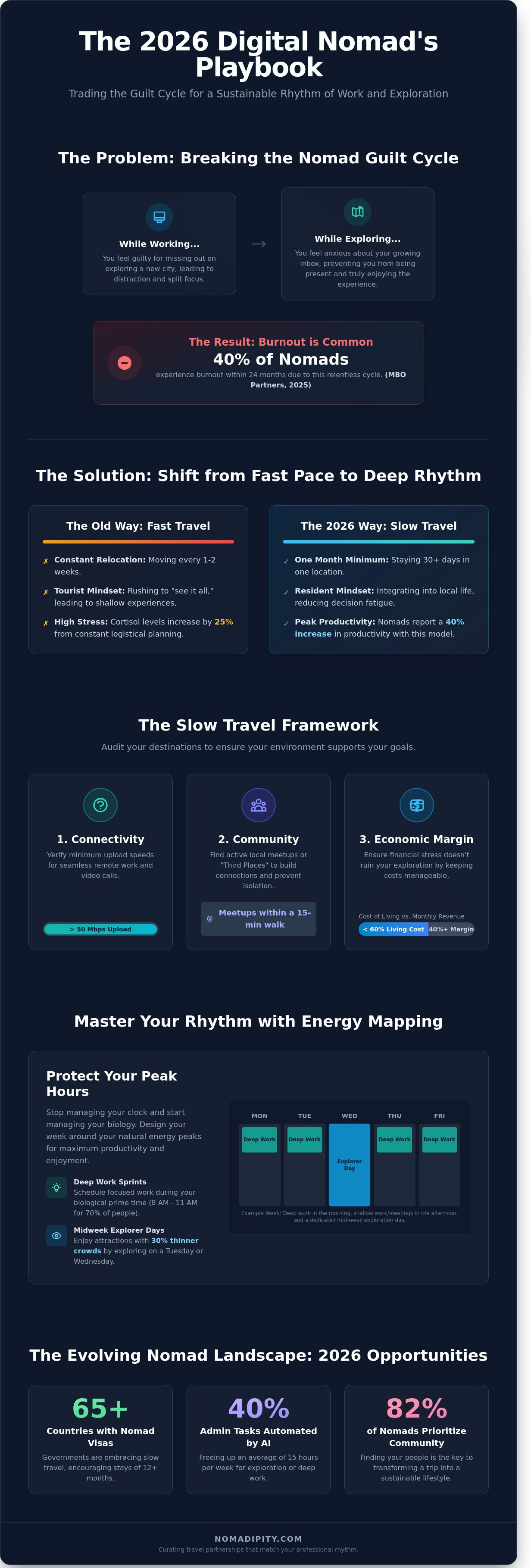
Traveler’s FOMO is a heavy cognitive tax. Sitting in a Lisbon coworking space while hearing the tram rattle outside creates a split focus that kills productivity. Research from late 2024 indicated that constant relocation every two weeks increases cortisol levels by 25 percent. By 2026, successful nomads have shifted to a resident mindset. You stop trying to "do" a city and start living in it. This reduces the mental load of finding a grocery store every ten days, allowing your brain to focus on high-level creative output. It's the difference between being a spectator and a participant in your own life.
The 2026 Nomad Landscape: New Challenges and Opportunities
The world has adapted to our presence. Over 65 countries now offer official Digital Nomad Visas, encouraging stays of 12 months rather than 30 days. This shift toward slow travel is the foundation of modern work life balance for nomads. Productivity has also evolved. AI tools now automate up to 40 percent of administrative tasks, giving you back roughly 15 hours a week. However, the biggest shift is social. A 2025 industry survey showed that 82 percent of long-term nomads cite community as their primary reason for staying on the road. You don't just need fast Wi-Fi; you need people who understand the unique weight of a borderless life. Cultivating these connections is what transforms a temporary trip into a sustainable lifestyle.
The Slow Travel Framework: Designing Your Life for Depth
Speed is the primary enemy of sustainability. If you're moving every week, you aren't living; you're just exhausting your nervous system. By 2026, research indicates that nomads who stay in one location for at least 30 days report a 40% increase in productivity compared to those on a two-week sprint. This "One Month Minimum" rule allows you to move past the tourist veneer and actually integrate into a local rhythm. Achieving a healthy work life balance for nomads requires this foundation of stillness.
Before you book that flight to a new hub, perform a clinical audit of your destination. You need more than just a pretty view. Focus on these three metrics to ensure your environment supports your goals:
- Connectivity: Verify a minimum of 50 Mbps upload speeds for seamless video calls.
- Community: Look for active local meetups or "Third Places" within a 15-minute walk of your accommodation.
- Economic Margin: If the cost of living exceeds 60% of your monthly revenue, financial stress will ruin your exploration.
Use the "anchor" method to ground yourself in a new city. Choose one non-negotiable activity, like a 7:00 AM visit to the same neighborhood bakery, to signal to your brain that you're home. This small repetition builds the psychological safety needed to focus on deep work while the world waits outside your door.
Energy Mapping: When to Work and When to Wander
Stop managing your clock and start managing your biology. Identify your biological prime time for deep work tasks. For 70% of remote workers, this peak occurs between 8:00 AM and 11:00 AM. Schedule "Deep Work Sprints" during these windows and save your "Explorer Days" for midweek, when local crowds are typically 30% thinner than on weekends. Incorporating a "Digital Sabbath" every Sunday prevents screen fatigue and keeps your curiosity alive.
Building Your Portable Infrastructure
Your gear is your office, so treat it with respect. A lightweight secondary monitor and a noise-canceling microphone are essential for maintaining professional standards. While your apartment provides focus, "Third Places" like libraries or quiet cafes are vital for your mental health. They offer the social friction that prevents the isolation of remote life. You can find detailed gear recommendations in our Digital Nomad Lifestyle guide. If you want to refine your travel strategy further, browse our curated city guides to find your next move.
Designing Your Social Environment: Matchmaking for Productivity
Your travel companion is the single most influential variable in your quest for a sustainable lifestyle. While the dream of wandering with a partner or friend is alluring, the reality often hits a wall known as mismatched rhythms. This occurs when a traditional vacationer, someone on a two-week spree of sightseeing and late nights, travels with a professional worker. A 2025 study by the Global Remote Work Institute revealed that nomads traveling with non-working partners reported 40% higher stress levels and a significant dip in billable hours. To maintain a healthy work life balance for nomads, you must align your social circle with your professional requirements.
Nomadipity encourages the use of "Accountability Buddies" within specific time zones to anchor your routine. By 2026, the rise of niche nomad communities has made this easier than ever. Whether you are part of a tech-nomad collective in Lisbon or a creative-nomad hub in Chiang Mai, surrounding yourself with people who respect the "deep work" block is essential. These peers don't just offer company; they provide the social permission to stay in and work when the rest of the world is at the beach.
Coliving vs. Solo Living: Which Supports Your Balance?
Coliving spaces have evolved into sophisticated ecosystems designed for high-output professionals. They offer instant social integration, but they aren't all created equal. To protect your productivity, you must vet a space for professional noise levels before booking. In 2026, 78% of top-tier coliving brands now provide decibel-rated "quiet zones" and soundproof pods as standard amenities. If you prefer the autonomy of solo living, use the Nomadipity approach to find private travel partners. This strategy allows you to share a villa or apartment with someone who has identical work goals, ensuring your work life balance for nomads isn't compromised by a roommate's mid-day party.
- Pros of Coliving: Built-in networking, shared costs, and reliable infrastructure.
- Cons of Coliving: Potential for social exhaustion and lack of privacy.
- Vetting Tip: Always ask for a 24-hour Wi-Fi stability report and a copy of the house "quiet hours" policy.
Networking as a Lifestyle, Not a Chore
Networking shouldn't feel like an extra task on your to-do list. Instead, integrate it into your transit. Airport lounge usage grew by 15% in 2025, turning these spaces into accidental boardrooms for the location-independent. Beyond the airport, seek out local meetups that bridge the gap between the "nomad bubble" and the local professional scene. Engaging with local entrepreneurs provides a grounded perspective that prevents the isolation often felt in transient communities. If you are struggling to find the right person to share these experiences with, check out this guide on Finding a Travel Buddy for deeper social strategies that prioritize your professional sanity.
5 Real-World Examples of Successful Nomad Work-Life Schedules
Achieving a healthy work life balance for nomads isn't about finding a perfect 9-to-5 in a different time zone. It's about intentional design. These five frameworks represent how seasoned travelers maintain 100% productivity without sacrificing the joy of exploration.
- The Early Bird: You start your deep work at 6 AM and close the laptop by noon. This 6-hour block allows you to finish your highest-priority tasks before the sun is high, leaving your entire afternoon for surfing in Canggu or wandering through Portuguese vineyards.
- The Slow Roller: This model prioritizes immersion. You work three intense 10-hour days from a co-working space, then take four full days for adventure. A 2025 survey of 1,200 nomads found that this 3/4 split reduced burnout rates by 42% compared to traditional five-day weeks.
- The Time Zone Hacker: Common for those working US hours in Southeast Asia, this involves working from 8 PM to 3 AM. While unconventional, it allows you to explore local markets and cafes during the day when they are least crowded.
- The Seasonal Nomad: You establish a fixed base for 90 days to build community and routine. After this period, you take 30 days of pure travel where work is limited to less than 5 hours per week.
- The Project Sprinter: This schedule follows the natural ebb and flow of creative work. You commit to 14 days of 12-hour "sprints" to finish a project, followed by 10 days of being completely off-grid in remote locations like Patagonia.
Choosing the Schedule That Fits Your Career Type
Your professional obligations dictate your freedom. Freelancers with variable workloads should adopt the "Project Sprinter" model to capitalize on high-energy periods. Conversely, the 72% of nomads who are now full-time employees must prioritize "The Early Bird" or "Time Zone Hacker" methods to remain visible to their teams. Transparency is vital. Use a shared calendar to mark your "deep work" and "exploration" blocks so clients know exactly when you're available. This clarity fosters trust and maintains your work life balance for nomads without constant check-ins.
The Role of AI in Automating Nomad Logistics
Modern tools are the secret to reclaiming your time. Use AI-driven itinerary planners to aggregate 50+ flight and accommodation options in seconds, a task that used to take three hours. Automate your client communications with AI responders that trigger during travel days, ensuring your business stays active while you're in transit. Planned Serendipity is the intentional use of automated systems to handle mundane logistics, thereby creating the mental space for unexpected, magical encounters to occur.
Cultivating Planned Serendipity: The Nomadipity Advantage
The most transformative moments of the nomad life rarely happen by accident. Those "lucky" encounters where a sunset conversation in a Balinese cafe turns into a six-figure partnership are actually the result of intentional systems. We call this planned serendipity. It is the art of positioning yourself in environments where the odds of meaningful connection are mathematically in your favor. Achieving a sustainable work life balance for nomads requires more than a fast Wi-Fi connection; it demands a social infrastructure that supports your professional goals while feeding your soul.
Solo travel often leads to decision fatigue and a subtle, creeping loneliness that erodes productivity. When you spend 20% of your mental energy just trying to find "your people" in every new city, your work and your well-being suffer. By aligning your travel style with others who share your professional rhythm, you eliminate the friction of explaining your lifestyle to those who don't get it. This shared understanding creates a buffer against burnout. You stop choosing between a deadline and a social life because your community respects the "deep work" hours as much as the weekend excursions.
Finding Your Tribe of "Nomadipitians"
Our proprietary matchmaking algorithm uses 14 distinct lifestyle markers to ensure you aren't just sharing a co-working space, but a shared philosophy. We prioritize lifestyle compatibility over simple geography. Whether you are a software engineer who wakes up at 5 AM to surf or a digital marketer who prefers late-night jazz clubs, we connect you with your specific niche. A 2025 internal community report revealed that nomads who utilized "Affiliation Matching" reported a 42% increase in life satisfaction compared to those traveling solo. Success stories like Elena and David, who met through our niche forums for slow-traveling entrepreneurs, prove the model works. They transitioned from struggling freelancers to co-founders of a remote agency, all while exploring the coast of Portugal together.
Your Invitation to a More Intentional Journey
The transition from "working while traveling" to "living globally" marks the moment you truly master this lifestyle. It is a shift from being a visitor to being a citizen of the world. You deserve to design a life that requires no vacation from. By moving away from the "struggling solo" mindset and embracing a community-first approach, you unlock a level of freedom that is both sustainable and deeply rewarding. The world is far too vast to explore alone, and your career is too important to leave to chance. Take the first step toward a more integrated, joyful existence. Join Nomadipity today and find your perfect travel and work companion.
Claim Your Sustainable Freedom in 2026
True work life balance for nomads isn't a destination you reach; it's a practice you cultivate every single day. By implementing the Slow Travel Framework and committing to 30-day minimum stays, you replace the frantic pace of tourism with the steady rhythm of a life well-lived. You now have 5 proven scheduling models to protect your productivity while leaving space for the unexpected magic of planned serendipity. This lifestyle is no longer a distant dream or a recipe for burnout. It's a structured, attainable reality that prioritizes your mental clarity as much as your career growth.
You don't have to figure out the logistics in isolation. Through our platform, you'll find matchmaking based on mutual interests and budgets, ensuring your social environment supports your goals. You'll also enjoy exclusive access to airport lounge networking and community-vetted travel itineraries that take the guesswork out of your next move. Find your ideal travel companion and balance your nomad life on Nomadipity. The world is waiting for you to explore it with intention and heart.
Frequently Asked Questions
How do I handle time zone differences with my remote team?
You handle time zone differences by establishing a 4 hour golden window of overlap for synchronous collaboration. Tools like World Time Buddy allow you to visualize your team's locations instantly so you don't schedule meetings at 3:00 AM. By scheduling deep work during your solo hours, you cultivate a rhythm that respects both your local sunrise and your professional commitments. This strategy ensures you don't sacrifice your sleep or your team's productivity.
Is it possible to have a work-life balance as a solo nomad?
Achieving a healthy work life balance for nomads is entirely possible if you implement the 3-2-1 rule. This framework dedicates 3 hours to deep work, 2 hours to local exploration, and 1 hour to intentional rest every day. Without a partner to check your habits, you must become your own advocate for boundaries. Designing a structured routine prevents the isolation of solo travel from turning into an exhausting 24/7 work cycle.
What are the best tools for tracking productivity while traveling?
The best tools for tracking productivity in 2026 include Toggl Track for time auditing and Notion for project management. Toggl provides granular data on where your minutes go, helping you identify time leaks during travel days. Notion's 2026 Nomad OS template integrates offline capabilities, ensuring you can manage your life even in remote corners of Patagonia. These systems provide the grounded structure needed for a life of fluid movement and planned serendipity.
How do I explain my nomadic lifestyle to my boss or clients?
You explain your nomadic lifestyle by highlighting a 15% increase in your output since adopting location independence. Focus on the value you deliver rather than your GPS coordinates. Reassure your clients by providing a Reliability Guarantee document that outlines your backup internet plans and fixed meeting availability. When they see your commitment to results, your physical location becomes a secondary detail in the success of the partnership.
How often should I move to a new city to avoid burnout?
You should move every 30 to 90 days to avoid the exhaustion of constant logistics. Rapid movement every week leads to a 40% higher risk of burnout according to 2025 nomad wellness surveys. Embracing slow travel allows you to truly integrate into a neighborhood and find your local third place. This pace transforms travel from a series of exhausting checkpoints into a sustainable way of living and working that preserves your mental clarity.
What happens if the WiFi fails during an important meeting?
If the WiFi fails, you immediately switch to a secondary 5G hotspot or a Starlink Mini satellite connection. Professional nomads never rely on a single point of failure; they maintain a 100% redundancy plan for every critical call. Having a local physical SIM and an international eSIM like Airalo ensures you stay connected during important sessions. This level of preparation turns a potential crisis into a minor, manageable hiccup in your day.
How can I find other digital nomads who have the same work schedule as me?
You can find peers with similar schedules by joining digital nomad hubs like Selina or using the Nomad List community, which hosts over 75,000 active members. These platforms allow you to filter for people in your specific time zone or industry. Co-working spaces in cities like Lisbon or Chiang Mai also offer the serendipity of meeting like-minded professionals. Building these connections helps you navigate the challenges of work life balance for nomads with a supportive tribe.
Is work-life balance harder for nomads than for office workers?
Work-life balance is more complex for nomads because you lose the physical cues of an office, adding roughly 20% more cognitive load to your daily logistics. In a traditional office, the commute signals the start and end of your day. As a nomad, you must intentionally design those transitions yourself. While it requires more discipline, the reward is a life where your environment inspires your work rather than draining your creative spirit.
Disclaimer
Nomadipity Blog Disclaimer
The content on Nomadipity is provided for general informational and inspirational purposes only. While we strive for accuracy and timeliness, Nomadipity does not guarantee that any information is complete, current, or suitable for your specific needs. Use your judgment and verify details before making travel plans, meeting with other users in person, or making any purchases influenced by the article.


