

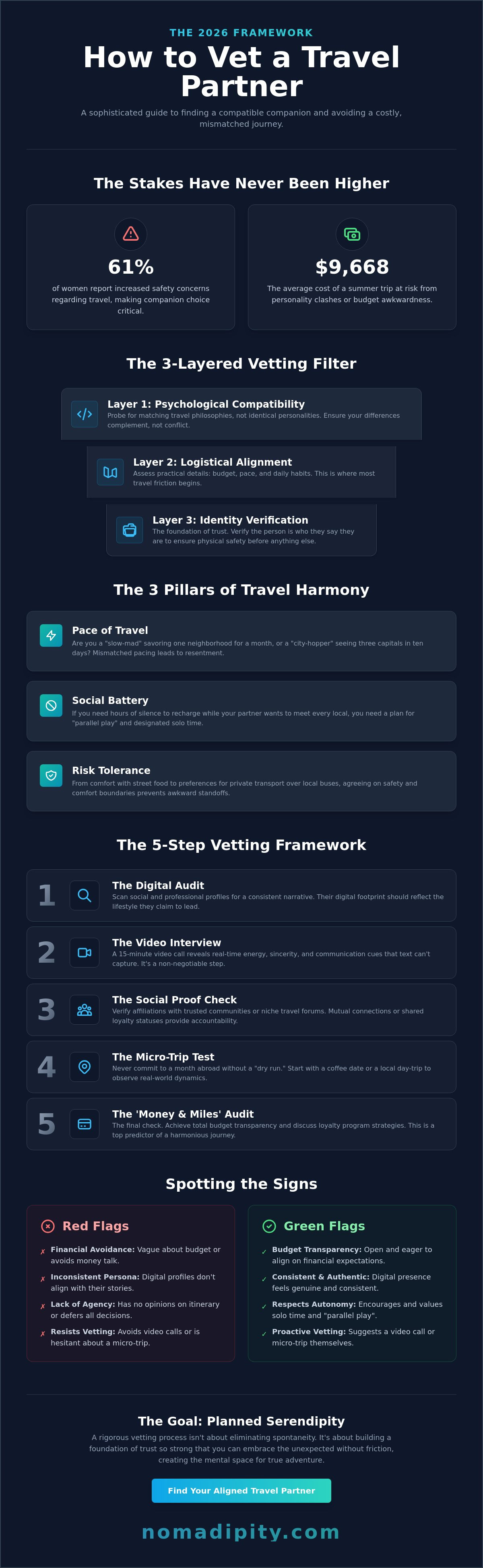
What if the greatest risk to your $9,668 summer trip isn't a missed connection or a lost passport, but the person sitting in the seat next to you? In 2026, 61% of women report increased concern regarding travel safety; this makes the search for a reliable companion feel more like a high-stakes gamble than an exciting prelude to adventure. You want the magic of shared discovery, yet you're likely tired of the budget-talk awkwardness or the lingering fear of a personality mismatch ruining a perfectly good itinerary.
We understand that hesitation. It's the natural response of a traveler who values depth over speed and connection over mere proximity. This guide will show you exactly how to vet a travel partner using a sophisticated framework that balances practical safety with the spirit of exploration. You'll master a vetting process that moves beyond surface-level interests to find someone who truly matches your pace and philosophy. We'll walk through the essential verification steps, budget alignment tactics, and the art of building "planned serendipity" so you can book your next flight with absolute confidence in your choice of companion.
Key Takeaways
- Move beyond the highlight reel by verifying identity and psychological compatibility before you've even reached the airport.
- Master a five-step framework on how to vet a travel partner that uses video interviews to gauge sincerity and digital audits to confirm travel styles.
- Spot critical red flags like financial avoidance or a lack of agency that'll help you avoid mismatched expectations on the road.
- Understand why total budget transparency and shared loyalty program strategies are the most reliable predictors of a harmonious journey.
- Leverage detailed traveler profiles and niche forums to find companions who align with your specific interests and professional lifestyle.
What Does It Mean to Vet a Travel Partner in 2026?
Vetting is often misunderstood as a cold, clinical background check. In reality, learning how to vet a travel partner is a deeply personal act of self-preservation and trip preservation. It's the bridge between a stressful, mismatched holiday and a truly transformative journey. By 2026, the landscape of global movement has shifted significantly. With 61% of women reporting heightened safety concerns and the average cost of international travel rising to over $1,200 per ticket, the stakes are higher than they've ever been. You aren't just looking for someone to split a hotel bill; you're looking for a "Nomadipitian." This is a traveler who values intentional living, depth over speed, and the quiet confidence of geographic autonomy.
Think of vetting as a three-layered filter. First, you verify identity to ensure physical safety. Next, you assess logistical alignment. Finally, you probe for psychological compatibility. This isn't about finding your personality twin. It's about ensuring your differences won't lead to resentment during a humid afternoon in Hanoi. True partnership actually celebrates geographic autonomy. It is the freedom to spend a morning solo at a local weaving cooperative while your companion catches up on remote work at a cafe, knowing you'll reunite for dinner with fresh stories and zero guilt.
The Core Pillars of Travel Compatibility
Compatibility isn't a vague feeling; it's a measurable alignment of daily habits and values. Consider these three pillars before you book a single flight:
- Pace of Travel: Are you a "slow-mad" who wants to inhabit one neighborhood for a month, or a city-hopper trying to see three capitals in ten days? Friction usually starts when one person feels rushed while the other feels stagnant.
- Social Battery: Be honest about your introversion. If you need four hours of silence to recharge but your partner wants to meet every local in the plaza, you'll need a pre-arranged plan for "parallel play" or solo time.
- Risk Tolerance: This covers everything from your comfort with unregulated street food to your preference for private transport over local buses. Agreeing on these boundaries early prevents awkward standoffs in a bustling souk.
Why Vetting Facilitates Planned Serendipity
It sounds like a contradiction, but structure is what makes magic possible. When you establish a foundation of trust through a rigorous vetting process, you reduce the logistical friction that usually drains your creative energy. You don't have to second-guess your partner's intentions or worry about hidden budget constraints. This clarity creates the mental space needed for genuine cultural engagement.
When the logistics are settled and the trust is solid, you can lean into the unexpected. You can say "yes" to a last-minute invitation to a village festival or a detour to a hidden beach because you already know your partner shares your spirit of adventure. If you're just starting your search for that perfect match, you can explore our guide on how to find a travel buddy to begin your journey toward more meaningful, shared experiences.
A 5-Step Framework for Vetting Potential Companions
Finding a soul-aligned travel companion isn't a matter of luck; it's a matter of logic. While many platforms suggest your perfect match is just a click away, seasoned travelers know that learning how to vet a travel partner requires a more intentional, multi-layered approach. This five-step framework moves you from digital curiosity to grounded confidence, ensuring your shared journey is defined by connection rather than conflict. By treating the vetting process as a progression, you protect your time, your budget, and your peace of mind.
- The Digital Audit: Look for a consistent narrative across their professional and social profiles. A person’s digital footprint should reflect the lifestyle they claim to lead.
- The Video Interview: Texting is a curated performance. A 15-minute video call reveals real-time energy, sincerity, and the subtle cues of communication that text simply cannot capture.
- Social Proof Check: Verify their affiliations. Do they belong to trusted communities or hold specific loyalty statuses? Mutual connections in niche travel forums provide a layer of accountability that strangers lack.
- The Micro-Trip Test: Never commit to a month in Southeast Asia without a "dry run." Start with a coffee date or a local day-trip to see how you handle small logistical hurdles together.
- The Scenario Stress-Test: Ask "what if" questions. What if the flight is canceled? What if the Airbnb is a disaster? Their answers reveal their problem-solving style and emotional resilience.
If you're ready to skip the guesswork and connect with travelers who have already been screened for compatibility, a matchmaking subscription can bridge the gap between a stranger and a trusted partner.
Conducting the Digital Footprint Audit
Start by looking for the "Verified Badge" on platforms like Nomadipity. In an era where 38% of travelers find international travel increasingly unpredictable, identity verification is no longer optional. Beyond safety, check for consistency. Does their travel history align with their stated budget and pace? Inconsistent itineraries or a lack of professional presence can be subtle indicators that someone isn't being entirely transparent about their lifestyle or geographic autonomy.
The Progressional Meet-up: From Coffee to Carry-on
The transition from digital to physical is where most mismatched partnerships are caught. A "micro-trip" serves as a low-stakes laboratory for your dynamic. Spend a Saturday navigating a nearby city or visiting an airport lounge together. This allows you to observe their "travel self" in the wild. Do they get flustered by crowds? Are they respectful to service staff? These small observations are far more telling than a week of pleasant texting. It’s about setting clear boundaries during this trial phase, ensuring you both feel comfortable walking away if the chemistry isn't right before any non-refundable deposits are paid.
Red Flags vs. Green Flags: Spotting Your Ideal Partner
Identifying the right companion is about more than shared interests; it's about observing how they handle the friction of reality. When you're learning how to vet a travel partner, you aren't just looking for a "yes" person. You're looking for a collaborator. A major red flag is an inability to discuss finances openly. With the average cost of a summer trip rising to $9,668 in 2026, any ambiguity about budgets can lead to resentment in the middle of a trip. If a potential partner deflects questions about split costs or daily spending limits, they're likely hiding constraints that will eventually limit your freedom. Money is the most common point of travel friction, and transparency is the only cure.
Another warning sign is a total lack of personal agency. If your companion expects you to handle every logistical hurdle, from checking REAL ID requirements to managing the $45 TSA Confirm.ID fee if they lose their license, you're becoming a tour guide rather than a partner. True partnership requires two people who can navigate the world independently. This is why geographic autonomy is such a vital green flag. A high-value companion doesn't just tolerate solo time; they actively encourage it. They understand that a morning spent exploring different corners of a city actually enriches the stories you share over dinner. It’s about being together by choice, not by necessity.
Behavioral Red Flags to Watch For
- Communication Rhythm: Watch out for "love-bombing" in the planning phase followed by days of silence. Reliability is built on a steady, predictable flow of information. If they ghost you during the planning stage, they'll likely ghost you when things get difficult on the road.
- Disrespecting Others: Pay close attention to how they treat service staff or local customs during your initial meetups. Disrespect in small moments is a preview of how they might behave when travel stress peaks.
- Rigidity: In a year where 38% of travelers find international movement more unpredictable, you need someone who can pivot. If they crumble when a flight is delayed or a museum is closed, they lack the resilience required for modern exploration.
Green Flags of a High-Value Companion
A proactive partner is a dream. If they're already suggesting ways to maximize lounge access or discussing the shift toward spend-based qualification in loyalty programs, they're invested in the quality of the experience. Transparency is equally essential. A partner who willingly shares their travel insurance details or identity verification status shows they value your peace of mind as much as their own. If your search for a companion is leaning toward the romantic side of the spectrum, you might find our guide on travel dating helpful for finding a partner who shares both your heart and your itinerary.
The 'Money & Miles' Audit: Aligning Budgets and Loyalty Perks
Money is often the silent ghost at the dinner table, present but unacknowledged until the bill arrives. When you're learning how to vet a travel partner, you have to move past the polite "we'll figure it out" and into the granular reality of bank accounts and booking classes. In 2026, travel spending for Americans has jumped 24% year-over-year. With an average international round-trip ticket costing $1,217, a mismatch in financial philosophy isn't just a minor annoyance. It’s a structural failure of the partnership. A true audit ensures that your companion's "spirit of adventure" is backed by the practical means to sustain it.
Beyond cash, your vetting process should include a "points and perks" review. Loyalty programs in 2026 have shifted toward spend-based qualification, making status a reliable indicator of a person's actual travel habits rather than just their mileage history. If a potential partner claims to value comfort but lacks lounge access or a strategy for upgrades, you might find yourselves in different tiers of the travel experience. Aligning your loyalty strategies allows you to share guest passes and status matches, effectively lowering the total cost of the trip while elevating the quality of your transit. It's about finding someone whose travel design matches yours, right down to the boarding group.
To find a companion whose financial values and travel style are already aligned with your own, consider a matchmaking subscription that filters for budget and affiliation from the very first click.
The Awkward Budget Conversation
Transparency is the ultimate tool for trip preservation. Don't just talk about the "total cost." Break it down into daily spend categories: accommodation, food, and those unplanned "splurge" moments. Are you using Splitwise for every coffee, or do you prefer a common travel kitty for shared expenses? Resentment grows in the gap between a "street food enthusiast" and a "fine dining loyalist." Addressing these financial tiers before you leave home ensures that neither of you feels pressured to overspend or deprived of the experiences you value most.
Leveraging Loyalty and Rewards
Coordinating your rewards is a high-level vetting tactic. If one partner has airline lounge access and the other doesn't, do you have guest passes to bridge the gap? Understanding how to leverage shared perks can turn a long layover into a productive work session or a relaxed social hour. For a deeper dive into optimizing these benefits, explore our guide on travel rewards programs. Finally, always establish a "mishap fund." In an era where 38% of travelers find movement unpredictable, having a pre-agreed plan for flight delays or lost luggage prevents a logistical hiccup from becoming a relational disaster.
Vetting Through the Nomadipity Social Network
The traditional approach to finding a companion often feels like shouting into a void. When you're trying to master how to vet a travel partner, you need more than a bio and a profile picture; you need an ecosystem built on accountability. The Nomadipity social network is designed to replace the uncertainty of the open internet with a curated community of vetted peers. Here, the process of verification is woven into the platform's architecture. By focusing on "Nomadipitians," travelers who value intentional living and deliberate pacing, you start your search from a foundation of shared philosophy rather than just shared destinations.
Detailed traveler profiles serve as your primary vetting tool. They allow you to see beyond the highlight reel to understand a person's professional background, travel affiliations, and niche interests. Group forums further enhance this by letting you observe how potential partners interact within the community. Are they helpful? Do they respect boundaries? These digital interactions provide a low-stakes environment to "pre-vet" a companion before you ever move to a video call or a shared meal. It’s about building trust through consistent, visible participation in a niche community. Shared itineraries also allow for low-stakes meetups at global hotspots, letting you test the waters before committing to a full journey.
Advanced Search Filters for Compatibility
The power of the network lies in its precision. You can filter potential matches by specific hotel rewards programs, airline status, or professional industries. This ensures that your partner's travel style matches your actual habits. For instance, you can find companions who frequent the same airport lounges or global hotspots as you. This level of granularity is what separates a generic search from a sophisticated audit. To deepen your connections, you can leverage the social network for frequent flyers to build a network that extends far beyond a single boarding pass.
Safety First: The Nomadipity Advantage
Safety in 2026 is a community effort. Nomadipity utilizes an optional identity verification service for a $5 fee, which matches government-issued IDs with a selfie to earn a "Verified Badge" on the user's profile. This simple step significantly reduces the risk of travel scams and identity fraud. Coupled with community-driven reporting and a focus on inclusive safety, the platform creates a space where you can plan with confidence. If you're ready to stop gambling on strangers and start traveling with vetted peers who share your commitment to geographic autonomy, join our community. Find your next companion through our matchmaking subscriptions and turn your next itinerary into a masterpiece of shared discovery.
Step Into the World With Absolute Confidence
Travel in 2026 is an investment in your personal growth and mental clarity. By mastering how to vet a travel partner, you're protecting that investment and ensuring your adventures are defined by shared joy rather than logistical friction. You now have the framework to move beyond surface level interests, from conducting digital audits to navigating the nuances of spend-based loyalty programs and shared budgets. Remember, the goal isn't just to find someone who wants to see the same sights. It's to find a companion who respects your geographic autonomy and matches your spirit of adventure.
The right partnership turns a simple trip into a masterpiece of planned serendipity. If you're ready to skip the uncertainty of the open internet, our community is waiting for you. Find your next vetted travel companion on Nomadipity today. You'll gain access to detailed traveler profiles with loyalty program integration, private forums for niche travel styles, and our trusted, verified Nomadipitian network. Don't leave your next great experience to chance. The world is vast and unpredictable, but with the right person by your side, it is always welcoming.
Frequently Asked Questions
How do I check if a potential travel partner is safe?
You can check a potential partner's safety by utilizing identity verification services and looking for social proof in their digital footprint. On platforms like Nomadipity, look for the "Verified Badge" which confirms their government ID matches their profile. This simple step is vital in a year where 61% of women report increased safety concerns. Beyond the badge, cross-reference their professional networks to ensure their story remains consistent across different platforms.
What are the most important questions to ask a travel buddy before a trip?
The most critical questions revolve around conflict resolution and logistical boundaries. Ask "what if" scenarios, such as how they'd handle a lost passport or a canceled flight. You should also discuss their social battery. Do they need four hours of silence every afternoon, or do they prefer constant interaction? Understanding their risk tolerance for things like local street food or private transport prevents friction once you're actually on the ground.
Is it weird to ask for a travel partner's ID or social media?
It isn't weird at all; in fact, it's a necessary step in 2026 for any responsible traveler. Requesting a social media audit or identity verification is an act of mutual respect. Most seasoned travelers expect these questions as part of the process of how to vet a travel partner. If someone gets defensive about sharing their background or verifying their identity, consider that a major red flag for the partnership's transparency.
How do I handle a travel partner who turns out to be incompatible?
If incompatibility arises, lean into the concept of geographic autonomy. You don't have to spend every waking second together to have a successful trip. Agreeing on "parallel play" or solo days allows you both to enjoy the destination at your own pace without resentment. Having a pre-arranged exit strategy, such as separate hotel bookings, ensures that a personality mismatch doesn't lead to a total logistical collapse of your itinerary.
Should I share a room with a travel partner I just met?
Only share a room if you've established significant trust through a micro-trip or extensive video calls. For a first-time companion, booking separate rooms is often the wiser choice to maintain personal agency and a private sanctuary. Given that 38% of travelers now find international travel more unpredictable, having your own space provides a necessary buffer for decompression. It allows you to recharge your social battery without the pressure of constant proximity.
What is the best way to split costs with a travel companion?
The most effective way is to use a common travel "kitty" for shared expenses or a specialized splitting app. Transparency is your best friend here. Discuss your daily spend tiers for accommodation and food before the trip begins. Since the average cost of a one-week vacation for a couple is between $3,982 and $4,550, even small misalignments in spending can quickly escalate into significant financial stress for both parties.
How can I tell if someone's travel style matches mine?
You can determine compatibility by reviewing their loyalty program status and past itineraries. A traveler who focuses on spend-based qualification and lounge access likely values comfort and efficiency. Contrast this with someone who prioritizes "hidden-season" travel to avoid crowds. Learning how to vet a travel partner involves looking for these subtle markers of lifestyle design. If their past trips show a frantic pace and yours show deliberate movement, you'll likely clash.
Can I find a travel partner for business trips and networking?
You certainly can by filtering for professional affiliations and specific airport lounge access. Many travelers now look for companions who share their remote work requirements and geographical autonomy. By connecting with peers who frequent the same global hotspots or professional forums, you can turn a standard business trip into a networking opportunity. This allows you to balance your professional responsibilities with the serendipity of meeting a like-minded traveler.

Disclaimer
Nomadipity Blog Disclaimer
The content on Nomadipity is provided for general informational and inspirational purposes only. While we strive for accuracy and timeliness, Nomadipity does not guarantee that any information is complete, current, or suitable for your specific needs. Use your judgment and verify details before making travel plans, meeting with other users in person, or making any purchases influenced by the article.


