

What if the most powerful tool for global freedom isn't a high-limit credit card, but a strategically managed balance of points? On January 1, 2024, major airlines overhauled their loyalty structures, leaving 30% of members feeling confused about their actual value. It's easy to feel like travel rewards programs are a game rigged for the ultra-wealthy. You might worry that by the time you save enough for that dream trip to Kyoto, the "price" in points will have doubled.
We agree that the system feels opaque; however, it doesn't have to stay that way. This guide will show you how to master the art of rewards to unlock a lifestyle of deeper global connections and intentional exploration. You'll find a clear roadmap for choosing your primary loyalty ecosystem, learn how status facilitates better travel experiences, and discover a community of like-minded travelers who value depth over speed. It's time to stop dreaming of "someday" and start designing your own version of planned serendipity in 2026.
Key Takeaways
- Discover how to navigate the modern ecosystem of loyalty to build a sustainable location-independent lifestyle that values depth over speed.
- Master the essential mechanics of airline miles and hotel points to turn your everyday spending into a passport for global exploration.
- Design a personalized strategy for travel rewards programs that avoids the trap of points hoarding and ensures your assets are always ready for the next adventure.
- Shift your focus from mere logistics to the human ROI, learning how to transform airport "dead time" into meaningful global connections.
- Learn to cultivate "planned serendipity" by setting up systems that invite magical, unexpected moments into your intentional travel design.
Beyond the Boarding Pass: Understanding Travel Rewards Programs in 2026
Travel isn't just about the movement between two points anymore. In 2026, travel rewards programs have matured into a sophisticated ecosystem that functions as the invisible backbone of a location-independent life. These programs integrate your airline choices, hotel stays, and daily credit card spending into a unified currency of freedom. You aren't just collecting points to shave a few dollars off a ticket. You're building a system that grants you entry into a world of curated experiences. This is where we find Planned Serendipity. By intentionally structuring your loyalty, you create the conditions where magic happens effortlessly. It's the difference between being a tourist and being a global citizen with a key to the city.
The Evolution of Loyalty: From Miles to Lifestyle Ecosystems
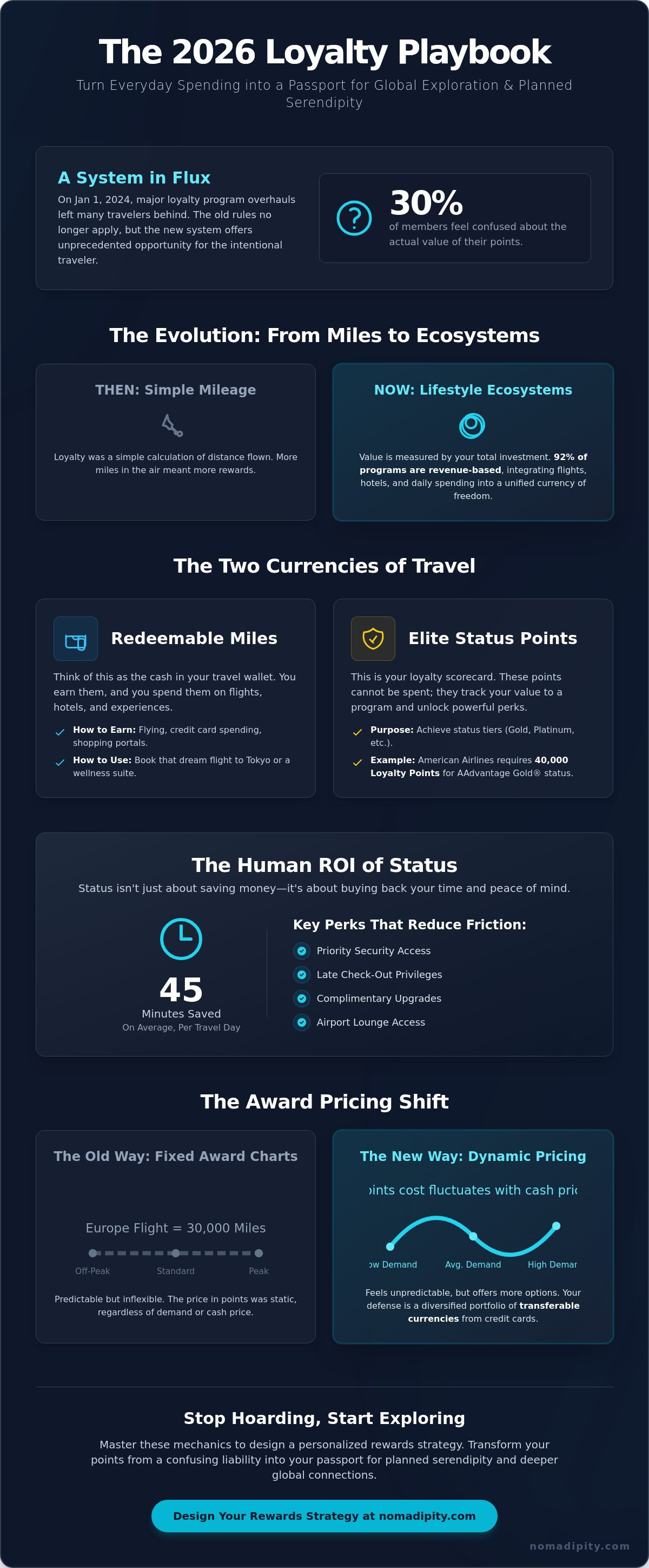
The concept of the frequent-flyer program began in 1981 with American Airlines, but it has transformed radically since those early days of simple mileage tracking. By 2026, over 92% of major loyalty programs have fully transitioned to revenue-based earning models. It's no longer about how many miles you physically cover, but the total value you bring to the ecosystem. Modern programs now leverage advanced AI to analyze your habits in real-time. They don't just send generic newsletters. Instead, they offer surprise and delight moments, like a complimentary upgrade to a wellness suite exactly when your travel patterns suggest you're feeling burnout. These systems are designed to recognize you as a person, not just a seat number.
Why Intentional Travelers Prioritize Rewards
For the intentional traveler, travel rewards programs provide a psychological safety net that is vital for long-term exploration. Knowing your next long-haul flight is covered by points creates a level of mental clarity that's hard to achieve when you're constantly weighing every expense. Status reduces the friction of life on the road. When you have late check-out privileges or priority security access, you save an average of 45 minutes per travel day. This time isn't just a metric; it's a gift. It's the extra hour you spend at a local market or the stress-free morning you enjoy before a cross-continental flight. Rewards sustain the slow travel lifestyle by making the logistical hurdles of movement feel less like a chore and more like a well-oiled machine. You aren't just saving money; you're buying back your peace of mind.
The Mechanics of Modern Loyalty: How Points, Miles, and Status Work
To design a life of planned serendipity, you need to understand the gears behind the curtain. In 2026, modern travel rewards programs operate on three distinct pillars: airline miles, hotel points, and transferable currencies. These aren't just digital numbers; they are the logistics of your future freedom. Understanding how they interact allows you to stop guessing and start orchestrating the moments that define your journey.
You must first distinguish between your "Redeemable Miles" and your "Elite Qualifying Miles." Think of redeemable miles as the cash in your travel wallet. You earn them by flying or spending on a co-branded card, and you spend them to book that dream flight to Tokyo. Elite Qualifying Miles, or "Status Points," are different. They cannot be spent. They are a scorecard that tracks your loyalty over a calendar year. By January 2026, most major carriers have moved to a spend-based model. For instance, American Airlines now requires 40,000 Loyalty Points for basic status, which means your value to the airline is measured by your investment, not just the miles you've sat in a seat.
The 2026 reality of travel rewards programs is defined by dynamic award pricing. The old award charts, where a flight to Europe cost exactly 30,000 miles, have mostly vanished. Now, the cost in points fluctuates with the cash price of the ticket. While this can feel unpredictable, credit card ecosystems act as the glue for nomadic rewards. By consolidating your daily spending into a single ecosystem, you create a buffer against these price swings, ensuring you always have the capital to move when inspiration strikes.
Airline vs. Hotel Programs: Choosing Your Primary Engine
Your primary engine depends on your travel style. Airline alliances like Star Alliance, with its 26 member carriers, offer a global reach that makes complex, multi-city itineraries possible. If you prioritize the journey, focus there. However, if you value the destination experience, hotel loyalty might be your focus. Hyatt remains a favorite for nomads because they often offer 2.1 cents per point in value, whereas Marriott wins on sheer footprint with over 8,700 properties worldwide. Once you've secured your room, you can use specific tactics to learn how to get hotel upgrades and turn a standard stay into an inspired retreat.
The Power of Transferable Points and Partnerships
Flexible points from providers like Chase, American Express, and Capital One are the gold standard for the modern nomad. Unlike brand-specific miles, these points can be moved to various "transfer partners" at a moment's notice. This flexibility is vital because it protects you from any single airline devaluing its currency. Transferable points are the currency of freedom in a fluctuating travel market. They allow you to pivot your strategy based on where the best deals live today. If you are ready to begin building your own reservoir of points, you can view our lifestyle design tools to find the right starting point for your location-independent life.
The Paradox of Choice: Avoiding Common Pitfalls in Travel Hacking
You stand at the edge of a vast digital ocean, staring at a hundred different credit card offers and airline logos. It's overwhelming. This analysis paralysis is the first hurdle in mastering travel rewards programs. You don't need to optimize every single penny to win. You just need to start. Many beginners freeze because they fear making a "sub-optimal" choice, yet the only true mistake is staying stationary. Perfection is the enemy of the plane ticket that takes you somewhere beautiful.
The allure of "Executive Platinum" or "Globalist" status is a powerful marketing drug. But ask yourself: does your lifestyle actually support it? If you're practicing slow travel and spending three months in a single coastal village, chasing hotel status through 60 nights of stays is a waste of resources. Authentic travel often happens in boutique guesthouses or local rentals where your status doesn't exist. Choose travel rewards programs that serve your actual habits, not the ones the commercials say you should have. Stay organized with a simple tracking app to monitor expiration dates once a month. Your goal is to design a life of movement, not to become a full-time accountant.
The Perils of 'Point Hoarding' vs. Earn-and-Burn
Think of your points as milk, not gold. They have an expiration date, even if the fine print says they don't. In early 2026, we've seen several major hotel chains increase redemption rates by 15 percent overnight. If you sit on a million points for three years, you're essentially watching your purchasing power evaporate. They are a depreciating asset. Use them for the memories. If a redemption offers a value of 1.5 cents per point or higher, take the win. Pay cash for cheap domestic flights. Save your stash for the high-value international business class seats that make long-haul travel feel like a dream. Points exist to facilitate serendipity, not to clutter a digital vault.
Devaluations and the Importance of Diversification
The landscape shifted significantly between 2025 and 2026. Two major US carriers moved toward fully dynamic pricing, making it harder to find those legendary fixed-rate awards. This is why diversification is your best defense. If you only collect miles with one airline, you're at the mercy of their board meetings. By focusing on transferable point currencies, you maintain the agency to pivot when one program loses its luster. You can find more on building these foundational habits in our guide to travel hacking for beginners. Don't keep all your travel eggs in one basket. Spread your loyalty across alliances to ensure that when one door closes, a window in a different cabin opens.
Designing Your Rewards Strategy for Planned Serendipity
Building a life of location independence requires a blueprint that balances spontaneity with structure. Start by auditing your last 12 months of spending. If 40% of your budget goes toward dining and groceries, your choice of travel rewards programs must prioritize those categories to accelerate your point accumulation. Once you understand your flow of capital, select one airline alliance and one hotel ecosystem to master. Spreading your loyalty too thin is a common mistake; depth yields far more "planned serendipity" than a scattered portfolio of points.
Aligning Programs with Your Nomadic Lifestyle Goals
Your destination dictates your strategy. If you plan to spend 2026 exploring Southeast Asia, a program like Singapore Airlines' KrisFlyer often provides better regional value than a US-centric carrier. For those prioritizing slow travel through Europe, look for ecosystems with strong rail partnerships or boutique hotel footprints. You can find a deeper breakdown of these regional nuances in our frequent flyer miles guide to help you execute this vision with precision.
Leverage a premium travel card to act as your safety net. In 2024, industry data showed that lounge access saved frequent travelers an average of $35 per airport visit in food and beverage costs alone. Beyond the snacks, these cards provide vital trip delay insurance that protects your budget when a remote flight in the Balkans gets canceled at midnight. Use tracking tools to monitor "sweet spots" and award availability. Platforms like Point.me or Seats.aero turn hours of manual searching into a five-minute task, ensuring you never overpay for a seat.
Leveraging Status for Better Travel Connections
High-tier status isn't just about the occasional first-class upgrade. It's a signal of commitment to the nomadic lifestyle. Focus your energy on the "mid-tier" sweet spot, such as Marriott Gold or Delta Gold. These levels typically offer the highest ROI for nomads, providing meaningful benefits like late check-outs and better Wi-Fi without requiring 100 nights away from your home base. If you move to a new region, use status-match challenges to quickly gain leverage with local carriers without starting from zero.
Finally, integrate social networking into your itinerary. Use your lounge access or hotel club floors as co-working spaces to meet others who have designed similar lives. These environments often harbor the very connections that lead to your next business venture or travel companion. Your travel rewards programs are the tools that build the stage for these unexpected moments to occur. If you're ready to start building your own path, explore our lifestyle design resources to find your next destination.
The Human ROI: Using Rewards to Cultivate Global Connections
The true value of travel rewards programs isn't found in a digital ledger or a credit card statement. It lives in the faces of the people you meet along the way. Think of your points as a tool to purchase the most scarce resource on earth: time. When you use an upgrade to sleep horizontally over the Atlantic, you aren't just buying comfort. You're buying the energy to be present when you land. You're buying the ability to say "yes" to a spontaneous invitation from a local artisan or a fellow nomad.
Loyalty status acts as a buffer against the friction of movement. By automating the logistics of travel through elite perks, you preserve your emotional bandwidth. This allows you to focus on the Human ROI. High-tier status often provides the "planned serendipity" we crave, putting you in the right places at the right times to meet the right people. It turns a solitary journey into a series of meaningful intersections.
Lounge Access as a Social Networking Hub
In 2026, the culture of the airport lounge has shifted significantly. These spaces have moved away from the hushed, library-like atmosphere of the past. Today, they function as vibrant community hubs for the location-independent workforce. You'll find communal worktables and dedicated social zones designed to facilitate interaction. Networking here doesn't have to be forced. Try sitting at the shared bar or using the communal dining areas rather than tucking yourself into a private corner. A simple question about a destination can spark a partnership that lasts years.
If you're questioning if an airport lounge membership worth it, consider the value of a single high-level connection made during a four-hour layover. These spaces are now the boardrooms of the global nomad, offering a level of networking that a crowded gate simply cannot match.
How Nomadipity Enhances the Value of Your Loyalty Status
Your travel rewards programs provide the access, but Nomadipity provides the community. It acts as the final, essential layer of your rewards ecosystem. By connecting with "Nomadipitians" who hold similar status or interests, you can transform a standard hotel stay into a collaborative experience. Imagine organizing an impromptu meetup at a five-star rooftop lounge or sharing an exclusive airport club guest pass with a fellow member who shares your passion for slow travel.
This platform allows you to find people who move at your pace and value the same depth of experience. It turns "dead time" in transit into an opportunity for growth and friendship. Don't let your status go to waste in isolation. Join Nomadipity to find your next travel companion and start designing a life where every mile leads to a new connection.
Design Your Future of Intentional Exploration
You've navigated the complex mechanics of points and sidestepped the common pitfalls of choice paralysis. By 2026, mastering travel rewards programs isn't just about scoring a seat; it's about building a reliable framework where magic can actually happen. You've learned to design a rewards strategy that prioritizes the human ROI, turning technical status into genuine global connections. This intentional approach ensures every mile you earn serves as a bridge to a more authentic, slow travel lifestyle.
Don't let your journey be a solo endeavor. When you align your logistics with your values, you open doors to a community that shares your vision. You can now find your next travel companion on Nomadipity, where you'll connect with 10,000+ frequent flyers who value depth over speed. Use our advanced traveler matchmaking filters to find like-minded explorers or join our exclusive lounge meetup forums to turn a standard layover into a lifelong friendship. The world is waiting for you to navigate it with purpose. Your next great story starts with the right partner by your side.
Frequently Asked Questions
Is it still worth joining travel rewards programs in 2026 with dynamic pricing?
Yes, travel rewards programs remain essential tools for intentional travelers because they provide a reliable hedge against rising cash prices. While 85 percent of major airlines moved to dynamic pricing by 2025, you can still find exceptional value during off-peak periods. By focusing on flexible points rather than fixed charts, you cultivate the ability to book a flight to Lisbon for 20,000 points instead of paying 1,200 dollars out of pocket.
Can I earn enough points for a free flight if I don’t travel for business?
You don't need a corporate expense account to fly for free. Most travelers earn 70 percent of their miles through everyday spending and strategic sign-up bonuses rather than actual flying. If you open a card with a 60,000-point welcome offer and use it for your groceries and utilities, you'll likely have enough for a round-trip international flight within six months. It's about designing your daily habits to fund your future serendipity.
What is the best travel rewards program for a complete beginner?
Chase Ultimate Rewards is the gold standard for beginners due to its simplicity and high redemption flexibility. With 14 airline and hotel transfer partners, it allows you to move points where they have the most value at any given moment. This program prevents you from being locked into a single airline, which is crucial when you're just starting to navigate the world of location independence. It's a reliable foundation for any diverse points portfolio.
How many travel credit cards should a digital nomad realistically have?
Most digital nomads find their sweet spot with three specific cards to maximize rewards and security. You need one premium card for lounge access and 5x points on travel, one mid-tier card for everyday categories like dining, and one no-annual-fee backup from a different payment processor. Carrying three cards ensures you're covered if a merchant doesn't accept Visa or if a bank freeze occurs while you're exploring a new time zone.
Do travel rewards points ever expire?
Expiration policies vary by company, but many major carriers like Delta and United moved to a points never expire model in 2019. Other programs, such as American Airlines, require account activity at least once every 24 months to keep your balance active. You can easily reset these clocks by making a small purchase through an online shopping portal or donating 1,000 miles to a partner charity. Staying active ensures your hard-earned points are ready when inspiration strikes.
Can I share my travel rewards or status with a travel buddy I meet on Nomadipity?
You can use your points to book a flight or hotel room for anyone, but sharing elite status is more restricted. Programs like World of Hyatt allow you to use a Guest of Honor award to share your Globalist perks with a friend during their stay. This creates a beautiful opportunity for shared serendipity, allowing you to treat a new connection to breakfast and lounge access. It's a powerful way to cultivate community while you travel.
What happens if an airline or hotel program goes bankrupt or merges?
History shows that your points are typically safe during mergers, as seen during the Alaska and Hawaiian Airlines merger in 2024. While the value might shift slightly, the new entity wants to keep you as a loyal customer. If a program faces bankruptcy, the 1978 Airline Deregulation Act doesn't provide specific point protections. It's wise to diversify your holdings across three different ecosystems to mitigate risk and protect your travel future.
How do I track all my different points and miles without getting overwhelmed?
Using a centralized tracking tool like AwardWallet or Point.me is the most efficient way to manage multiple travel rewards programs. These platforms monitor 600 different loyalty programs and send you automated alerts before any points expire. Instead of manually checking 10 different websites, you can view your entire travel net worth in one 5-minute session each week. This system frees your mind to focus on the journey rather than the technical logistics.

Disclaimer
Nomadipity Blog Disclaimer
The content on Nomadipity is provided for general informational and inspirational purposes only. While we strive for accuracy and timeliness, Nomadipity does not guarantee that any information is complete, current, or suitable for your specific needs. Use your judgment and verify details before making travel plans, meeting with other users in person, or making any purchases influenced by the article.


