

What if the primary barrier to a life of global exploration isn't actually your bank balance, but rather your willingness to master a hidden set of rules? You have likely stared at a $1,400 international flight receipt and felt that familiar pang of frustration, wondering why the world feels accessible only to the few. It's easy to feel overwhelmed by the labyrinth of loyalty programs or the fear that one wrong move might tank your credit score by 40 points in a single month. We've all been there, feeling like an outsider to a game we were never taught to play.
This guide to travel hacking for beginners will show you how to flip the script for 2026, transforming those complex systems into a toolkit for intentional living. You can master the art of travel hacking to unlock luxury experiences and meaningful connections without the premium price tag. We're going to explore how to book your first first-class seat for the cost of economy, secure quiet airport lounge access, and build a network of like-minded explorers who value slow travel as much as you do. It's time to design your own version of planned serendipity.
Key Takeaways
- Shift your perspective from budget sacrifice to strategic optimization, learning to design a lifestyle where luxury and authenticity coexist.
- Master the mechanics of points and transferable partners to multiply the value of every mile you earn.
- Follow our step-by-step guide to travel hacking for beginners to audit your spending and align your habits with your "North Star" travel goals.
- Navigate the myths of credit health with confidence, ensuring your journey toward location independence is built on a grounded financial foundation.
- Learn how to leverage community wisdom to turn standard itineraries into moments of planned serendipity and meaningful connection.
What is Travel Hacking? Beyond the Boarding Pass in 2026
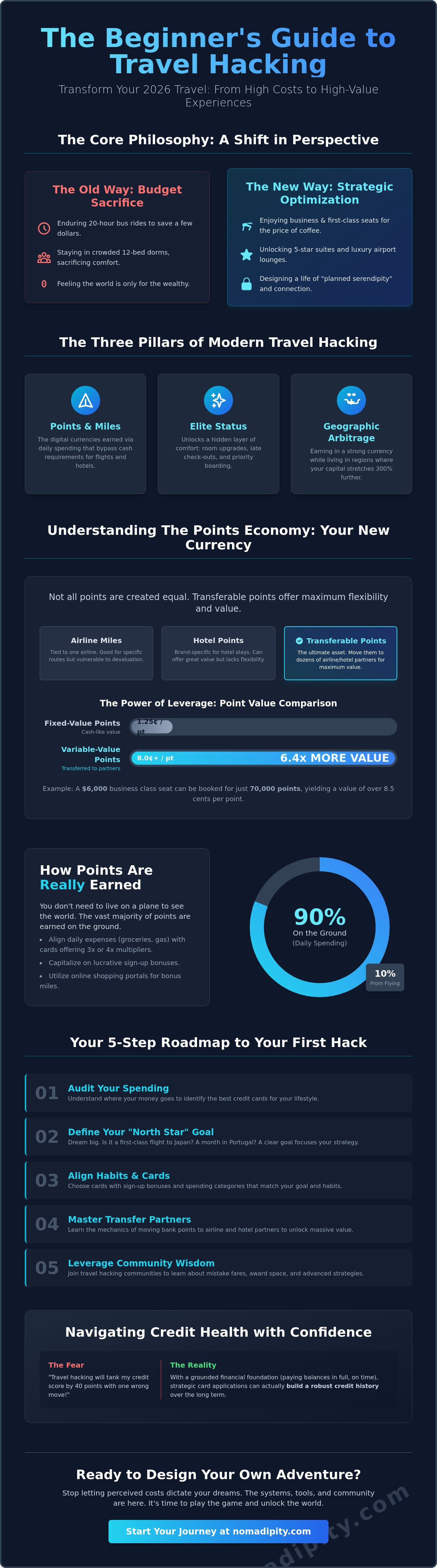
Travel hacking isn't a secret handshake for the elite; it's a strategic framework for anyone who refuses to choose between seeing the world and maintaining their bank balance. At its core, travel hacking for beginners involves the intentional use of credit card rewards, loyalty programs, and daily lifestyle choices to drive travel costs toward zero. While the traditional budget traveler often sacrifices comfort by sleeping in 12-bed dorms or taking 20-hour bus rides to save a few dollars, the travel hacker optimizes systems to enjoy business class seats and five-star suites for the price of a local coffee. It's about playing the game with the rules the travel industry already provided.
In 2026, we've entered a golden age of exploration. Integrated digital platforms and AI-driven booking tools now do the heavy lifting that used to require hours of manual spreadsheet tracking. By January 2026, industry reports suggest that 85% of major travel platforms will offer real-time reward optimization, making it simpler than ever to spot value. This technical shift allows us to cultivate "planned serendipity." By setting up the right financial and digital systems, you create a safety net that allows for those magical, unplanned moments. Perhaps it's a last-minute detour to a Japanese mountain village or an extra week in Portugal, made possible because you had the points to spare and the systems in place to use them.
The Three Pillars of Modern Travel Hacking
- Points and Miles: These are the digital currencies earned through daily spending and frequent-flyer programs that bypass traditional cash requirements.
- Elite Status: This unlocks a hidden layer of travel comfort, offering room upgrades, late check-outs, and priority boarding that turn a standard trip into an elevated experience.
- Geographic Arbitrage: This involves leveraging location independence to earn in a strong currency while living or traveling in regions where your capital stretches 300% further than it would at home.
Why Travel Hacking is About Connection, Not Just Cash
Saving money is the entry point, but the true value lies in the doors that open. Perks like airport lounge access aren't just for free snacks; they're hubs for networking with other location-independent professionals and global citizens. The community aspect is equally vital. In 2026, decentralized travel groups share "mistake fares" within seconds, allowing members to snag trans-Pacific flights for under $150. These connections turn a solitary journey into a shared adventure. Travel hacking is a deliberate tool for intentional living and global citizenship that transforms the world from a distant map into a reachable home.
The Core Mechanics: Points, Miles, and Elite Status
Understanding the currency of travel is the first step toward the life you've imagined. You'll encounter three primary types: airline miles, hotel points, and transferable bank points. Airline miles and hotel points are tied to specific brands. They're useful, but they're also subject to devaluations where a company suddenly raises the price of a free night or flight. Transferable points, earned through banks like Chase or American Express, are the ultimate safeguard. These are your flexible assets. You can move them to dozens of different airlines or hotels exactly when you need them.
In 2026, the gap between fixed-value and variable-value points has widened. Fixed-value points act like cash; they're always worth a set amount, often 1.0 to 1.25 cents. Variable-value points are the heart of travel hacking for beginners. By transferring points to a partner airline, you might redeem them for a business class seat worth $6,000 using only 70,000 points. That's a value of over 8 cents per point. This leverage is the secret weapon that turns a standard vacation into a luxury experience.
Elite status adds a layer of comfort that transcends the flight itself. While beginners often chase the upgrade, the real value lies in the logistics. Free checked bags, priority boarding, and lounge access transform the friction of travel into a seamless flow. In a 2025 industry report, frequent travelers valued mid-tier status at over $2,400 annually in saved fees and perks. It's about being treated like a human in an increasingly automated world.
Earning Without Flying: The Daily Spend Strategy
You don't need to live on a plane to see the world. Most pro hackers earn 90% of their points on the ground. Align your daily expenses, like groceries and gas, with cards that offer 3x or 4x multipliers. Sign-up bonuses (SUBs) are your greatest accelerator. A single new card can often net you 60,000 to 100,000 points, enough for a round-trip ticket to Europe. Use shopping portals and dining programs to stack rewards, earning multiple times on a single purchase.
The Power of Transferable Currencies
Chase Ultimate Rewards and Amex Membership Rewards remain the gold standard in 2026 because of their vast networks. If you're just starting, follow the Rule of One. Master one ecosystem before you branch out. Learn the transfer partners and redemption rules of Chase before moving to Amex. This focus prevents point fatigue and helps you reach your first goal faster. Mastering these currencies is the core of travel hacking for beginners. For a deeper look at how these systems interact, check out the frequent flyer miles guide to see the specific mechanics in action. Once you've built your foundation, you can curate your own journey with confidence.
Debunking the Myths: Why Travel Hacking is Accessible to Everyone
Many people view travel hacking as a shadowy practice reserved for the financially elite or the mathematically obsessed. This misconception keeps countless dreamers grounded. Travel hacking for beginners is not about gaming a system. It's about optimizing the life you're already living to create opportunities for adventure. You don't need to be a spreadsheet wizard to make this work. You simply need a shift in perspective and a few reliable systems to guide your path.
The Credit Score Question
The most common fear is that opening multiple credit cards will demolish your credit score. In reality, the math often works in your favor. While a hard inquiry might cause a temporary dip of 5 to 10 points, your overall credit health usually strengthens over time. By increasing your total available credit, you lower your credit utilization ratio. This ratio accounts for 30% of your total FICO score. You must follow the golden rule: pay your balance in full every single month without exception. Travel hacking, when done right, often improves credit through increased total limits. It turns your financial responsibility into a passport for global exploration.
You don't need a six-figure salary to sit in a lie-flat seat over the Atlantic. Travel hacking is about redirection, not extra spending. If you spend $1,500 a month on groceries, utilities, and transit, you're already qualified to earn significant rewards. The difference between "churning" and responsible hacking lies in your pace and intent. Churning involves opening dozens of cards for short-term gain. Sustainable hacking focuses on cards that align with your long-term lifestyle goals. In 2026, the time commitment has dwindled significantly. Automation tools now handle the heavy lifting of tracking expiration dates and point valuations, moving the practice from a manual hunt to a background process that serves your life.
Overcoming the "Too Complex" Hurdle
Complexity is a choice, not a requirement. You don't need to master every airline alliance on day one. Start with one card and one specific dream, like a week in Kyoto or a flight to Lisbon. Modern apps in 2026 use AI to suggest the best card for every purchase in real-time, removing the guesswork from your daily routine. This allows you to focus on the experience rather than the logistics. Even a single perk can transform your journey. You might wonder, is an airport lounge membership worth it in a world of crowded terminals? When you realize one card can grant you a quiet sanctuary and a free meal, the value becomes tangible. Travel hacking for beginners is the art of making these small, intentional choices to cultivate a life of planned serendipity.
By treating your points like a secondary currency, you gain agency over your movement. It's about designing a life where the world feels smaller and more welcoming. Start small, stay consistent, and watch as the barriers to your dream destinations begin to dissolve.
Your Beginner Roadmap: A Step-by-Step Guide to Your First Hack
The transition from dreaming to doing requires a tactical shift. You aren't just collecting points; you're designing a system for planned serendipity. Travel hacking for beginners is most effective when you treat it as a sequence of intentional moves rather than a frantic scramble for every offer that hits your inbox. Success in this space is less about luck and more about the systems you cultivate.
Step 1: Audit your foundation. Before opening a new card, check your credit score. A score of 740 or higher typically secures the best approval odds for premium cards. Use a free tool to track your "5/24 status," a common industry threshold where certain banks deny applicants who have opened five or more personal credit cards from any issuer in the last 24 months.
Step 2: Define your North Star. Vague goals lead to wasted points. Do you want a honeymoon in Bali or a month-long slow travel stint in Lisbon? Knowing your destination dictates which airline and hotel partners you'll need to prioritize. It turns a nebulous desire into a concrete target.
Step 3: Choose your Gateway Card. For most, a card with flexible "transferable" points is the right choice. These points don't lock you into one airline. They give you the agency to move your rewards to whichever partner offers the best value for your specific trip.
Step 4: Meet the minimum spend safely. Most top-tier cards require spending a specific amount, often between $3,000 and $6,000, within the first three to six months. Don't buy things you don't need. Instead, time your application with large, existing expenses like annual car insurance premiums or planned home repairs to reach the goal without overspending.
Step 5: Book and experience the magic. Once those points land, transfer them to a partner and book. That first "free" ticket is the moment the lifestyle becomes real. It’s the proof of concept that changes how you view the world.
Choosing Your First Goal
Many beginners make the mistake of using points for short, domestic economy flights. If a ticket costs $150, using 15,000 points gives you a value of only one cent per point. This is a poor return. Aim for high-value redemptions like international business class or luxury resorts where points can be worth three to seven cents each. You can also get hotel upgrades to turn a standard stay into a suite experience, often for zero extra cash. Focus on the experiences that would otherwise be financially out of reach.
Booking Your First Award
Use award search engines like Point.me or Roame to find real-time availability across dozens of airlines. The "Book First, Plan Later" strategy works well for high-demand routes, provided the airline has a flexible cancellation policy. Remaining flexible with your dates by just two or three days can be the difference between a 100,000-point flight and a 60,000-point one. This agility is the core of travel hacking for beginners. It allows you to navigate the complexities of airline inventory with quiet confidence.
Connecting the Dots: How Community Supercharges Your Rewards
You have learned the mechanics of earning points and the strategy of redeeming them. However, the true potential of travel hacking for beginners is unlocked when you stop treating it as a solo mission. In 2026, information moves faster through human networks than through any search engine. When you join a community of like-minded explorers, you gain access to real-time intelligence on "hidden" perks, such as unadvertised lounge renovations or specific hotel staff known for generous upgrades. Sharing your journey makes the logistics feel less like a chore and more like a collective game where everyone wins.
Social networks and private forums act as a central nervous system for the modern traveler. These spaces are where you will find the 15 percent of "mistake fares" that never make it to the major deal sites. Beyond the data, there is a profound sense of agency that comes from helping others. Leveraging your earned status to gift a lounge pass or using your points to book a room for a friend creates a cycle of generosity. This is where Nomadipity steps in. We act as the vital bridge between the technicality of "having points" and the soulful reality of "having experiences."
From Lounge Access to Lifelong Friendships
Airport lounges are often viewed as exclusive bubbles of quiet, but they are actually fertile ground for connection. If your credit card provides guest passes, don't let them expire. Inviting a fellow traveler into the lounge is a simple act that often leads to fascinating stories or shared itineraries. This social approach extends to "travel matchmaking," where you can find partners to share the costs of high-end experiences. Sharing a $1,500-a-night luxury villa in the hills of Tuscany or a private catamaran in the Greek Isles becomes affordable when you pool resources with others. If you want to expand your circle, you can find a travel buddy through our community to turn these luxury aspirations into shared memories.
Designing Your Nomadic Future
For many, travel hacking for beginners is the first step toward a permanent shift in how they view work and movement. It provides the financial safety net required to embrace a full digital nomad lifestyle. When your major transit and accommodation costs are subsidized by points, the overhead of living abroad can drop by as much as 50 percent compared to staying in a fixed location. You aren't just saving money; you're buying the freedom to stay longer and go deeper. Your first successful redemption isn't just a free flight. It's the proof of concept for a life designed around intentionality and planned serendipity. Join the Nomadipity community today to find your next travel companion and begin the journey of a lifetime.
Your Journey Into Planned Serendipity Starts Now
The world in 2026 offers more than just destinations; it offers a chance to redefine how you move through it. You've learned that travel hacking for beginners isn't about exploiting loopholes but about mastering the mechanics of points and elite status. By following a structured roadmap, you can turn everyday expenses into 5 star experiences. Research from the 2024 State of Travel report shows that 84 percent of frequent flyers cite community knowledge as their primary source of savings. You don't have to navigate these logistics alone.
The tools are ready for you to design a lifestyle where location independence feels like home. When you cultivate the right systems, you open the door to those magical, unplanned moments that define a life well-lived. Whether you're looking for your first redemption or your tenth, the right network makes the difference. Design your next adventure and find your travel tribe on Nomadipity. You'll get exclusive access to a global network of frequent flyers, advanced traveler search filters for budget and style matching, and an ad-free experience for premium members. The horizon is waiting for you to claim it with confidence.
Frequently Asked Questions
Is travel hacking actually legal?
Yes, travel hacking is entirely legal and relies on following the established rules of loyalty programs. You're simply participating in marketing offers and credit card rewards programs that banks use to attract new customers. The IRS confirmed in Announcement 2002-18 that frequent flyer miles earned through business travel or personal credit card use are not considered taxable income. It's a legitimate way to navigate the financial system and cultivate a life of location independence.
How much do I need to spend per month to make travel hacking worth it?
You don't need a massive budget to succeed at travel hacking for beginners as long as you can meet minimum spend requirements. Most entry level rewards cards require a spend of $3,000 to $4,000 within the first 90 days to unlock a sign up bonus. This averages out to approximately $1,333 per month. By shifting your existing costs for groceries, utilities, and rent to a rewards card, you can earn these points without increasing your monthly expenses.
What is the best credit card for a travel hacking beginner in 2026?
The Chase Sapphire Preferred remains the most recommended starting point for new hackers in 2026. It typically offers a 60,000 point sign up bonus, which holds a value of $750 when you redeem it through the Chase Travel portal. This card allows you to transfer points to 14 different airline and hotel partners at a 1:1 ratio. It provides the flexibility needed to design a life of planned serendipity without being locked into a single airline.
Can I travel hack if I have a low credit score?
You generally need a credit score of 670 or higher to qualify for the most effective travel rewards cards. If your score is currently below this mark, focus on using a secured credit card for 6 to 12 months to build your history. FICO data shows that on time payments make up 35% of your total score. Once you cross the 700 threshold, you'll have access to the premium tools required for serious travel hacking for beginners.
Do frequent flyer miles ever expire?
Expiration policies vary by airline, but many major carriers have moved away from expiring points entirely. Delta SkyMiles, United MileagePlus, and Southwest Rapid Rewards points do not expire as long as your account is active. Other programs, like American Airlines, require account activity at least once every 24 months to keep your balance. A simple $5 purchase through an airline's shopping portal is enough to reset the clock and protect your hard earned rewards.
How do I find "mistake fares" before they are gone?
Finding mistake fares requires using automated alert services like Going or Secret Flying to monitor global distribution systems. These platforms catch pricing errors, like the 2023 instance where round trip tickets to Europe were sold for $200. You typically have a window of 1 to 3 hours to book these before the airline corrects the price. Acting quickly allows you to embrace the unexpected and explore far off destinations for a fraction of the cost.
Is travel hacking still worth it with increasing airline fees?
Travel hacking is more valuable than ever because point redemptions often bypass the 5% to 10% annual price hikes seen in the travel industry. While some airlines add fuel surcharges, you can avoid these by booking through partner carriers. For example, using 15,000 points for a flight that costs $450 in cash gives you a value of 3 cents per point. This strategy ensures your travel remains sustainable and authentic even as global costs rise.
How do I manage multiple credit cards without getting overwhelmed?
Use specialized tracking apps like AwardWallet or Travel Freely to monitor your cards and deadlines. These tools track over 600 loyalty programs and send notifications before your annual fees are due or your points expire. Organizing your logistics this way reduces the mental load and prevents you from missing out on valuable bonuses. It turns a complex system into a simple routine, giving you more time to focus on the joy of your journey.

Disclaimer
Nomadipity Blog Disclaimer
The content on Nomadipity is provided for general informational and inspirational purposes only. While we strive for accuracy and timeliness, Nomadipity does not guarantee that any information is complete, current, or suitable for your specific needs. Use your judgment and verify details before making travel plans, meeting with other users in person, or making any purchases influenced by the article.


