

What if your morning coffee and monthly internet bill were actually the hidden architects of a sunrise in Kyoto or a sunset in Lisbon? You probably feel that travel hacking is a labyrinth of expiring dates and fine print that only benefits the ultra-wealthy. It's easy to look at 15,000 orphaned points and feel like "free travel" is a marketing scam designed to keep you clicking. You aren't alone in that frustration. This frequent flyer miles guide is built to strip away the noise and replace it with a system of planned serendipity. It's about making the world feel smaller and more welcoming through intentional design.
I promise that by following these steps, you can secure a free international flight by this time next year and unlock quiet airport lounges where the real networking happens. We'll break down how to stack rewards from multiple sources and choose a single credit card that fits your specific lifestyle. You're about to learn how to cultivate a life where the world is both vast and remarkably accessible. Let's turn your routine expenses into a passport for your next great adventure.
Key Takeaways
- Understand how modern loyalty programs have evolved into a powerful digital currency that fuels your wanderlust through intentional spending rather than just distance flown.
- Use this frequent flyer miles guide to master the "Golden Trio" of earning, allowing you to accumulate a million miles without ever becoming a weary road warrior.
- Navigate global alliances to leverage your status across continents, earning rewards on one airline to unlock dream destinations on another.
- Learn the precise math behind high-value redemptions to identify "sweet spots" that turn standard points into extraordinary, first-class experiences.
- Design your personalized loyalty roadmap by setting a clear travel goal and selecting the right anchor tools to launch your journey within the next 30 days.
What Are Frequent Flyer Miles? The Foundation of Modern Wanderlust
Have you ever stared at a world map and felt the weight of your bank account holding you back? Frequent flyer miles change that equation entirely. They aren't just digital numbers in a database. They represent a loyalty currency issued by airlines to reward your engagement with their brand. To truly master the basics, you might ask: What Are Frequent Flyer Miles? At their core, they are the keys to a lifestyle designed around movement and intentionality. This frequent flyer miles guide aims to help you turn those points into tangible experiences.
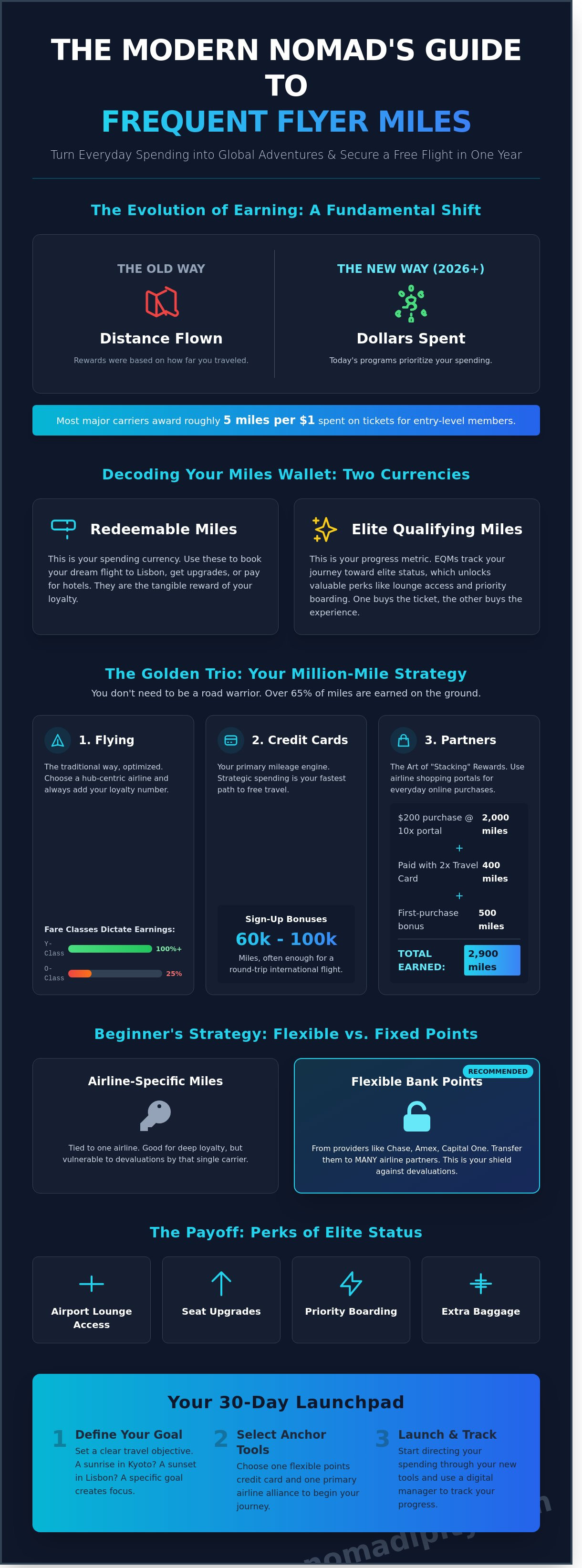
By 2026, the landscape of loyalty has shifted significantly. The old days of earning rewards based on "distance flown" have largely vanished. Modern programs now prioritize "dollars spent," a revenue-based model where your value is tied to your ticket price. Most major carriers now award roughly 5 miles for every $1 spent for entry-level members. This shift requires a more strategic approach to how you book and track your journeys.
You must distinguish between two distinct types of currency within these programs. Redeemable miles are the ones you spend on that dream flight to Lisbon. Elite Qualifying Miles, however, are the metrics that track your progress toward status. One buys the ticket. The other buys the upgrade to business class or the extra baggage allowance that makes location independence sustainable. We call this "planned serendipity." By cultivating a healthy balance of miles, you create a system where unexpected global connections become possible. When a last-minute opportunity arises in a distant city, your miles ensure you can say yes without checking your bank balance first.
The Different Flavors of Travel Rewards
Not all points carry the same weight. You will encounter airline-specific miles and flexible bank points from providers like Chase, Amex, or Capital One. For your first 12 months of travel hacking, prioritize flexible points. They offer a shield against airline devaluations because you can transfer them to multiple partners. A co-branded credit card serves as your mileage engine. These cards often provide sign-up bonuses of 60,000 to 100,000 miles, which is frequently enough for a round-trip international flight if you book with intention.
Why Miles Matter for the Modern Nomad
Miles offer more than a free seat; they unlock the human side of travel. Elite status can mean skipping a 90-minute security line or finding a quiet lounge to finish a client proposal during a layover. This creates a powerful psychological shift. You move away from asking if you can afford a trip and begin asking where you should go next. Miles sustain slow travel by neutralizing the highest cost of a nomadic life. They allow you to navigate the world with a sense of quiet confidence and agency.
How to Earn Miles: A Multi-Stream Strategy for 2026
You don't need to spend 200 days a year in a pressurized cabin to see the world for free. Industry data from 2024 suggests that savvy travelers now earn over 65% of their points while their feet are firmly on the ground. By mastering the 'Golden Trio' of flying, strategic credit card spend, and partner activities, you can cultivate a million-mile balance without a corporate travel budget. This frequent flyer miles guide focuses on the art of 'stacking.' Imagine buying a $200 suitcase through an airline portal offering 10 points per dollar, paying with a card that earns 2x on travel, and triggering a 500-mile first-purchase bonus. You've just earned 2,900 miles on one transaction. To track these moving parts without losing your mind, use a digital manager to centralize your passwords and expiration dates.
Earning Through the Air: The Traditional Way
Hub selection is your foundation. If you're based in Atlanta, Delta is your logical home; in London, it's British Airways. Always attach your loyalty number to every booking, even the 'cheap' ones. Be aware that fare classes dictate your earnings. A deeply discounted 'O' class ticket might only net you 25% of the distance flown. Conversely, a full-fare 'Y' ticket often yields 100% or more. Understanding this academic framework for valuing miles allows you to see your ticket as a financial asset rather than just a seat. It's about playing the long game with every boarding pass.
Earning on the Ground: The Lifestyle Approach
Your lifestyle is a goldmine. Use airline shopping portals for every online purchase, from office supplies to co-working memberships. During the 2025 holiday season, many portals offered 12x to 15x multipliers at major retailers. Link your credit card to a dining program to earn 3 to 5 miles per dollar at local cafes. These small wins accumulate into significant journeys, turning a Tuesday morning latte into a future sunset in Bali. It's a way to design your daily routine around the promise of future exploration.
The Power of Welcome Bonuses
Sign-up bonuses are the ultimate accelerants. A single card offering 80,000 points can instantly fund a business-class upgrade that would otherwise take years to earn. Meet the $3,000 to $6,000 minimum spend requirements by timing your application with large, planned expenses like car insurance or home repairs. Always respect the rules, such as Amex's 'once-per-lifetime' restriction, to ensure your strategy remains sustainable. As you accumulate these wins, you'll find it easier to cultivate a life of intentional movement without the heavy price tag.
Navigating Alliances and Elite Status for Maximum Leverage
Think of airline alliances as a global passport for your points. You aren't tethered to a single carrier; instead, you're tapping into a network that spans the planet. This frequent flyer miles guide highlights that your loyalty is portable. If you earn miles on United, you can spend them on a 12-hour flight from Tokyo to Singapore via ANA. It's the ultimate form of leverage for the intentional traveler who values flexibility over rigid brand loyalty.
Decoding the Major Alliances
Star Alliance remains the heavyweight champion with 26 member airlines. It offers the most comprehensive coverage for those exploring remote corners of the globe through carriers like Lufthansa and Singapore Airlines. Oneworld, currently consisting of 13 members like Qatar Airways and British Airways, is often the choice for those seeking premium cabin consistency. If your journey focuses on European hubs or major Asian cities, SkyTeam’s 19 members, including Delta and Air France-KLM, provide the most fluid connectivity for your frequent flyer miles guide strategy.
The Perks of Elite Status
Elite status turns the airport from a place of friction into a curated experience. Lounge access is the highlight here. These spaces serve as a sanctuary for networking with fellow intentional travelers or catching up on deep work in a quiet corner. Beyond the atmosphere, the math adds up. According to 2023 industry data, travelers with mid-tier status save an average of $45 per flight on checked bag fees. The real magic happens with complimentary upgrades. Moving from a cramped middle seat to a lie-flat bed on a long-haul flight isn't just a luxury; it’s a way to arrive at your destination ready to design your day rather than needing 24 hours to recover.
Don't start from zero if you've already put in the work elsewhere. The status match is a savvy shortcut that many travelers overlook. Airlines like Delta and Alaska frequently offer programs where they’ll match your current status from a competitor for a 90-day trial period. If you fly a specific number of miles during that window, you keep the status for the rest of the year. It’s a strategic way to pivot your loyalty without losing your hard-earned perks. You can parlay one successful year of travel into a lifetime of elevated experiences by jumping between programs when the timing is right. This isn't just about points; it's about engineering a lifestyle that rewards your curiosity.
Redeeming for Serendipity: How to Use Miles for High-Value Experiences
Miles are more than just digital coupons. They are the architecture of a life lived with intention. To truly master this frequent flyer miles guide, you must shift your perspective from merely saving money to buying experiences that would otherwise remain out of reach. The logic starts with the Cent-Per-Point (CPP) calculation. Simply subtract any taxes or fees from the current cash price of the ticket, then divide that number by the miles required. If the result is below 1.5 cents per point, you're likely better off paying cash and saving your miles for a more magical opportunity. High-value redemptions often reach 5 or 8 cents per point, turning a modest balance into a luxury experience.
Sweet spots represent the intersections where airline pricing logic fails and your advantage begins. These are specific routes where the mileage cost remains low regardless of the cash price. For example, using 7,500 Turkish Miles & Smiles to fly anywhere in the United States, including Hawaii, is a legendary sweet spot. You can also leverage stopovers to cultivate deeper connections with the world. Programs like Alaska Airlines allow you to spend 3 or 4 days in a hub city like Tokyo or London for zero extra miles. This effectively gives you two trips for the price of one, supporting a philosophy of slow travel and discovery.
Don't overlook the social ROI of award travel. Accessing a premium lounge isn't just about the quiet or the complimentary meal; it's about the proximity to like-minded explorers. These spaces are perfect to find a travel buddy or network with fellow digital nomads who value location independence as much as you do. A single conversation in a lounge in Doha or Singapore can lead to a partnership that changes your entire trajectory.
Redemption Basics: Finding the Award Seat
Airlines typically release their calendar 330 days in advance. If you want a specific seat on a high-demand route, you need to be ready at that 330-day mark. However, serendipity favors the spontaneous too. Lufthansa often opens First Class award space to partners only 15 days before a flight. It's a high-stakes game that requires flexibility. Whatever you do, never redeem miles for merchandise or gift cards. These options often value your points at 0.5 cents each, which is a 70% loss compared to travel redemptions.
The Transferable Points Advantage
The most successful nomads don't just collect airline miles; they cultivate transferable points. Moving points from a bank to an airline partner can often double or triple their value. This frequent flyer miles guide recommends waiting for transfer bonuses, which frequently offer 25% or 30% more miles for every point moved. Consider this case study: 60,000 points might cover a $515 economy flight if used in a bank travel portal. By transferring those same points to a partner like Virgin Atlantic during a promo, you could book a $4,200 ANA Business Class seat. This isn't just a flight; it's a way to arrive refreshed and ready to create.
Designing Your Loyalty Roadmap: Your First 30 Days
Theory only takes you so far. To truly master this frequent flyer miles guide, you must move from passive reading to active design. The first 30 days are about building an engine that runs on your existing habits. You aren't spending more money; you're simply changing the way that money works for you. By the end of this month, the dream of a business class seat to Tokyo or a slow-travel summer in Portugal will shift from a "someday" thought to a scheduled reality.
Success in this lifestyle relies on what we call planned serendipity. You build the systems and collect the points so that when a rare award seat opens up or an unexpected invitation to a remote villa arrives, you have the currency to say yes. It's about being prepared for the magic you can't yet see.
Step 1: The Audit
Before you apply for anything, look at your financial foundation. Check your credit score today; you should aim for a 700 or higher to qualify for the most lucrative "anchor" cards. List your top three monthly expenses, which for 72% of nomads includes housing, food, and transit. Sign up for AwardWallet to centralize your new accounts in one dashboard. Finally, name your "Dream Destination." Grounding your strategy in a specific location, like a cherry blossom tour in Japan, makes the logistics feel purposeful rather than tedious.
Step 2: The First Move
Apply for a flexible points card to serve as your primary tool. The Chase Sapphire Preferred or American Express Gold Card are excellent starting points because they allow you to transfer points to multiple airlines. Once your card arrives, follow these steps:
- Shift your bills: Move every recurring subscription and utility to the new card to hit your welcome bonus.
- Automate: Set up an auto-pay from your checking account to ensure you never carry a balance.
- Join the Big Three: Register for the loyalty programs of the top three airlines at your home airport immediately.
Hitting a 60,000-point welcome bonus often requires spending $4,000 within 90 days. This single move can often cover a round-trip international flight if you book strategically.
Step 3: Connect and Cultivate
Isolation is the enemy of exploration. Set up your Nomadipity profile this week to find mileage mentors who have already navigated the routes you desire. If possible, attend an airport lounge meetup. Seeing the tangible perks, like a quiet workspace and a hot shower between flights, reinforces why you're doing this. Finally, write one sentence defining your 2026 travel "Why." Whether it's "I want to work from a beach in Bali to reclaim my creativity" or "I want to visit my family without financial stress," this sentence is your North Star.
This frequent flyer miles guide is your blueprint. The world is waiting for you to design your way into it. Start today.
Craft Your Roadmap to Endless Horizon
Living a life of location independence isn't a distant dream for 2027; it starts with the intentional systems you build today. By implementing a 3-tier earning strategy and leveraging the 3 major global alliances, you can secure your first 100,000-point redemption within your first 6 months of focused planning. This frequent flyer miles guide provides the framework to turn routine expenses into high-value experiences, like a $6,000 first-class suite booked for the price of a tax fee. You've learned how to navigate status tiers and design a 30-day roadmap that transforms travel from a yearly luxury into a sustainable lifestyle. Planned serendipity isn't an accident; it's the result of having the right tools and the right people by your side.
Don't navigate the skies alone. Join a network of 5,000+ intentional travelers who value depth over speed. Design your next journey and find your travel tribe on Nomadipity, where you'll access our exclusive frequent flyer community, coordinate lounge meetups in 150+ airports, and find itinerary-based matchmaking to connect with like-minded nomads. Your next great story is already waiting to be written. We'll see you at the gate.
Frequently Asked Questions
How many frequent flyer miles do I need for a free flight?
You generally need between 7,500 and 12,500 miles for a one-way domestic flight in the United States. This frequent flyer miles guide highlights that international economy seats typically start at 30,000 miles for a one-way trip. Some budget-friendly carriers like Southwest use revenue-based pricing, where a $150 flight might cost 10,000 points. Always check the specific award chart of your carrier to confirm the exact requirements for your next journey.
Do frequent flyer miles expire if I don't use them?
Expiration policies vary by airline, but major carriers like Delta, United, and Southwest miles never expire. American Airlines and Alaska Airlines require account activity at least once every 24 months to keep your balance active. You can prevent loss by making a small purchase through an airline shopping portal or using a co-branded credit card. This simple action resets the clock and protects your hard-earned rewards for another two years of potential exploration.
Is it better to use miles for economy or business class?
Business class redemptions provide the highest mathematical value, often yielding 3 to 8 cents per mile compared to the 1.2 cents typical for economy. If you book a $5,000 business class seat for 80,000 miles, you're getting 6.25 cents of value. While economy lets you travel more often, business class transforms long-haul flights into a restful part of your nomadic lifestyle. Choose based on whether you value the frequency of trips or the comfort of the experience.
Can I transfer miles to someone else or a different airline?
You cannot directly move miles from one airline to another, but you can book flights on partner carriers within the same alliance. For example, you can use British Airways Avios to book an American Airlines flight. Transferring miles to another person's account is possible but often expensive. Most airlines charge a fee of $0.01 per mile plus a $30 processing fee, which usually makes it a poor financial decision compared to booking the flight for them.
How do I find award flight availability easily?
Modern search tools like Point.me or Seats.aero are the most efficient ways to locate award space across dozens of programs simultaneously. These platforms aggregate data from over 60 airlines to show you real-time availability. Instead of searching each site individually, you can see all your options in one interface. This frequent flyer miles guide suggests setting alerts for specific routes to capture seats the moment they're released, ensuring you don't miss out on rare opportunities.
Will opening a travel credit card hurt my credit score?
Opening a new travel credit card typically results in a temporary credit score drop of 5 to 10 points. This happens because the bank performs a hard inquiry, which accounts for 10 percent of your FICO score. Your score usually recovers within three to six months as you maintain a history of on-time payments. The long-term benefit of a higher total credit limit often outweighs the initial minor dip by lowering your overall credit utilization ratio.
What is the best frequent flyer program for beginners in 2026?
Air Canada Aeroplan remains the top choice for beginners in 2026 due to its massive network of 45 airline partners and predictable pricing. It doesn't pass on expensive fuel surpluses, which can save you $400 on a single international booking. The program is intuitive and allows you to add a stopover for just 5,000 extra points. This flexibility makes it easy to design a multi-city itinerary without navigating the complex rules found in other legacy programs.
How can I get into airport lounges without a business class ticket?
You can access over 1,400 airport lounges worldwide by holding a premium credit card like the American Express Platinum or a standalone Priority Pass membership. The Amex Platinum carries a $695 annual fee but provides entry to Centurion Lounges and Delta SkyClubs. If you prefer a lower cost entry, some lounges offer day passes for roughly $50. These spaces offer the quiet and reliability needed to stay productive and refreshed while you navigate the world.

Disclaimer
Nomadipity Blog Disclaimer
The content on Nomadipity is provided for general informational and inspirational purposes only. While we strive for accuracy and timeliness, Nomadipity does not guarantee that any information is complete, current, or suitable for your specific needs. Use your judgment and verify details before making travel plans, meeting with other users in person, or making any purchases influenced by the article.


