
What if the most life-changing encounter of your next trip wasn't a hidden waterfall, but the person sitting three rows behind you? We've all felt that specific sting of digital loneliness, staring at a stunning horizon while surrounded by people who don't share our budget or our professional drive. It's exhausting to sift through chaotic forums only to find travelers whose goals clash with your own. If you're tired of the mismatch, you'll find that finding travel communities online has evolved into a precise art of intentional connection.
This guide proves that building your tribe is no longer a game of chance. You'll learn how to find a "nomadic mirror" by using loyalty programs and niche platforms to engineer planned serendipity. We will explore the shift toward algorithm-based matching and how to master the digital landscape to build a network that makes global exploration feel both manageable and deeply personal. It's time to move beyond the crowd and find the people who truly speak your language.
Key Takeaways
- Shift your focus from broad forums to high-intent, niche ecosystems where "planned serendipity" is built into the very framework of the community.
- Learn a precise vetting process for finding travel communities online that prioritizes verified profiles and high-quality interactions over sheer numbers.
- Audit your travel identity by defining non-negotiables like budget and work hours before you start your search, ensuring your digital tribe matches your lifestyle.
- Use "itinerary-first" search strategies to find travelers with immediate overlap in your upcoming destinations for meaningful networking at 30,000 feet.
- Leverage your loyalty programs and professional affiliations as matching tools to connect with companions who share your specific travel values and standards.
The Evolution of Finding Travel Communities Online in 2026
The digital landscape has shifted. We've moved past the era of shouting into crowded Facebook groups where the noise often drowned out the signal. By 2026, the process of finding travel communities online has evolved into a sophisticated search for high-intent, niche ecosystems that value depth over breadth. It's no longer about just finding a place to stay; it's about finding the people who make that place feel like home. This shift represents a move toward "planned serendipity," a framework where you establish the right digital connections to facilitate meaningful, unplanned moments in the physical world.
Technology has matured from simple "buddy finding" tools to complex lifestyle matchmaking. We now look for more than just a warm body to share a hostel room. We look for peers. Finding a digital home before you physically relocate provides a massive psychological cushion. It replaces the anxiety of the unknown with the quiet confidence of a pre-established network. You aren't just moving to a new city; you're stepping into a waiting circle of friends.
Why Solo Travel Doesn't Have to Mean Traveling Alone
Digital loneliness is a quiet epidemic. With an estimated 40 million people living as digital nomads in 2026, the need for a social safety net has never been higher. Solo travel is liberating, but it can also be isolating if you don't have a way to bridge the gap between "stranger" and "friend." There's a vital difference between a rigid group tour and community-based travel. A community acts as a social catalyst without stripping away your autonomy. While travelers once relied solely on community-driven travel guides to navigate logistics, they now use online hubs to find the people who will share those experiences. It's the difference between seeing a monument and discussing its history over a shared meal with someone who actually gets you.
The Rise of the 'Nomadic Mirror' Concept
Alignment is the new currency of travel. The "nomadic mirror" concept is about finding peers who reflect your specific lifestyle, from your professional goals to your daily budget. If you're a remote executive, your needs are vastly different from a budget backpacker. Friction often arises when travel styles don't match. Finding travel communities online that prioritize these mirrors ensures you aren't constantly negotiating your standards. Shared affiliations, such as mutual loyalty programs or professional industries, serve as a foundation for trust. When you find someone who values the same airline lounge or the same morning deep-work ritual, the connection is immediate. You've found a peer, not just a passenger.
Navigating the Three Pillars of Digital Travel Circles
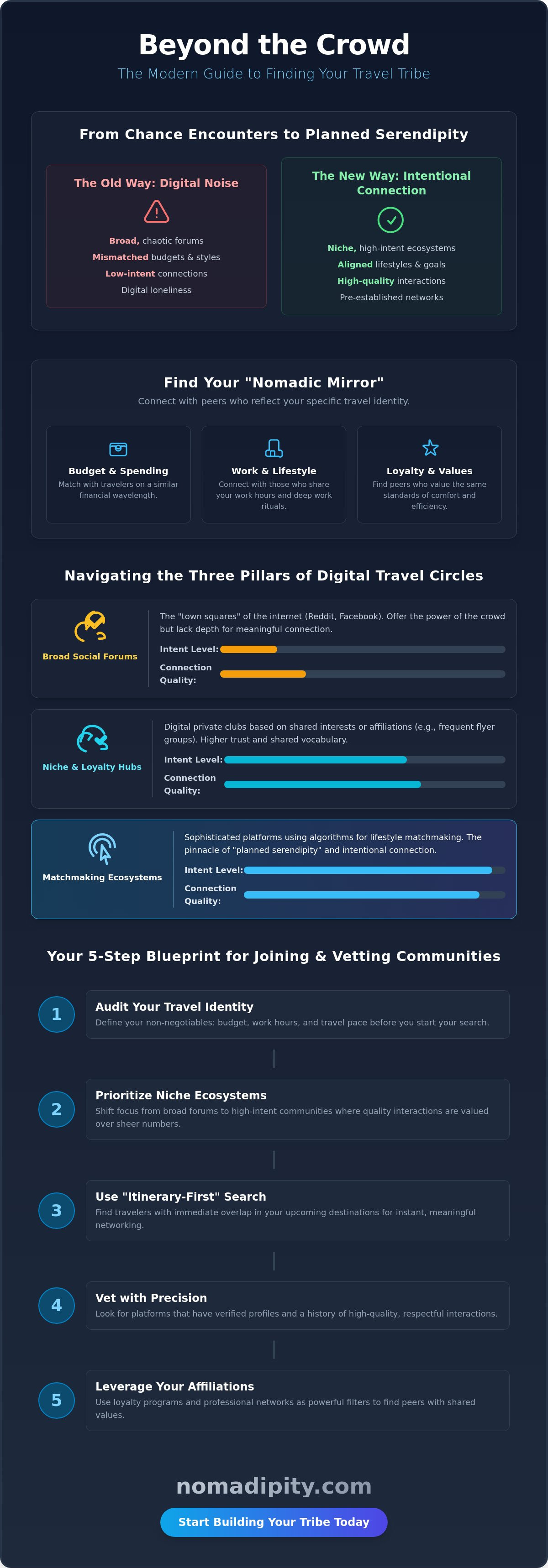
A travel community is a digital space that facilitates real-world connection through shared intent. Understanding this definition is the first step in moving away from the chaotic noise of the open web and toward spaces that actually serve your lifestyle. The landscape is generally divided into three distinct pillars: broad social forums, niche networking hubs, and matchmaking ecosystems. Each serves a different purpose, but only the latter two truly lean into the concept of structured spontaneity that defines modern exploration.
Broad social forums like Reddit or Facebook are the town squares of the internet. They offer the "power of the crowd," providing quick answers to logistical questions about visas or local SIM cards. However, they're often too vast to foster intimate connections. Skift research on travel communities has shown that while these platforms receive massive traffic, travelers are increasingly seeking more customized, high-intent spaces. This is where finding travel communities online becomes a more surgical process. You're looking for the digital equivalent of a private club, not a crowded stadium.
Loyalty Circles and Reward Program Communities
Frequent flyer status and hotel elite tiers are more than just perks; they're powerful community filters. When you participate in communities built around loyalty programs, you're connecting with people who share a similar "travel vocabulary." These are the peers who understand the value of a specific lounge or the logic behind a mileage run. This shared understanding of the "points and miles" lifestyle creates an immediate baseline of trust. It's much easier to network at 30,000 feet when you know the person next to you values the same standards of comfort and efficiency that you do.
Interest-Based Micro-Communities
The most successful connections often stem from "the why" of your journey rather than just the destination. Interest-based micro-communities focus on specific lifestyles, such as wellness, photography, or deep-focus remote work. We've seen a significant transition from asking "where are you going?" to "how do you live?" These smaller circles offer a much higher conversion rate from an online chat to an offline meetup. Because the shared interest is already established, the "planned serendipity" feels natural rather than forced. If you're ready to stop searching and start connecting, finding a travel companion who mirrors your professional drive and personal interests is the most effective way to build your tribe.
Matchmaking ecosystems represent the third pillar, using your itinerary and lifestyle data to pair you with travelers who are already on your wavelength. These platforms remove the guesswork, allowing you to establish a network of peers before you even pack your bags. It's about finding the right people, in the right place, at the right time.
Evaluating the Best Platforms for Your Travel Style
The quest for the perfect digital tribe requires a discerning eye for the "signal-to-noise" ratio. On massive, decentralized platforms like Reddit, you might find a wealth of information, but the sheer volume of users makes finding travel communities online feel like searching for a needle in a haystack of varying budgets and conflicting philosophies. You're often met with a chaotic list of suggestions rather than a structured path to connection. To find your nomadic mirror, you must evaluate platforms based on how effectively they filter for intent, safety, and lifestyle alignment.
The cost of community is often a direct reflection of its quality. While free forums are accessible, premium subscription networks act as a gatekeeper for intent. As of May 2026, membership fees for established communities vary significantly. Couchsurfing requires a contribution of approximately $4.99 per month, while a lifetime membership to Nomad List sits at $99. Worldpackers offers plans ranging from $59 to $139 for solo travelers. These costs aren't just barriers; they're filters that help ensure the people you meet are as invested in the experience as you are. When you pay for a community, you're often paying for a higher standard of vetting and a more sophisticated user base.
Forums vs. Dedicated Matchmaking Apps
Choosing a dedicated matchmaking app over a general social network is often the difference between a chaotic group chat and a structured networking opportunity. General forums are excellent for logistical advice, but they lack the tools for true compatibility matching. Centralized apps prioritize itinerary-sharing, which is the ultimate filter for travel. It moves the conversation from a vague "I want to go to Italy" to a concrete "I will be in Florence on October 12th." This level of specificity instantly weeds out the dreamers from the doers, allowing you to focus on peers who are actually moving at your pace.
The Importance of Profile Depth
A simple bio is no longer enough to establish trust in 2026. High-quality communities are defined by their onboarding process. Look for platforms that ask about your professional affiliations, loyalty program tiers, and specific travel non-negotiables. These details provide a layer of vetting that a standard social profile can't match. Seeing a potential companion's industry or their preference for specific hotel rewards programs tells you more about their lifestyle than a dozen sunset photos ever could. When a platform values profile depth, it signals that they prioritize meaningful, long-term connections over superficial "buddy finding."
A Step-by-Step Blueprint for Joining and Vetting Communities
The process of finding travel communities online is a journey in itself. Before you ever download an app or pay a subscription fee, you must audit your own nomadic identity. What are your non-negotiables? If you require four hours of deep focus every morning before seeing another soul, a high-energy group forum likely won't serve your needs. Be honest about your budget, your preferred pace, and your professional requirements. Once you understand your own rhythm, look for itinerary-first platforms. These allow you to find immediate overlap with others who are already heading where you're going. Think of the weeks before your trip as a digital departures lounge. It's a space to build rapport and establish trust while you're still in the comfort of your home. Vetting is a collaborative process designed to ensure mutual comfort, not a suspicious interrogation.
Setting Up Your Traveler Profile for Success
Your profile is your digital handshake. Avoid the generic brochure speak that often plagues travel sites. Instead of saying you "love adventure," describe the specific type of morning you crave. Are you searching for a quiet cafe with reliable Wi-Fi or a sunrise hike in the foothills? Share your upcoming itineraries to attract peers with similar trajectories. Highlighting your affiliations, like being a Delta SkyMiles member or a Marriott Bonvoy loyalist, helps you find people who value the same standards of comfort. If you want a more tailored approach, consider finding your next travel companion through a service that matches you based on these deep-level lifestyle markers.
Safety and Boundaries in Online Travel Circles
Trust is built in layers. When finding travel communities online, watch for red flags like profiles with no history or individuals who dodge specific questions about their plans. Always move the conversation from text to a video call before meeting in person. This "vibe check" is essential for verifying identity and checking for personality chemistry. You can use this vetted travel companion checklist to ensure you're covering all the necessary bases. Be explicit about boundaries early on. Discuss how you'll handle shared costs and, perhaps more importantly, how much "alone time" you each require. Setting these expectations upfront prevents the friction that often ruins a perfectly good trip.
Cultivating Planned Serendipity with Nomadipity
Nomadipity exists at the intersection of intentionality and chance. While other platforms offer a sea of faces, we provide a mirror. Finding travel communities online often feels like a full-time job, but it shouldn't be. Our approach moves beyond the superficial "where are you going" and dives into the "how do you travel." By focusing on your professional affiliations, loyalty program tiers, and specific budget requirements, we create a foundation where serendipity can actually thrive. It's about establishing a framework so that the magic of the unexpected has room to happen. We don't just find you a companion for a weekend; we help you build a network that spans continents.
This isn't about a one-off meeting in a hostel lobby. It's about finding the person who shares your airline lounge access, your deep-work schedule, and your curiosity for the world's hidden corners. This is networking that lasts a lifetime, fueled by shared values and mutual respect. When you align your travel DNA with others who move at your pace, the friction of global exploration melts away. You're no longer just navigating a city; you're engaging with it alongside someone who truly gets you.
Why Matchmaking is the Future of Travel
Traditional social media lacks the precision required for a lifestyle on the move. Our matchmaking filters prioritize your specific travel DNA, ensuring that every connection feels relevant to your current path. Whether you're seeking a peer to share a quiet coworking space in Lisbon or a fellow points enthusiast to navigate a complex itinerary, our system understands the nuances of your life. In 2026, the need for a social network for frequent flyers is more than a luxury; it's a logistical necessity for maintaining sanity and connection at 30,000 feet. We integrate with your existing habits, from the lounges you frequent to the local hotspots you've yet to discover. By finding travel communities online that use data to foster human connection, you're investing in the quality of your future experiences.
Joining the Nomadipitian Movement
Stepping into our community means leaving the isolation of solo travel behind. You aren't just a user on a platform; you're a member of a global network of thinkers, doers, and explorers. Our niche group forums and global meetups are designed to foster deep engagement rather than surface-level chatter. You'll find that the transition from a solo traveler to a Nomadipitian is one of the most rewarding shifts you can make. It’s the moment you realize that while the world is vast, you’re never truly alone in it. Start your journey of planned serendipity with Nomadipity today.
Your Tribe is Waiting Over the Horizon
The landscape of global exploration has fundamentally changed. We've moved beyond the era of accidental encounters and entered an age where your digital network serves as your most reliable safety net. By prioritizing the concept of planned serendipity, you ensure that every mile traveled is shared with those who mirror your professional drive and personal standards. Whether you're leveraging loyalty program tiers or vetting peers through deep-level profile assessments, the focus is now on the quality of the connection rather than the quantity of the crowd.
Mastering the art of finding travel communities online is about more than just filling a seat; it's about enriching your journey with intentionality. You deserve a network that understands the intricacies of your lifestyle and respects your boundaries. With advanced traveler search filters, loyalty program integration, and verified traveler profiles, you can finally bridge the gap between digital interaction and real-world adventure. Discover your next travel companion on Nomadipity and transform your solo journey into a shared legacy. The world is vast and welcoming, and now, you have the tools to find the people who make it feel like home.
Frequently Asked Questions
Is it safe to find travel communities online?
It is safe if you prioritize platforms that utilize verified profiles and identity checks. Look for communities that require a formal onboarding process and have active moderation to filter out bad actors. Moving from a digital chat to a video call is a vital step in your vetting protocol. This ensures that the person you are meeting matches their online presence before you ever share a physical space.
What are the best free travel communities for beginners?
Beginners can start with broad platforms like Reddit or the roammate app, which is currently free to download on both Apple and Google Play stores. These spaces offer a low-pressure way to observe how travelers interact and share advice. While they lack the deep matchmaking of premium services, they provide a solid foundation for finding travel communities online before you decide to commit to a paid subscription.
How do I find travel partners with the same budget as me?
You can find budget-aligned partners by using platforms that include specific financial filters or lifestyle markers. Many niche communities ask users to define their daily spending range or preferred accommodation types, such as boutique hotels versus hostels. Being explicit about your budget in your own profile is also essential. This transparency prevents the friction that arises when one person wants a luxury villa while the other prefers a shared dorm.
Can I find professional networking opportunities in travel communities?
Yes, many modern travel communities are designed specifically to facilitate networking at 30,000 feet. Look for platforms that allow you to filter by industry or professional affiliation. For digital nomads, these spaces often serve as mobile coworking hubs where you can meet peers who share your work ethic. Connecting with fellow professionals ensures that your travel schedule won't clash with your deadlines, making the nomadic lifestyle truly sustainable.
What is the difference between a travel buddy app and a travel dating site?
Travel buddy apps focus on shared itineraries and platonic companionship, while dating sites prioritize romantic compatibility. Some platforms, like Nomadipity.com, offer both components but keep them distinct through specific user filters. The main difference lies in the primary intent of the connection. Buddy apps are about the journey and the logistical overlap, whereas dating sites are about the person. Always check a platform's community guidelines to ensure they align with your goals.
How do I vet a travel community before paying for a subscription?
You should vet a community by checking its "onboarding" depth and the activity level of its current members. Look for recent posts and verified user reviews to gauge the signal-to-noise ratio. Many platforms offer a limited preview of their member directory or a "lite" version. If the community feels stagnant or the profiles look like generic brochures, it is likely not worth the subscription fee. High-quality networks usually prioritize depth over sheer numbers.
What should I include in my traveler profile to attract the right people?
Your profile should include your upcoming itineraries, your professional affiliations, and your travel non-negotiables. Don't just list your favorite countries. Instead, describe your daily rhythm. Do you wake up at dawn for photography, or are you a night owl looking for local jazz clubs? Mentioning your loyalty program tiers, such as Marriott Bonvoy or Delta SkyMiles, also helps you find peers who value the same standards of comfort and efficiency.
Are there specific communities for solo female travelers or digital nomads?
Yes, there are many niche spaces tailored specifically for these demographics. For solo women, apps like Tourlina provide a vetted environment for finding female companions. Digital nomads often flock to platforms like Nomad List to find hubs with reliable Wi-Fi and community events. finding travel communities online that cater to your specific demographic ensures that the advice and connections you find are relevant to your unique safety concerns and professional requirements.

Disclaimer
Nomadipity Blog Disclaimer
The content on Nomadipity is provided for general informational and inspirational purposes only. While we strive for accuracy and timeliness, Nomadipity does not guarantee that any information is complete, current, or suitable for your specific needs. Use your judgment and verify details before making travel plans, meeting with other users in person, or making any purchases influenced by the article.


