

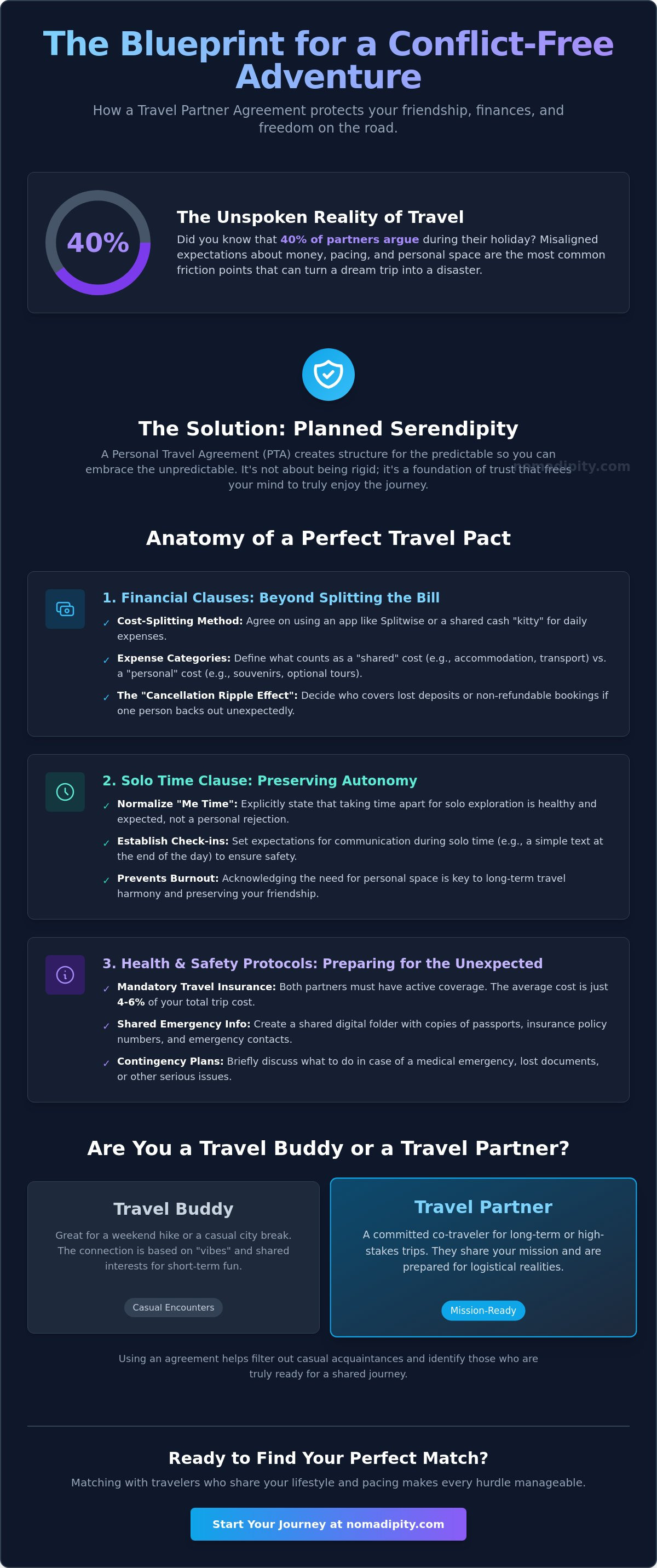
Did you know that 40% of partners find themselves arguing during their holiday? It's a sobering statistic that highlights how quickly the dream of global exploration can hit the wall of reality. Whether you are planning a month in a secondary city or a digital nomad workcation, the friction often stems from unspoken expectations about money and personal space. You have likely felt that familiar anxiety about being stuck with a surprise bill or clashing over a packed itinerary. That's why using a travel partner agreement template isn't about being rigid; it's about creating a foundation of trust so you can actually enjoy the journey.
We all crave that sense of structured spontaneity where the logistics are handled, leaving room for genuine cultural engagement. This 2026 guide will show you how to protect your friendship and your finances with a practical framework designed for modern adventurers. You will learn how to establish a clear plan for sharing costs, balance solo time with shared experiences, and set up safety protocols for when things go wrong. By the end, you'll have the tools to ensure your next trip is defined by connection rather than conflict.
Key Takeaways
- Understand how a Personal Travel Agreement creates "planned serendipity," giving you the structure needed to embrace unplanned moments.
- Master the essential sections of a travel partner agreement template to protect your finances and clarify how you'll handle shared costs.
- Normalize the need for geographic autonomy by including a "Solo-Time" clause that prevents burnout and preserves your friendship.
- Learn the collaborative approach to drafting your pact so it feels like an exciting shared project instead of a rigid set of rules.
- Discover how matching with travelers who share your specific lifestyle and pacing can make every logistical hurdle feel manageable.
What is a Travel Partner Agreement and Why Do You Need One?
Imagine standing in the middle of a bustling market in Hanoi or a quiet street in Lisbon. You want to linger over a second espresso, but your companion is already checking their watch, anxious to hit the next museum. This friction is where travel dreams go to die. A Personal Travel Agreement (PTA) is a non-commercial pact that acts as a handshake captured on paper. Unlike a traditional partnership agreement designed for corporate ventures, this document is built for human connection. It serves as a memorandum of understanding between friends, ensuring that your shared journey is defined by what I call "planned serendipity."
By establishing a travel partner agreement template before you book your flights, you aren't being cold or overly legalistic. You're actually being kind. Structure isn't the enemy of adventure; it's the architect. When you know exactly how costs are split and who handles the emergency logistics, your mind is free to wander. You stop worrying about the "what-ifs" and start noticing the smell of jasmine in the air or the way the light hits the cobblestones. This psychological safety reduces pre-trip anxiety and sets clear boundaries that protect both your wallet and your peace of mind.
The Difference Between a Travel Buddy and a Travel Partner
A travel buddy is someone you might grab a drink with or join for a weekend hike. They're great for casual encounters, but "vibes" aren't enough for long-term digital nomadism or high-budget expeditions. A travel partner is a committed co-traveler. They are someone who shares your mission and understands the intricacies of geographic autonomy. Using a travel partner agreement template helps you move from being a simple "match" to being "mission-ready." It filters out the casual acquaintances and identifies the people truly prepared for the logistical realities of unconventional living.
Avoiding the 'Friendship-Ending' Trip
We've all heard the horror stories of best friends who stopped speaking after a week in Italy. Common friction points like hidden costs, mismatched energy levels, or the sudden arrival of "guest" surprises can turn a dream into a nightmare. An agreement serves as a neutral third party during these disputes. It’s much easier to point to a shared document than to start a confrontation when you're tired and jet-lagged. It allows you to address the need for solo time without it feeling like a personal rejection. A Personal Travel Agreement is a proactive tool for relationship preservation that ensures your shared memories stay golden.
The Anatomy of a Perfect Travel Partner Agreement Template
Building a shared life on the road requires more than just a shared Pinterest board. A truly effective travel partner agreement template serves as a blueprint for your daily existence, translating vague intentions into actionable boundaries. It shouldn't feel like a sterile legal contract. Instead, think of it as a set of guardrails that keep your journey on track when the initial excitement of a new destination begins to fade. By addressing the granular details now, you protect the magic of the trip later.
Financial Clauses: More Than Just Splitting the Bill
Money is the most common friction point for companions, yet it is often the hardest topic to broach. Your agreement needs to be explicit about how you plan to handle shared bills, whether you prefer digital tracking apps like Splitwise or a communal "kitty" for daily groceries and fuel. Define what constitutes a "non-negotiable" expense versus a luxury upgrade. If one of you wants a boutique hotel while the other is happy in a hostel, decide how that price gap is bridged before you book. You must also address the "cancellation ripple effect." If one person backs out at the last minute, who covers the lost deposit on that shared Airbnb? Establishing these rules early prevents resentment from taking root.
Health and Safety Protocols
Safety isn't just about avoiding danger; it's about being prepared for the unpredictable. In 2026, the average cost of travel insurance is between 4% and 6% of your total trip, a small price for the security it provides. Your travel partner agreement template should mandate that both parties carry active coverage, with policy numbers and emergency contact info shared in a central folder. For digital nomads, an annual policy averaging around $413 is often the smarter move for year-round protection. Beyond the paperwork, establish a simple "Check-In" system for solo excursions. Knowing someone is aware of your location allows for true geographic autonomy without the weight of worry. Listing allergies and existing medical conditions ensures that if the worst happens, your partner can act with confidence.
Social boundaries are equally vital. Discuss your expectations regarding guests, sleep schedules, and even substance use. Are you early risers or night owls? Is your shared space a sanctuary or a social hub? If the partnership eventually hits a wall, having a "travel divorce" clause provides a graceful exit strategy. It outlines how to split shared assets or change bookings without a scene. Finding a companion who naturally aligns with these values is much easier when you subscribe to a community that prioritizes lifestyle compatibility from the very first hello.
Navigating the 'Hard' Conversations: Money, Privacy, and Solo Time
Transparency is the bedrock of any shared journey. Before you even look at flight prices, you need to sit down with your potential companion and get real about the gritty details. The most successful travelers, those who truly embrace the nomadic lifestyle, prioritize radical transparency long before they reach the airport. They use a travel partner agreement template as a catalyst for these awkward but essential chats. It’s far better to discover a mismatch in spending habits while sitting on your couch than while arguing over a dinner bill in a crowded market in Marrakesh.
The Budget Alignment Audit
Are you aiming for a shoestring adventure, a mid-range exploration, or a luxury retreat? You must categorize the trip clearly from the start. Don't overlook the "invisible" costs that can bleed a budget dry. Think about local tipping cultures, data roaming fees, and the simple price of laundry in a foreign city. I always recommend establishing a "buffer fund" in your agreement. This is a dedicated pool of money for those unexpected, serendipitous opportunities that make travel truly magical, like a last-minute boat tour or a spontaneous cooking class.
Privacy and Personal Space
Shared accommodations can be a test of even the strongest bonds. Decide early if you're comfortable with shared dorms or if private rooms are a non-negotiable requirement for your mental clarity. Many seasoned travelers use the "headphone rule" to signal a need for quiet time without having to say a word. It’s an essential part of mastering the art of planned serendipity. By normalizing the need for distance, you actually bring yourselves closer together when you do decide to explore as a pair.
For the 18 million US workers who identify as digital nomads, the line between work and leisure is often blurred. Set firm work hours within your agreement. If you're on a "workcation," your partner needs to know exactly when you're unavailable for sightseeing. Finally, address the "third-party guest" scenario. If one partner meets a local match and wants to invite them back to a shared space, what are the rules? Defining these social deal-breakers prevents discomfort and keeps your shared home a sanctuary. Geographic autonomy means you are free to explore separately, but it requires a foundation of mutual respect to work effectively.
How to Introduce the Agreement Without 'Killing the Vibe'
Bringing up a formal document during the "honeymoon phase" of trip planning can feel like a cold shower. You're dreaming of sunset cocktails in Bali, and suddenly you're talking about cancellation clauses. But wait. The right timing is everything. Don't lead with the document on your first coffee date. Instead, wait until the "wouldn't it be cool if..." turns into "I'm looking at flights for October." This is the moment to introduce your travel partner agreement template. Frame it as a way to protect the very vibe you're both so excited about.
A Script for the 'Contract' Conversation
"I value our friendship too much to let travel stress ruin it." This is your golden opening line. It's honest, warm, and sets a collaborative tone. By framing the agreement as a way to unlock more freedom, you shift the focus from restriction to empowerment. Explain that having these rules in place means you won't have to waste precious travel time debating who owes what for the airport taxi. In 2026, these documents are living things. Keep them digital so you can make quick updates as your journey evolves and you discover new rhythms on the road.
Make the process a shared project. This isn't a list of demands you're handing down from on high. It's a collaborative edit. Use a shared digital space where both of you can contribute to the travel partner agreement template, adding clauses, tweaking budgets, and voicing concerns. This approach turns the logistics into a creative exercise in lifestyle design. It ensures that both parties feel heard and invested in the success of the journey before the first bag is packed.
Vetting Your Partner Through the Process
If your potential companion recoils at the idea of a written plan, take note. This is a massive red flag. A partner's reaction to the agreement is a perfect preview of their travel behavior. Are they dismissive of your need for security? Do they avoid hard conversations about money? If they won't engage with the template, they likely won't engage with the challenges of the road. Learning how to find a travel buddy who respects your boundaries is the first step toward a successful journey.
Whether you prefer a cloud-based folder or a printed copy tucked into your passport holder, keep it accessible. You want to be able to reference it in a heartbeat if a dispute arises. The best way to avoid these awkward vetting stages altogether is to subscribe to a matchmaking service that connects you with adventurers who already value this level of intentionality. When you start with a match who shares your travel philosophy, the agreement becomes a celebration of your alignment rather than a hurdle to overcome.
Beyond the Template: Finding Your Nomadipity Match
While a travel partner agreement template provides the necessary safety net, the true success of your journey depends on who is holding the other end of that pact. It's the difference between a trip that feels like a series of compromises and one that feels like a shared evolution. Finding the right person is where the real magic happens. Nomadipity’s matching algorithm is designed to take the heavy lifting out of this selection process by focusing on the core pillars of compatibility: mutual interests, professional affiliations, and precise travel styles. We don't just find you a warm body to share a room with; we find a companion who shares your rhythm.
When you have access to detailed traveler profiles, the "hard conversations" about money and personal space aren't nearly as daunting. You already know if their budget matches your "mid-range" preference or if they value geographic autonomy as much as you do. This alignment means your travel partner agreement template becomes a simple confirmation of shared values rather than a negotiation between strangers. Being part of the Nomadipitian community allows you to vet potential companions through shared experiences and community feedback long before you hit the airport lounge for that first face-to-face meetup.
Leveraging Loyalty and Interests
One of the most overlooked ways to simplify your financial clauses is through shared loyalty. If you and your partner both hold status with the same airline or hotel group, the logistics of upgrades and lounge access become seamless. This shared "travel language" reduces friction and makes the "Financial Commitments" section of your agreement much easier to navigate. We encourage our members to look beyond simple destinations and find matches based on their deeper approach to movement. To dive deeper into this world of connected travel, explore our thoughts on social networking for frequent flyers and how it's changing the way we meet on the move.
Start Your Journey with Confidence
The world is vast and unpredictable, but it's also incredibly welcoming when you approach it with the right mindset and the right person. Remember that the goal of any agreement is to facilitate those unplanned, beautiful moments that define a life well-lived. By establishing your framework now, you're giving yourself permission to find value in the unexpected later. You've done the work, you've set the boundaries, and you've found your match. Now, it's time to let the journey begin. Join Nomadipity and find your next travel partner today to start building a future of stress-free, shared adventures.
Ready to Design Your Next Great Adventure?
The road ahead is most beautiful when you aren't looking back at a trail of unresolved arguments or financial stress. By now, you understand that a travel partner agreement template is more than a document; it's a commitment to the longevity of your friendship and the quality of your experiences. You've learned how to navigate those delicate conversations about budget and privacy, turning potential friction into a foundation of trust that allows for true planned serendipity.
Why leave your next journey to chance when you can begin with alignment? Our vetted community of frequent flyers is waiting to meet you. We offer matchmaking based on over 20 specific travel style metrics, ensuring you find someone who values geographic autonomy as much as you do. Members also enjoy exclusive perks for hotel rewards members, making the logistics of shared travel even more seamless. Don't let a mismatch in pacing or budget ruin your dream trip.
Join Nomadipity to find your perfectly aligned travel partner and step into the world with a companion who is truly on your wavelength. The unexpected is waiting, and it's much better when shared with someone who understands the plan.
Frequently Asked Questions
Is a travel partner agreement legally binding in 2026?
A travel partner agreement is generally viewed as a memorandum of understanding rather than a legally binding contract, unless you take specific steps to notarize it for high-value trips. It serves as a moral and social compass for your journey. While it might not hold up in a small claims court without formal legal drafting, its primary power lies in preventing disputes from escalating by clarifying expectations before you ever leave home.
What should I do if my travel buddy refuses to sign an agreement?
If a potential companion refuses to engage with a travel partner agreement template, you should treat it as a significant red flag. This resistance often signals a discomfort with transparency or a lack of preparation for the logistical realities of shared travel. It is much better to discover this misalignment while you are still in the planning phase than when you are navigating a foreign city together and facing a crisis.
How do we handle shared expenses if one partner has a higher budget?
Handling budget disparities requires setting a clear baseline for all shared expenses like housing and transportation. If one partner wants a luxury experience while the other prefers a shoestring approach, the agreement should state that the person choosing the upgrade covers the price difference. This prevents the lower-budget traveler from feeling financial pressure and ensures the higher-budget traveler can still enjoy their preferred level of comfort without resentment.
Should we include a 'cancellation fee' in our personal agreement?
Including a cancellation clause is highly recommended to protect both parties from the financial ripple effect of a sudden change in plans. You should decide who is responsible for non-refundable deposits if one person backs out at the last minute. This ensures that the remaining traveler isn't left holding the bill for a shared apartment or a car rental they can no longer afford on a single income.
What happens if we decide to split up and travel solo mid-trip?
A 'travel divorce' clause outlines exactly how you will handle a mid-trip split if your paths naturally diverge. It should cover how to divide shared assets or handle the remaining nights of a pre-booked stay. Normalizing the idea that you might eventually want to move toward solo travel allows you to part as friends rather than out of frustration, preserving the relationship for future adventures.
How do I include 'work-from-anywhere' requirements in the contract?
Digital nomads should specify their professional needs by listing dedicated deep-work hours and specific Wi-Fi requirements. Your travel partner agreement template can include a section for quiet zones during the day. This ensures your companion knows exactly when you are professionally unavailable, preventing the common guilt that comes with choosing a laptop over a local landmark when deadlines are looming.
Can we use a digital app instead of a written template?
While digital apps are fantastic for tracking daily expenses and splitting bills, they rarely capture the nuanced social boundaries found in a comprehensive template. You can certainly use apps for the math, but keep a written record of your agreements on solo time, guests, and safety protocols. Having a central document ensures that both of you have a single, shared source of truth for your travel philosophy.
What is the most common cause of travel partner disputes?
The most frequent causes of friction are disagreements over finances and mismatched energy levels regarding the daily itinerary. When one person wants to see ten sights a day and the other prefers to linger in a quiet cafe, resentment builds quickly. Addressing these pacing preferences and spending habits before you leave is the best way to ensure your journey remains restorative rather than exhausting for both of you.

Disclaimer
Nomadipity Blog Disclaimer
The content on Nomadipity is provided for general informational and inspirational purposes only. While we strive for accuracy and timeliness, Nomadipity does not guarantee that any information is complete, current, or suitable for your specific needs. Use your judgment and verify details before making travel plans, meeting with other users in person, or making any purchases influenced by the article.


