
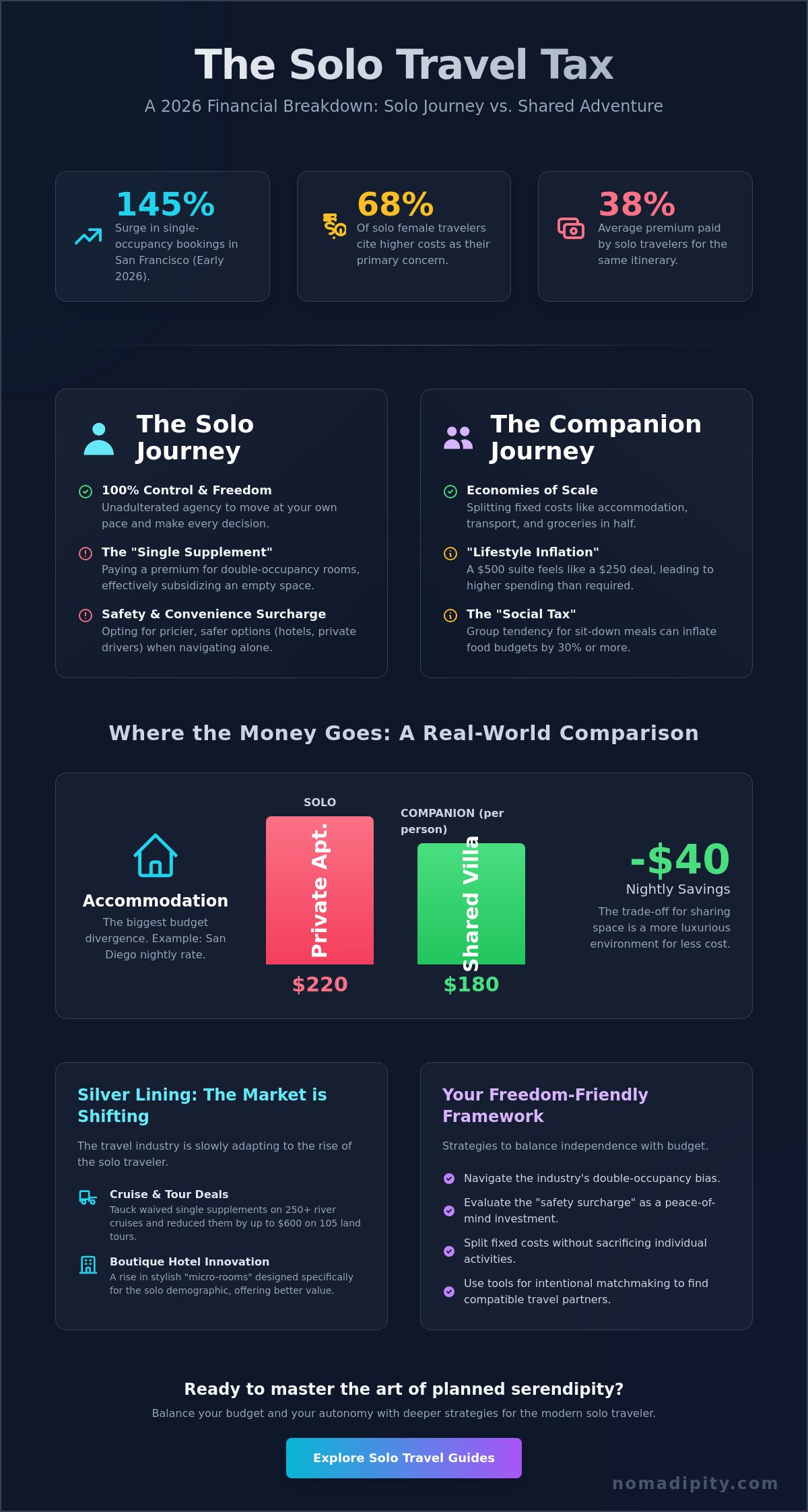
What if the true price of your independence wasn't a financial surcharge, but a missed opportunity for shared serendipity? You've likely felt the sting of the "single supplement" while booking a hotel in San Francisco, where single-occupancy bookings surged 145 percent in early 2026. It's frustrating to realize that the solo travel vs companion cost gap often forces you to pay for a second person who isn't even there. You value your freedom, yet 68 percent of solo female travelers now cite higher costs as their primary concern.
We believe your journey should be defined by authenticity rather than budget constraints. This article provides a strategic breakdown of the financial and intangible costs of wandering alone versus with a partner. You'll learn how to leverage 2026 industry shifts, such as Tauck waiving single supplements on over 250 European river cruises, to keep your budget intact. We'll also explore a framework for cultivating planned serendipity by connecting with like-minded travelers who share your specific travel style. By the end, you'll have a clear method to balance your craving for solitude with the logistical ease of a shared journey.
Key Takeaways
- Recognize how the travel industry's double-occupancy bias creates a hidden premium on your independence and learn to navigate these structural costs.
- Analyze the solo travel vs companion cost breakdown to identify where you can save on housing while avoiding the "lifestyle inflation" that often comes with group bookings.
- Evaluate the "safety surcharge" and mental load of solo navigation to determine when paying for extra security or logistical help is a wise investment in your peace of mind.
- Establish a "freedom-friendly" budget framework that lets you split fixed costs with a partner without sacrificing your individual choice of activities or meals.
- Explore tools for intentional matchmaking to find companions who match your hotel reward tiers and travel rhythm, turning logistical necessity into planned serendipity.
The Economics of Exploration: Why Solo Travel Costs More
The travel industry was built for the "Noah's Ark" model of existence. Everything moves in pairs. From hotel rooms to cruise cabins, the default setting is double occupancy, which leaves the independent traveler facing a financial penalty. This fee, commonly known as the single supplement, acts as a structural barrier for independent spirits. It's the hidden premium you pay for the privilege of not sharing your space. When you look at the solo travel vs companion cost, you aren't just paying for your bed; you're often subsidizing the empty half of the room.
Designing your trip around this financial reality requires a shift toward "planned serendipity." This isn't about rigid scheduling. It's about creating systems that allow for magical, unplanned moments while mitigating the "solo tax" through intentional choices. You shouldn't have to choose between your autonomy and your bank account. While the price of freedom is often higher, the emotional cost of missing out on shared laughter or a high-five at a summit is also a factor to weigh against your desire for solitude.
The Single Supplement: A 2026 Reality Check
The market is slowly waking up to the power of the solo traveler. On January 23, 2026, Tauck announced it would waive single supplements on more than 250 European river cruise sailings, specifically for Category 1 cabins. They also reduced supplements by up to $600 for 105 different land tour departures across Asia, Africa, and Latin America. Despite these welcome shifts, traditional resorts still lag behind boutique hotels that are increasingly designing "micro-rooms" for the solo demographic. Recent industry data from May 2026 indicates that solo travelers pay an average premium of 38 percent more for the same itinerary than those traveling in pairs.
Economies of Scale in Travel
When you travel with a companion, your daily budget breathes a sigh of relief. Fixed costs like Ubers from the airport, rental cars in the countryside, and bulk groceries for a week-long stay are suddenly cut in half. Solo travelers often find themselves paying a "convenience surcharge" just to stay safe. You might choose the $150 well-lit hotel over the $80 hostel in a remote alley, or opt for a private driver instead of navigating a complex bus system alone at night. These invisible costs add up quickly. You're essentially deciding if the 30 to 50 percent premium you pay is worth having 100 percent control over every turn you take. It's a trade-off between the efficiency of a shared tab and the pure, unadulterated agency of moving at your own pace.
Decoding the 'Solo Tax': Real-World Cost Comparisons
To truly understand the solo travel vs companion cost, we have to look past the stickers on the suitcase and examine the daily ledger. Travel spending generally rests on three pillars: housing, transport, and food. While going solo offers the ultimate freedom to eat cereal for dinner, it often lacks the "economies of scale" that a partnership provides. Interestingly, traveling with others can trigger "lifestyle inflation." You might never book a $500-a-night luxury suite on your own, but when split with a friend, that $250 price tag feels like a steal. You end up spending more for a higher standard of living than you actually required. There is also the "Social Tax" to consider. Solo travelers are more likely to grab a quick street-side snack; groups tend to gravitate toward sit-down meals and shared bottles of wine, which can inflate your food budget by 30 percent or more. For those looking to navigate these nuances, The Solo Travel Guide: Mastering the Art of Planned Serendipity in 2026 offers deeper insights into balancing your social life and your savings.
Accommodation: The Biggest Budget Divergence
In May 2026, the gap between solo and shared housing remains the most significant expense. A one-bedroom apartment in a central hub like San Diego might cost you $220 per night. Conversely, a shared two-bedroom villa with a pool often lists for $360. By splitting that cost, you pay $180 and gain a significantly more luxurious environment. However, you must weigh this against the "privacy premium." Is the $40 nightly saving worth the lack of a private sanctuary? To soften the blow of going it alone, savvy travelers use travel rewards programs to secure room upgrades or free nights, effectively neutralizing the solo surcharge. According to recent Solo Travel Statistics, these strategic maneuvers are becoming essential as solo travelers often face costs up to 50 percent higher than couples.
Transport and Tours: Splitting the Bill
Transport costs have a clear tipping point. If you're exploring a city with robust public transit, the cost difference is negligible. The moment you head into the countryside, the math shifts. A rental car, fuel, and parking fees are fixed costs. For a solo traveler, a $100-a-day car is a heavy lift, but for a pair, it's a manageable $50 each. Group tours also present a challenge because "per person" rates frequently hide a solo surcharge for the accommodation portion of the trip. To combat this, many travelers now look for "day-of" groups at local hostels or hubs to share the cost of a private driver or a specialized guide. If you're looking to bridge this gap without the hassle of cold-calling strangers, you might find a like-minded companion who shares your specific budget and pace through an intentional matchmaking community.
Beyond the Bill: The Logistics and Safety Premium
The price of solo exploration isn't always found on a receipt. It's often hidden in the choices you make to stay secure and sane. When calculating the solo travel vs companion cost, you must account for the "Safety Surcharge." This is the price you pay for peace of mind. For many, especially the 84 percent of solo travelers who are women, safety isn't a luxury; it's a non-negotiable expense. You might find yourself booking a $200 hotel in a bustling, well-lit district rather than a $90 alternative on the outskirts. This choice is often forced by the reality of hidden single supplement fees and the need for secure, central environments.
Then there's the "Mental Load." When you're solo, you're the sole CEO, navigator, and translator. There's no one to lean on when the train is canceled or the map doesn't match the street signs. This constant vigilance requires a larger emergency fund. You need a cash buffer for that last-minute $80 Uber when you feel unsafe, or the extra night in a hotel because you're too exhausted to navigate a new city. A companion acts as a living contingency plan, effectively reducing your need for expensive contingency funds.
Navigating the World Alone: The Energy Tax
Decision fatigue is a quiet thief of joy. After three weeks of choosing every meal, route, and accommodation alone, your brain gets tired. This "Energy Tax" can lead to expensive mistakes or missed opportunities for authenticity. Having a co-pilot to share the mental load allows you to look up from your phone and actually see the world you're exploring. Sharing the burden of navigating a complex foreign transit system, like the Tokyo subway or the London Underground, turns a stressful chore into a shared puzzle.
Safety and Serendipity
Risk mitigation has a direct line to your bank account. You'll likely opt for a $40 private transfer over a $5 night bus if you're alone in an unfamiliar city at 2 AM. Traveling with a buddy doesn't just split the bill; it opens doors to experiences that might feel too risky to attempt solo. It's a form of "friendship insurance." Having someone to watch your bags while you use the restroom or to call for help if you twist an ankle on a remote trail provides a level of security that money simply can't buy. This safety allows you to cultivate more adventurous moments, knowing you aren't navigating the risks entirely on your own.
The Companion Framework: Strategies for Splitting the Tab
Finding the right partner is about more than shared interests; it's about financial synchronization. Talking about money before you board the plane is non-negotiable. If you're a "flashpacker" who values boutique stays and your partner is a "budget backpacker" counting every cent, resentment will build faster than your frequent flyer miles. To navigate the solo travel vs companion cost effectively, you need a "Freedom-Friendly" splitting model. This means you share the big expenses like housing, but keep your daily food and activity spending entirely separate. This preserves the serendipity of your personal journey while slashing your accommodation bill by 50 percent. For a deeper dive into vetting your next partner, check out our Find a Travel Buddy: The Ultimate 2026 Guide to Shared Adventures.
By 2026, digital nomad culture has refined the art of the shared ledger. We no longer rely on messy spreadsheets or awkward "who-owes-who" conversations at the end of a trip. Modern expense-sharing apps allow you to log a shared taxi in real-time, instantly calculating the split based on current exchange rates. This transparency keeps the peace. It allows you to focus on the sunset in Santorini rather than the $15 you're owed for the airport shuttle.
Defining Your Travel Style
Resentment builds fast when budgets don't align. You must identify your financial "tribe" before booking. Are you looking for the luxury of a Hilton Diamond breakfast or the grit of a local guesthouse? If one partner has high-tier loyalty status, you can leverage those perks to save on shared costs like lounge access or room upgrades. It's also vital to include an "Alone Time" clause. Agreeing to spend 25 percent of your trip apart ensures you maintain your independence while still reaping the financial rewards of a shared journey.
Logistics of the Split
Agree on the "Big Rocks" first. These are your non-negotiables: the flights and the primary housing. Once those are settled, set a daily "slush fund" for shared incidentals like taxis, tips, and communal groceries. This fund prevents the "death by a thousand cuts" feeling of constant small transactions. Use apps with real-time currency conversion for international trips to avoid losing money on outdated exchange rates. If you're ready to stop overpaying for your independence, you can subscribe to our matchmaking community to find a partner who mirrors your budget and your wanderlust.
Designing Your Journey: Finding the Right Partner for Planned Serendipity
The choice between independent exploration and shared adventure doesn't have to be a permanent one. You can design a lifestyle that oscillates between both. When you look at the solo travel vs companion cost, it's clear that the right partner acts as a financial and emotional catalyst. Nomadipity.com isn't just another travel app; it's a premier social network built for intentional matchmaking. We believe that by setting up the right systems, you open the door to magical, unplanned moments. This is the essence of planned serendipity. You aren't just finding a body to fill the other half of a hotel room; you're cultivating a connection with someone who understands your rhythm.
Our platform allows you to filter potential companions by more than just their bucket list. You can find partners who hold specific hotel rewards or airline lounge access, turning a logistical mismatch into a strategic advantage. If you have Marriott Bonvoy Platinum status and they have an extra guest pass for an airport lounge, your shared journey becomes more luxurious without either of you spending an extra dime. It's about aligning your "Travel DNA" to create a trip that feels both seamless and authentic. Join Nomadipity.com to find your perfect travel match for 2026 and start designing a journey that reflects your values.
Beyond Matchmaking: Building a Global Network
The journey doesn't end with a single trip. Our group forums cater to niche communities like points hackers and slow travelers, allowing you to share wisdom and cultivate long-term connections. You might start by networking in airport lounges or through our social network for frequent flyers. This transition from a solo explorer to a member of a global nomad family provides a safety net that spans continents. It's about finding your tribe in a world that often feels designed for couples only. You gain access to a collective intelligence that makes location independence feel sustainable rather than exhausting.
The Nomadipity.com Advantage
Security and compatibility are our cornerstones. Every potential companion is vetted through a community-driven platform, ensuring you meet people who are as committed to intentional living as you are. We analyze interests, budgets, and affiliations to ensure your "Travel DNA" is a match. This reduces the friction that often plagues shared trips. Ultimately, travel is about the human connection as much as the landscapes. By choosing your companions with intention, you ensure that every dollar saved on the solo travel vs companion cost is invested back into a richer, more meaningful experience. The world is vast, but it feels much smaller when you're navigating it with a friend who shares your vision.
Cultivate Your Next Great Adventure
Finding the sweet spot between solitude and savings is a design challenge worth solving. You've seen how the solo travel vs companion cost dynamic impacts everything from your housing choices to your mental energy. While the financial tax on independence is a reality, it doesn't have to be a barrier to your exploration. By choosing partners who align with your budget style and rewards strategy, you turn logistical hurdles into opportunities for deeper connection and authentic discovery.
You don't have to manage the weight of navigation and safety surcharges alone. Whether you're seeking a fellow rewards hacker or a companion for a slow travel journey, the right network makes the unconventional feel attainable. Ready to split the cost and double the fun? Join Nomadipity.com today!
The world is vast and unpredictable, but it becomes much more manageable when approached with the right mindset and the right people. Start designing your next chapter with confidence.
Frequently Asked Questions
Is it always cheaper to travel with a companion?
No, traveling with others can actually trigger "lifestyle inflation" that negates the savings of splitting a room. While you share fixed costs, you might find yourself dining at more expensive restaurants or booking tours you wouldn't have chosen alone. Many travelers find their daily discretionary spending increases by 20 to 30 percent when they're matching a partner's pace rather than sticking to their own frugal habits.
How much is the average solo traveler supplement in 2026?
The average single supplement in 2026 remains a significant hurdle, with many solo travelers paying a 38 percent premium for the same itinerary as a couple. While some forward-thinking operators have started waiving these fees for specific dates, the majority of the industry still defaults to double-occupancy pricing. This structural bias is the primary reason the solo travel vs companion cost remains a top concern for independent explorers.
Can I save money on solo travel by using points and rewards?
Travel rewards are the ultimate equalizer for the independent spirit. By using credit card points for hotel stays, you effectively bypass the double-occupancy pricing models that penalize single guests. Strategic use of free night certificates can reduce your total accommodation budget by 100 percent for specific legs of your journey, allowing you to maintain your freedom without the financial sting of the solo tax.
What are the best apps for splitting travel expenses with friends?
Splitwise and Tricount remain the gold standards for keeping shared ledgers in 2026. These tools allow you to log expenses in real-time and settle up at the end of the trip using integrated payment platforms. For international adventures, look for apps that offer live currency conversion to ensure that a 50/50 split remains fair regardless of fluctuating exchange rates in the local market.
How do I find a travel companion who has the same budget as me?
Intentional matchmaking platforms are the most reliable way to find a partner with a matching financial "Travel DNA." You can filter for specific budget styles, such as "luxury" or "slow travel," to ensure your spending habits align before you even meet. This vetting process prevents the friction of mismatched expectations and allows you to design a journey built on mutual transparency and shared goals.
Is solo travel safer than traveling with a stranger from the internet?
Safety is subjective, but traveling within a community-vetted network often provides a higher level of security than wandering entirely alone. While 68 percent of solo travelers prioritize personal safety, having a verified companion offers a form of "friendship insurance" that money can't buy. A vetted partner can watch your bags or call for help, whereas solo travelers must rely entirely on their own vigilance in unfamiliar environments.
What happens if my travel companion and I have a falling out during the trip?
You should always establish an "Independence Clause" before the trip begins to protect your autonomy. This agreement allows either person to walk away and continue the journey solo without any hard feelings. It's essential to decide how you will handle pre-paid shared costs, such as a non-refundable rental, to ensure that a personal disagreement doesn't turn into a financial disaster for either party.
How do I negotiate costs if my partner has a much higher budget than I do?
Stick to a "Freedom-Friendly" model where you only split the "Big Rocks" like housing and transport. If your companion wants a five-star dinner while you prefer street food, you simply meet up afterward for a sunset drink. This approach allows you to balance the solo travel vs companion cost by sharing the most expensive logistical items while maintaining complete agency over your daily discretionary spending.

Disclaimer
Nomadipity Blog Disclaimer
The content on Nomadipity is provided for general informational and inspirational purposes only. While we strive for accuracy and timeliness, Nomadipity does not guarantee that any information is complete, current, or suitable for your specific needs. Use your judgment and verify details before making travel plans, meeting with other users in person, or making any purchases influenced by the article.


