

What if the greatest risk to your 2026 expedition isn't a missed flight or a dead phone battery, but the unspoken tension sitting across from you at dinner? You've likely felt that sudden, sharp anxiety when a mismatched budget or a dip in energy levels makes communicating with your travel companion feel like a chore rather than a connection. It's exhausting to feel like you're losing your autonomy just to keep the peace. You want to explore the hidden galleries, they want a four-hour nap, and suddenly, your shared dream feels like a heavy compromise.
This struggle doesn't have to define your journey. When you embrace the concept of planned serendipity, these friction points become the very catalysts that lead to your most authentic experiences. Whether you met through a $5 identity-verified matchmaking service or you've been friends for a decade, you deserve a trip where both parties feel heard and energized. This guide will show you how to master the delicate dance of travel dialogue, providing actionable strategies to handle stress and design a journey that fosters deep, lasting growth for both of you.
Key Takeaways
- Build a "No-Judgment Zone" before departure to align on the five essential pillars of a successful shared experience.
- Master the art of communicating with your travel companion through a five-minute "Daily Pulse Check" that keeps your energy levels and expectations in sync.
- Explore how "Parallel Play" allows you to maintain your personal autonomy while deepening your connection with your partner.
- Identify your specific "Stress Persona" and apply the HALT method to navigate inevitable travel friction with grace and clarity.
- Learn how selecting partners based on shared communication styles and values can turn potential conflicts into moments of planned serendipity.
The Foundation of Planned Serendipity: Why Communication Trumps Itineraries
Most travelers spend months obsessing over flight paths, hotel ratings, and local restaurant reviews, yet they often neglect the one variable that can actually sink a trip. Travel communication is the intentional exchange of needs, boundaries, and desires before and during a journey. It functions as the invisible architecture of your adventure. While a traditional itinerary tells you where to be at 10:00 AM, The Foundation of Planned Serendipity ensures you actually want to be there together. We define "Planned Serendipity" as the act of setting a robust communication framework that creates a safety net. This safety net allows for magical, unplanned moments to flourish because neither person is weighed down by unspoken resentment or hidden agendas.
In 2026, emotional intelligence is the most vital item in your suitcase. As AI-powered tools continue to compress our planning cycles and automate logistics, the human element has become the primary focus of modern exploration. Even a social network for frequent flyers requires its members to master the art of dialogue to sustain connections that last beyond the boarding gate. Mastering the skill of communicating with your travel companion is what separates a stressful vacation from a transformative journey of shared growth.
The Psychology of the "Travel Pressure Cooker"
Travel is a physiological and psychological disruptor. Lack of sleep, unfamiliar sensory inputs, and the constant navigation of foreign environments trigger our primal stress responses. Misaligned expectations are the root of 90% of travel fallouts, often stemming from a failure to discuss how individual autonomy shifts into shared decision-making. When you are abroad, you aren't just managing your own energy; you are navigating a shared ecosystem. You must recognize that your companion's "fight or flight" response might look different than yours when a train is missed or a reservation is lost.
Moving from Passive to Proactive Dialogue
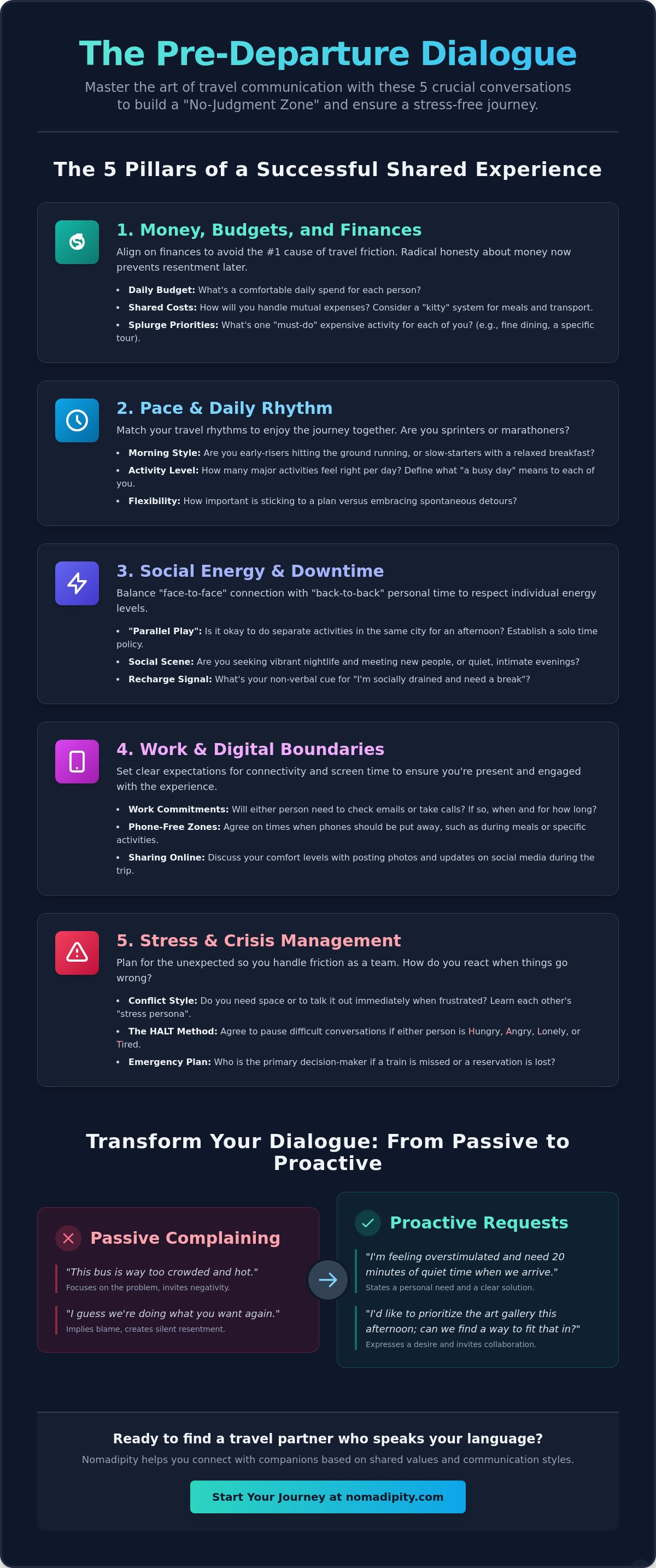
Success depends on your ability to differentiate between complaining and expressing a specific need. An intentional traveler understands that the relationship is just as important as the destination itself. To cultivate an open, non-judgmental atmosphere, try replacing passive-aggressive comments with clear requests. Consider these shifts in perspective:
- Passive: "This bus is way too crowded and hot."
- Proactive: "I am feeling overstimulated by the crowd and need twenty minutes of quiet time once we reach the hotel."
- Passive: "I guess we're doing what you want again."
- Proactive: "I'd like to prioritize the art gallery this afternoon; can we find a way to fit that in?"
By moving toward proactive dialogue, you design a trip based on mutual respect rather than silent compromise. This level of transparency is the only way to navigate the complexities of modern travel while keeping your connection intact. When you prioritize communicating with your travel companion as a foundational skill, you stop merely surviving the trip and start cultivating a shared legacy of adventure.
The Pre-Departure Dialogue: 5 Crucial Conversations to Have Now
Before you even zip your suitcase, you need to establish a "No-Judgment Zone." This is a dedicated, safe space where you and your partner can speak with radical honesty about your expectations for the journey ahead. It's incredibly tempting to be "polite" during the early planning stages to avoid friction, but politeness is often the precursor to deep-seated resentment once you're on the ground. If you find a travel buddy through a digital platform, this step is even more vital. You don't have years of shared history to fall back on, so you must build your communication foundation from scratch. Effectively communicating with your travel companion involves addressing five specific pillars: finances, pace, work-life boundaries, social energy, and crisis management.
Money, Budgets, and the "Kitty" System
Money is the most common friction point in any shared adventure. Don't wait until you're standing in front of a $100 tasting menu in Tokyo to realize your budgets are miles apart. Discuss your daily spending caps, your "must-splurge" items, and even your tipping philosophies. As of May 2026, digital tracking apps have made it easier than ever to avoid the "I'll get the next one" trap, which frequently leaves one person feeling financially slighted. Agree on your financial dealbreakers early, such as the choice between a social hostel or a boutique hotel, to ensure no one feels pressured into spending beyond their comfort level.
The "Pace of the Day" and Energy Management
Are you a 6:00 AM sunrise chaser or a 2:00 AM jazz club enthusiast? Finding a middle ground is about respecting energy cycles rather than forcing a shared schedule. We suggest the "One Big Thing" rule. Each person picks one non-negotiable activity per day, and the rest of the time is kept intentionally flexible. This balances the FOMO (Fear Of Missing Out) of the over-planner with the JOMO (Joy Of Missing Out) of the slow traveler. It creates the space for planned serendipity to occur, allowing you to breathe between scheduled events without feeling rushed.
Digital Nomadism: Work Hours vs. Wander Hours
This is the gap most traditional travel guides completely miss. If you're balancing a career with your travels, you must set clear boundaries around Slack notifications and deep work blocks. Communicating the need for reliable Wi-Fi before booking a remote, "off-grid" adventure is a logistical necessity, not an afterthought. Respect the "office" space, even if that office is just a corner of a beach club in Bali. If you want to find a partner whose professional rhythm matches your own, you can explore our travel matchmaking subscriptions to cultivate a connection with someone who values location independence as much as you do.
The Daily Rhythm: Navigating 'Face-to-Face' vs. 'Back-to-Back' Time
Once you're on the ground, the abstract plans you made in your pre-departure dialogue meet the reality of 20,000-step days and intense cultural immersion. This is where the cadence of your connection truly matters. We categorize travel time into two distinct types: face-to-face time, where you're actively engaged with one another, and back-to-back time, where you share a physical space but focus on your own internal worlds. Mastering the balance between the two is the secret to longevity on the road. It's about finding comfort in the silence between the sights.
Implementing a "Daily Pulse Check" is the simplest way to keep your rhythm steady. This is a five-minute sync, perhaps over a morning espresso or a late-night glass of wine, to assess energy levels and emotional states. Are you feeling like a four out of ten today? Say it. This transparency allows for planned serendipity; by knowing your limits, you can leave intentional gaps in the day for quiet reflection or spontaneous solo walks. Don't underestimate the power of "Parallel Play" as a travel superpower. Sitting at the same Parisian cafe, one person reading a novel while the other edits photos, allows you to recharge without the pressure to perform or entertain.
Similarly, you must normalize the "Solo Sabbatical." Taking four hours or even a full day apart to explore different neighborhoods isn't a sign of a failing connection; it's a vital tool for communicating with your travel companion that you value your own autonomy as much as the shared experience. These gaps in the day often lead to the most authentic stories you'll tell later that night.
The "Deal of the Day" Strategy
Decision fatigue is a real threat to travel harmony, often leading to a 30% increase in minor bickering during the late afternoon "slump." To combat this, adopt the "Deal of the Day" strategy where you alternate who makes the "snap decisions" each day. This includes everything from which alleyway to turn down to where to grab a quick lunch. This relieves the constant mental load of negotiation and encourages the "non-planner" to occasionally take the lead. You'll often find that the less-structured partner discovers hidden gems that weren't on any AI-generated itinerary.
Communicating the Need for Space
Saying "I need to be alone" can feel jarring if you haven't established the language for it beforehand. Use gentle, scripted phrases like, "I'm hitting my social limit and want to do some solo wandering until our 7:00 PM reunion." Recognizing the signs of social burnout, such as irritability or glazed eyes, is a skill you must cultivate. By setting a firm "reunion time" to share your solo discoveries over dinner, you turn your time apart into fresh fuel for your connection, ensuring the trip remains a journey of shared growth rather than shared exhaustion.
Navigating the Storm: How to Resolve Conflict Without Ruining the Vibe
Even the most meticulously designed journeys will eventually encounter a moment of friction. Conflict on the road isn't a sign of a failed trip; it's a natural byproduct of the travel pressure cooker we discussed earlier. The secret to communicating with your travel companion during these high-stakes moments is understanding your specific "Stress Persona." Most people fall into one of three categories when pushed to their limit: the runner, who seeks immediate physical distance; the fighter, who wants to resolve the issue through immediate, often heated debate; or the freezer, who shuts down emotionally to process the overwhelm. Recognizing your own pattern, and that of your partner, prevents a minor disagreement from spiraling into a trip-ending fallout.
Before you engage in a difficult conversation, apply the "HALT" method. This psychological staple suggests you should never discuss a conflict when you are Hungry, Angry, Lonely, or Tired. In a 2025 survey of long-term travelers, nearly 70% of respondents admitted that their most intense arguments occurred during the "late afternoon slump" when blood sugar was low and physical fatigue was high. If you find yourself reaching a breaking point, use a pre-agreed "Safety Word." This is a neutral, often humorous word that signals an immediate need for a de-escalation break, no questions asked. It allows both parties to step back before saying something they might regret.
When you are ready to talk, lean heavily on "I" statements. Instead of accusing your partner with "You're moving too fast," try saying, "I feel overwhelmed when we have three museum tours in one morning." This shifts the focus from blame to personal needs, making it easier for your companion to hear you without getting defensive. If you want to ensure your next partner has a compatible conflict style from day one, sign up for our travel matchmaking subscriptions to find a companion who shares your values.
Lounge Diplomacy: Using Perks to Pivot
Environment dictates the quality of your resolution. Trying to settle a budget dispute on a crowded, noisy subway platform is a recipe for disaster. Instead, practice "Lounge Diplomacy." Seek out the quiet corner of a hotel bar or use an airport lounge pass to find a space with lower sensory input. The physical comfort of a soft chair and a controlled environment naturally lowers cortisol levels, making it significantly easier to navigate heavy topics with clarity and grace. Once the issue is resolved, use a "Reset Button" ritual, like a shared dessert or a specific song, to signal that the argument is officially over and the vibe is restored.
Cooling-Off Periods and the "24-Hour Rule"
Sometimes, the best way of communicating with your travel companion is to stop talking for a while. Adopt the "24-Hour Rule," which dictates that what is said in a moment of extreme travel-exhaustion does not define the friendship or the future of the trip. Give each other the grace to walk away and cool off. An effective apology on the road should be authentic and specific; acknowledge the impact of your stress response and focus on how to adjust the rhythm moving forward. This proactive approach turns every storm into an opportunity for deeper connection and shared resilience.
Cultivating Connection: How Nomadipity.com Simplifies the Conversation
You've navigated the psychology of travel stress and mastered the daily pulse check. Now, the question remains: how do you find the right person to practice these skills with? Nomadipity.com isn't just a directory; it's a sophisticated matchmaking system designed to filter for the nuances that actually matter. By prioritizing "Communication Style" and "Travel Values" from the very first click, we remove the guesswork that often leads to mid-trip friction. A detailed traveler profile acts as your digital handshake, setting clear expectations regarding budgets, work hours, and energy levels before you even send your first message. This level of transparency is the first step in communicating with your travel companion with clarity and purpose.
The Nomadipitian community functions as a living mentor network. Here, seasoned digital nomads and slow travelers share the wisdom they've gained from thousands of miles and dozens of partners. You aren't just joining a platform; you're entering a culture that values depth over speed and authenticity over aesthetic. For those seeking an extra layer of security, our $5 identity verification through Veriff provides peace of mind in an unpredictable world. This ensures that the person you're planning with is exactly who they claim to be, allowing you to focus on the excitement of the journey ahead.
Matchmaking Beyond the Itinerary
Shared interests are the starting point, but shared language is the goal. When you align on affiliations like specific hotel rewards or airline tiers, you create an immediate baseline of logistical understanding. Our group forums offer a unique space to observe how potential partners interact in threads, allowing you to vet their tone and responsiveness in a low-stakes environment. Essentially, a find a travel buddy search is actually a search for a compatible communicator who understands the ebb and flow of life on the road. This intentionality makes communicating with your travel companion feel like a natural extension of your friendship rather than a constant series of negotiations.
Your Next Step in Planned Serendipity
Travel remains the ultimate test of human connection. It exposes our vulnerabilities, our strengths, and our capacity for growth. You are now equipped with the tools to handle the stress, the silence, and the serendipity of the road. Don't leave your next experience to chance. It's time to design your next adventure with a partner who truly "gets it" and values the art of the shared journey as much as you do. Join Nomadipity.com and find your perfectly matched travel companion today.
Your Next Chapter of Shared Exploration
The art of discovery isn't just about the miles you cover; it's about the quality of the connection you maintain along the way. By establishing a "No-Judgment Zone" before you leave and mastering the "Daily Pulse Check," you turn potential friction into fuel for your journey. You've learned that communicating with your travel companion is a proactive skill, involving everything from setting financial dealbreakers to identifying your specific stress persona. These systems don't restrict your freedom. They create the essential architecture for planned serendipity to occur throughout your 2026 adventures.
Now that you have the tools, it's time to find the right partner to use them with. Nomadipity offers a unique space for location-independent explorers and rewards members to connect within an exclusive community. Our matchmaking system filters through 15+ travel compatibility factors to ensure your values and rhythms align before the first flight is booked. This intentional approach is designed for the modern landscape of travel, where human connection is the ultimate luxury.
Design your next journey with a partner who speaks your travel language. Join Nomadipity.
The world is vast and full of unexpected magic. Go find it with someone who makes the journey even better.
Frequently Asked Questions
How do I tell my travel partner I need alone time without being rude?
State your need for space clearly and frame it as a way to recharge for your shared time later. Use a simple script like, "I'm going to take two hours for a solo wander to recharge; let's meet back at the fountain at 4:00 PM." This prevents the other person from feeling rejected while ensuring you maintain your personal autonomy during the trip.
What should we do if we realize our budgets are completely different mid-trip?
Initiate an immediate, transparent budget audit to find a sustainable middle ground before resentment builds. According to a 2025 financial survey, 30% of travel arguments are rooted in mismatched spending. Agree to alternate between low-cost local street food and the occasional splurge meal to ensure both partners feel their financial boundaries are respected without sacrificing the experience.
How often should we check in about how the trip is going?
Perform a brief check-in every 24 hours to prevent small frustrations from snowballing into major conflicts. Consistency is the most effective tool when communicating with your travel companion. A five-minute morning sync allows you to adjust the day's pace based on current energy levels, ensuring the itinerary remains a flexible guide rather than a rigid set of rules.
What is the best way to handle a "planner" vs. "go-with-the-flow" dynamic?
Delegate specific days where each partner takes the lead on decision-making. The planner can design the schedule for Monday, while the go-with-the-flow partner chooses the direction for Tuesday. This rotation reduces decision fatigue and ensures both travel styles are honored. It allows the planner to relax and the spontaneous traveler to practice taking more responsibility for the group's logistics.
Can a travel companion app really help with communication?
Yes, a matchmaking app can significantly improve the experience by pre-filtering for compatible communication styles and travel values. By communicating with your travel companion through a platform that requires detailed profiles, you establish expectations before the trip begins. This data-driven approach reduces the likelihood of personality clashes that occur when travelers are matched based solely on destination interests rather than lifestyle habits.
What are the biggest "red flags" in a travel partner’s communication style?
The biggest red flags include the frequent use of the silent treatment and a persistent refusal to use "I" statements. If a partner relies on passive-aggressive comments rather than stating needs, it indicates a lack of emotional intelligence. Industry data from 2025 suggests that 75% of travel fallouts stem from these avoidant behaviors, which are difficult to resolve in the high-pressure environment of a foreign country.
How do we handle work-life balance if only one of us is a digital nomad?
Establish "Deep Work" blocks that are respected as sacred office hours, even in a holiday setting. The working partner should provide a clear schedule of when they will be "online" versus "offline." This allows the non-working partner to plan their own solo activities without feeling ignored. Clear boundaries prevent the vacationer from feeling lonely and the nomad from feeling guilty about their professional commitments.
Is it better to travel with a close friend or a new companion found online?
Traveling with a new companion found online often allows for clearer boundary setting because there is no pre-existing baggage. A 2025 study showed that 40% of travelers felt more comfortable stating their needs to a new partner than a long-term friend. While friends offer comfort, a new companion matched through a specialized service is often more intentional about maintaining the health of the travel relationship from day one.

Disclaimer
Nomadipity Blog Disclaimer
The content on Nomadipity is provided for general informational and inspirational purposes only. While we strive for accuracy and timeliness, Nomadipity does not guarantee that any information is complete, current, or suitable for your specific needs. Use your judgment and verify details before making travel plans, meeting with other users in person, or making any purchases influenced by the article.


