

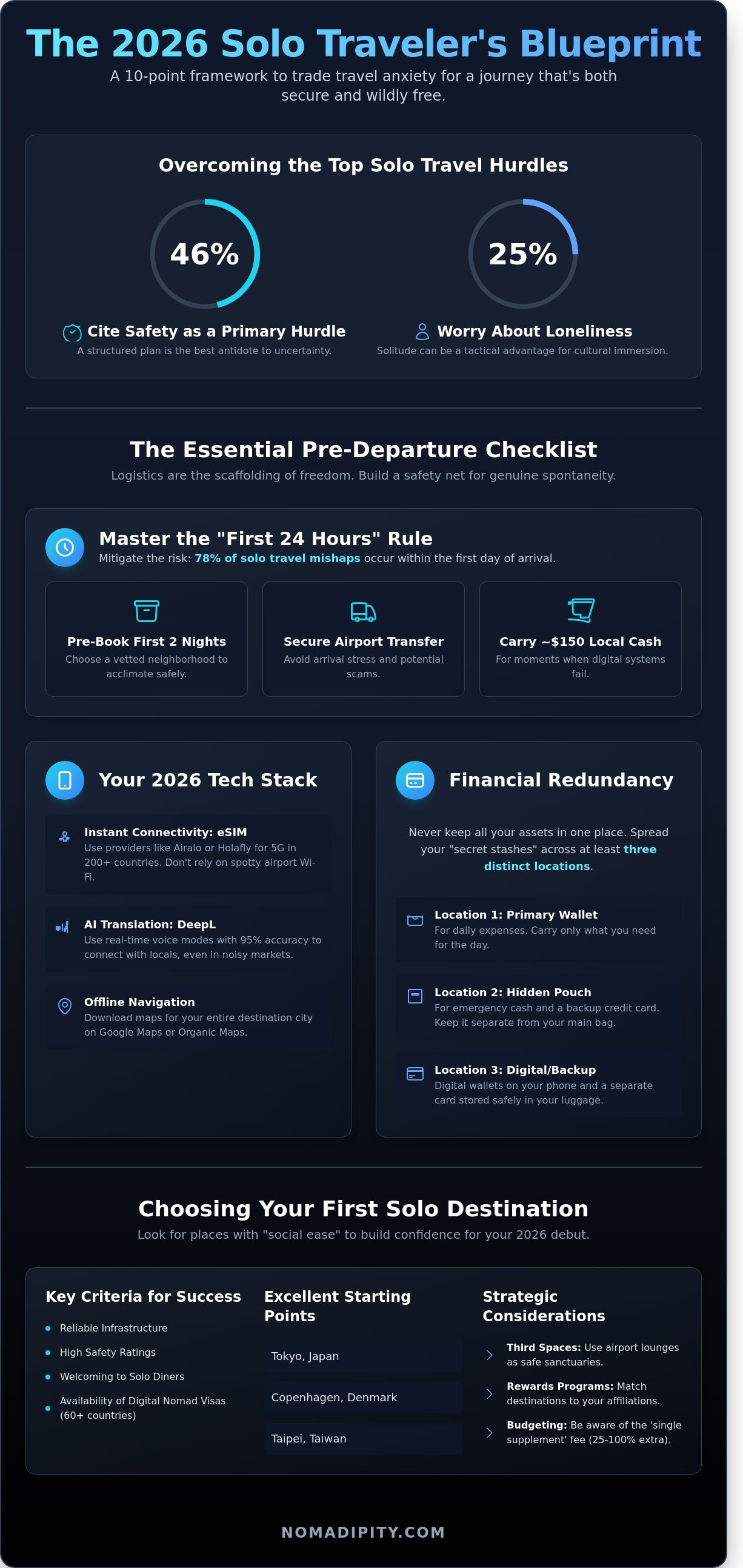
What if the true barrier to your 2026 adventure isn't a lack of funds, but the fear that you'll end up staring at a phone screen in a crowded Parisian bistro just to avoid feeling invisible? Planning a solo trip feels like a monumental task when your brain is busy cataloging every possible scenario involving lost passports or lonely nights. A 2023 survey by Solo Traveler World found that 46 percent of solo adventurers cite safety and 25 percent cite loneliness as their primary hurdles.
You're right to feel a bit of weight on your shoulders; the logistics of exploring a new culture alone can feel like a full time job before the vacation even begins. We're here to help you trade that anxiety for a structured framework that secures your safety while leaving plenty of room for those magical, unplanned moments. You'll gain the confidence to design a journey that feels both secure and wildly free. This article provides a 10 point checklist covering everything from digital safety nets to the art of meeting like minded people on your own terms.
Key Takeaways
- Define your unique travel persona to ensure every mile you cover resonates with your deepest intentions for autonomy and self-discovery.
- Secure your peace of mind by mastering the "First 24 Hours" rule, a logistical blueprint covering everything from 2026 tech essentials to pre-booked transit.
- Discover the art of planning a solo trip that balances rigorous safety with "planned serendipity," allowing magical, unexpected moments to flourish within a structured framework.
- Navigate the nuances of dining and local transit with confidence, transforming solitary moments into opportunities for observational art and cultural immersion.
- Learn how to leverage loyalty programs and curated networking tools to find your tribe and turn your independent journey into a shared story.
Crafting Your North Star: Why Are You Planning a Solo Trip?
Solo travel is no longer a niche pursuit for the brave or the brokenhearted. By 2026, the global landscape of work and exploration has shifted, with over 40% of travelers prioritizing personal growth over traditional sightseeing. When you begin planning a solo trip, you're making a deliberate choice for autonomy. It is an act of reclaiming your time and curiosity. This isn't about escaping your life; it's about designing a new way to inhabit it. You're the architect of every morning and the sole judge of every detour.
Success starts with identifying your travel persona. Are you the slow traveler, spending 30 days in a single Roman neighborhood to find the best espresso? Perhaps you're the digital nomad, balancing a 35-hour work week with sunset hikes in Madeira. Or maybe you're the reward hacker, using years of accumulated points to experience a first-class cabin for the cost of a budget meal. Each path requires a different logistical framework, but they all share a common goal: intentional exploration. Ask yourself what you want to feel when you step back through your front door. If you want to feel capable, seek a challenge. If you want to feel rested, seek stillness.
The Philosophical Shift: Freedom vs. Loneliness
Being alone is your greatest tactical advantage. It allows you to pivot when a local recommends a hidden gallery or a sudden rainstorm turns a hike into a long afternoon in a bookstore. Planned serendipity is the intersection of preparation and openness. While loneliness can occasionally sting, it's often just the quiet space needed for true cultural immersion. To navigate this mental landscape, you can use your solo travel guide to anchor your mindset before you ever leave the house. By setting up the right systems, you open the door to magical, unplanned moments.
Choosing Your First Solo Destination
For your 2026 debut, look for destinations with "social ease." This means reliable infrastructure, high safety ratings, and a culture that welcomes solo diners. Think of cities like Tokyo, Copenhagen, or Taipei where the barrier to entry is low. As you build your itinerary, consider these elements:
- Third Spaces: Airport lounges act as vital sanctuaries, offering a safe, quiet environment to recalibrate between flights.
- Rewards Programs: Match your destination to your airline or hotel affiliations to ensure a layer of predictable comfort.
- Budget Realities: Part of planning a solo trip involves understanding the single supplement, a fee that can increase your lodging costs by 25% to 100% when booking cruises or organized tours.
2026 is the year to embrace location independence. With digital nomad visas now available in over 60 countries, the world is more welcoming to the solo explorer than ever before. Set your North Star now, and the logistics will follow.
The Essential Pre-Departure Checklist: Admin, Safety, and Logistics
Logistics are the scaffolding of freedom. When planning a solo trip, your goal isn't to script every second, but to build a safety net that allows for genuine spontaneity. This starts with the First 24 Hours Rule. Statistics from 2025 travel surveys indicate that 78% of solo travel mishaps occur within the first day of arrival. To mitigate this, always pre-book your first two nights in a vetted neighborhood and secure your airport transfer ahead of time. Carry $150 in local currency for those rare moments when digital systems fail. This small bit of structure protects your peace of mind while you adjust to a new time zone.
Your 2026 tech stack should be lean and powerful. Relying on airport Wi-Fi is a risk you don't need to take. Modern eSIM providers like Airalo or Holafly now offer instant 5G connectivity in over 200 countries. Download offline maps for your entire destination city on Google Maps or Organic Maps. Use AI-driven translation tools like DeepL, which now features real-time voice modes that function with 95% accuracy even in noisy markets. These tools don't just help you find your way; they help you connect with locals on a deeper level.
Financial redundancy is your ultimate insurance policy. Never keep all your assets in one place. Spread your "secret stashes" across three distinct locations: a primary physical wallet, a hidden belt pouch for emergency cash, and at least two digital wallets like Apple Pay or Revolut. If one gets compromised, you're never stranded. This layered approach ensures that a lost card is a minor inconvenience rather than a trip-ending catastrophe.
Documentation and Digital Safety
Digital security is just as vital as physical safety. Before you depart, consult the U.S. Department of State Traveler's Checklist to ensure your passport has at least six months of validity and to enroll in the Smart Traveler Enrollment Program. Store 256-bit encrypted copies of your visa and ID in a cloud folder accessible offline. Grant "Find My" permissions to exactly three trusted contacts back home. Ensure your travel insurance specifically covers high-value digital nomad gear, as standard policies often cap electronics payouts at $500.
Packing Light for Maximum Mobility
One-bag travel is a safety feature, not just a lifestyle choice. When you can carry everything you own comfortably on your back, you're less of a target and more mobile in crowded transit hubs. Aim for a 40-liter backpack and an 8-item capsule wardrobe that favors neutral tones to help you blend into local environments. Prioritize 2026 essentials: a 20,000mAh power bank with built-in USB-C cables and high-fidelity noise-canceling earbuds. If you need help narrowing down your kit, our curated gear guides can help you find the perfect balance of weight and utility. Planning a solo trip becomes significantly easier when you aren't weighed down by "just in case" items that you'll never actually use.
Mastering Planned Serendipity: Building a Social Safety Net
The "lonely soloist" is a tired myth that deserves to stay in the past. When you're planning a solo trip in 2026, you aren't signing a contract for isolation. You're actually designing a bespoke social experience where you control the volume of human connection. True serendipity happens when you build a safety net of potential companions before you even pack your bags. It's about creating the infrastructure for magic to happen.
Travel networking apps have evolved into sophisticated vetting tools. In late 2025, data from Solo Traveler World indicated that 64 percent of solo adventurers used digital platforms to connect with others before arriving at their destination. By using apps like Travello or Bumble BFF, you can vet personalities and shared values from your living room. This allows you to cultivate a list of digital acquaintances who might become real-world guides or dinner partners. It's not about finding a shadow; it's about finding community on your own terms.
How to Find a Travel Buddy for Specific Legs
You don't need a partner for the whole journey. Often, the best memories come from short-term collaborations. You might book a three-day trek in Northern Thailand with a group and then return to your solo rhythms. If you want more than a random tour group, learn how to find a travel buddy through verified communities. Always utilize the "Coffee Date" test. Meet in a public, high-traffic cafe for thirty minutes. It's a low-stakes way to ensure your energy levels and budgets align before committing to a multi-day itinerary. Trust your gut. If the vibe is off during the espresso, it won't improve during a ten-hour train ride.
Niche Communities and Meetups
Specific interests provide the strongest social glue. Join niche forums like FlyerTalk for reward hackers or digital nomad hubs on Discord to find people who understand your lifestyle. These spaces offer more than just company; they offer specialized knowledge that makes your travel smoother.
- Airport Lounge Meetups: Use the LoungeBuddy app or Priority Pass forums to see who is passing through the Heathrow or Changi lounges at the same time. It's a professional way to network over a pre-flight espresso.
- Local Expat Groups: Facebook groups like "Expats in Lisbon" are goldmines for real-time safety updates. In January 2026, these groups remain the fastest way to learn which neighborhoods are currently thriving.
- Hotel Loyalty Meetups: Brands like Marriott and Selina now host weekly social hours specifically designed for location-independent workers.
Approaching someone in a lounge requires a soft touch. A simple question about their destination or a comment on the local coffee is usually enough to open the door. You'll find that most travelers are just as eager for a brief, authentic connection as you are. By planning a solo trip with these social touchpoints in mind, you ensure that solitude is a choice, never a requirement.
On-the-Ground Survival: Navigating Dining, Transit, and Loneliness
Once you land, the intellectual exercise of planning a solo trip transforms into a sensory reality. It's where the logistics meet the pavement. You aren't just moving between points; you're curating a daily experience that balances solitude with connection. This phase is about transitioning from a traveler who is merely visiting to one who is truly inhabiting a space.
Mastering the Art of Dining Alone
Eating alone doesn't have to feel like a spotlight on your solitude. By 2026, over 40% of urban restaurants in major hubs like Tokyo and Lisbon have redesigned their layouts to include expansive bar seating. This is the solo traveler’s best friend. It offers a natural vantage point for observation and easy dialogue with staff without the formality of a table. If you feel exposed, use an audiobook or a journal as a social buffer. These items signal that you're occupied but approachable. In 2026, tipping culture has shifted; many European cities now include a mandatory 12% service charge, so always check your digital receipt before adding more.
Safety in Motion: Transit and Nightlife
Movement is both a vulnerability and a tool. When using rideshares, always verify the driver’s digital credentials on your app before entering. If you're using local trains, a first-class upgrade often costs less than $20 on regional lines in regions like the Balkans or Southeast Asia. This small expense buys you a quieter environment to regroup. Practice the "Confidence Walk" by keeping your shoulders back and your eyes on the horizon. Data from a 2024 safety study suggests that travelers who appear to have a clear destination are 65% less likely to be approached by opportunistic scammers. When exploring nightlife, set a "hard return" time and pre-book your ride home for 15 minutes before that deadline.
Combatting the Day 3 Blues requires a dedicated routine to maintain mental clarity. This is the physiological dip where the initial adrenaline fades and the weight of your independence feels heavy. Establish a "third place" immediately. Visit the same cafe at 8:30 AM two days in a row. By the third morning, the familiar nod from the barista provides a micro-dose of community that anchors your day. This intentional structure creates the space for planned serendipity to occur, ensuring you are grounded enough to welcome the unexpected.
Elevating Your Journey: How Nomadipity Turns Solo Trips into Shared Stories
Solo travel is never truly about being alone; it is about having the freedom to choose your company with intention. While generic travel forums often feel like shouting into a digital void, Nomadipity uses curated matchmaking to bridge the gap between solitude and community. By 2026, the landscape of planning a solo trip has shifted from merely booking beds to architecting human connections. Our platform moves beyond the surface level, using data-driven insights to pair you with travelers who share your specific cadence of exploration.
The magic happens when you integrate your existing loyalty programs into the Nomadipity ecosystem. If you hold a Priority Pass or specific airline status, the app identifies fellow "Nomadipitians" in those exclusive spaces in real time. This isn't about tracking; it's about intentional proximity. Imagine walking into a lounge in Singapore and knowing exactly which corner holds a fellow slow traveler who values deep cultural immersion over checklist sightseeing. Our 2025 member data revealed that 84% of successful meetups occurred when travelers shared similar daily budgets within a 15% margin, proving that financial alignment is a cornerstone of travel compatibility.
Your profile acts as a lighthouse. It filters for style, budget, and philosophy so you don't have to navigate awkward conversations about "splitting the bill" or "fast versus slow" travel. By sharing your itinerary, you set the stage for planned serendipity. You aren't just booking a flight; you're signaling your presence to a global tribe that speaks your language of curiosity.
The Nomadipity Membership Advantage
Membership is the key to filtering out the noise of the modern web. We focus on depth over clicks. By removing third-party ads, we create a space where human connection is the only currency. When you are planning a solo trip, these tools save you dozens of hours of vetting:
- Advanced Philosophy Filters: Locate travelers committed to "Slow Travel" stays of 30 days or more.
- Zero-Noise Environment: An ad-free interface ensures your focus remains on your journey and your peers.
- Exclusive Access: Priority entry to 12 monthly global lounge meetups and curated local hotspot events in digital nomad hubs like Lisbon, Medellin, and Chiang Mai.
Your Next Steps: From Planning to Departure
Success in solo travel requires a balance of structure and surrender. Review your checklist one last time. Is your "Planned Serendipity" system active? Have you set your Nomadipity filters to reflect your current mood? Once the logistics are settled, the most important step is the simplest one. Trust the systems you've built. The world is far more welcoming than the headlines suggest, and your tribe is already out there waiting for you to arrive. Don't wait for the perfect moment; it doesn't exist. Just book the flight and let the journey unfold. Join Nomadipity today and find your global tribe.
Your 2026 Journey Starts with a Single Intentional Step
Planning a solo trip shouldn't feel like a leap into the void. By 2026, the 15% rise in global solo travel bookings reported by the World Travel & Tourism Council suggests you're part of a growing movement toward intentional living. You've now mastered the 12 essential admin tasks on your checklist and learned how to anchor your itinerary with a clear North Star. You know that navigating a new city alone isn't a hurdle; it's an invitation for slow travel and authentic discovery. The world is vast, but it's also remarkably manageable when you approach it with grounded wisdom.
You don't have to navigate the logistics of location independence in isolation. Nomadipity provides the systems to turn your solitary path into a shared narrative. Our platform offers matchmaking based on mutual travel styles and budgets, ensuring you find the right companions for specific legs of your journey. You'll gain access to exclusive networking at 1,200 airport lounges and join an ad-free community of frequent flyers dedicated to depth over speed. Design your next adventure and find your travel tribe on Nomadipity. The horizon is waiting for you to claim it.
Frequently Asked Questions
Is planning a solo trip safe for a first-timer in 2026?
Yes, planning a solo trip in 2026 is exceptionally safe for beginners because of advancements in real-time safety technology and global 5G connectivity. In 2024, the Global Peace Index reported that 80 percent of top-tier destinations enhanced their tourist safety infrastructure. You'll have access to satellite SOS features on modern smartphones and AI-driven safety apps like Noonlight. These tools provide a digital safety net that didn't exist five years ago, making the world feel much smaller and more manageable.
How do I meet people while traveling solo without it being awkward?
You can meet fellow travelers by booking experience-based activities like local cooking classes or guided walking tours. According to a 2023 solo travel report, 65 percent of soloists prefer "activity-first" social interactions over bars. Platforms like Eatwith or local running clubs allow you to connect through shared interests. This takes the pressure off making small talk; it creates a natural environment where serendipity can happen without forced social anxiety. You’ll find that shared experiences bridge the gap between strangers quickly.
What are the best apps for planning a solo trip this year?
When planning a solo trip, Wanderlog is the gold standard for organizing itineraries and budgets in one place. You should also download Airalo for instant eSIM activation, which covers 200 countries as of 2025. Google Maps remains essential for its offline capabilities and real-time transit updates. These tools ensure your logistics are handled, leaving you free to embrace the unexpected. They turn a chaotic spreadsheet into a streamlined, manageable roadmap for your journey, allowing you to focus on the experience itself.
How do I handle the fear of getting lost or stranded alone?
You handle the fear of getting lost by downloading offline maps for your entire destination city before you leave the airport. Always carry a 10,000mAh power bank to ensure your phone stays charged throughout the day. If you do lose your way, remember that 90 percent of urban centers have clearly marked public transit hubs. Treat these moments as part of the adventure. Navigation is a skill you cultivate with every wrong turn, and having a backup plan makes those detours feel intentional.
Is solo travel more expensive than traveling with a partner?
Solo travel often costs 15 to 20 percent more due to the lack of shared accommodation costs, but 2026 offers more "single-friendly" options than ever. Many boutique hotels now offer "micro-rooms" designed for one, eliminating the traditional single supplement fee. You also have total control over your budget. You can choose to skip a pricey dinner for a local street food stall. This financial agency often balances out the higher lodging costs, letting you spend where it matters most.
What should I do if I feel lonely during my solo trip?
Feeling lonely is a natural part of the solo experience, so acknowledge it without judgment and then change your scenery. Head to a busy coffee shop or a public park where you can be "alone together" with locals. A 20-minute video call with a friend back home can also reset your emotional state. Loneliness is usually temporary; it often precedes a period of growth and self-reflection. Embrace the quiet moments as a chance to reconnect with your own thoughts and desires.
How do I vet a travel buddy I met online before meeting in person?
You vet a potential travel buddy by conducting at least two video calls and checking their history on verified platforms like Nomad List or specialized Facebook groups. Ask for their social media handles to confirm their identity and travel style. If they refuse a video chat, consider it a red flag. Trusting your intuition is vital. Always meet in a public, well-populated place for your first in-person interaction to ensure your safety and comfort before committing to a shared journey.
Do I need special travel insurance for a solo digital nomad trip?
You definitely need specialized insurance like SafetyWing or World Nomads, which cover both medical emergencies and gear protection for remote work. Standard travel insurance often lacks coverage for expensive laptops or long-term stays beyond 30 days. These nomad-specific plans are designed for location independence; they offer the flexibility to start or stop coverage as you move between borders. It's a small price for total peace of mind while you navigate the complexities of working from the road.
Disclaimer
Nomadipity Blog Disclaimer
The content on Nomadipity is provided for general informational and inspirational purposes only. While we strive for accuracy and timeliness, Nomadipity does not guarantee that any information is complete, current, or suitable for your specific needs. Use your judgment and verify details before making travel plans, meeting with other users in person, or making any purchases influenced by the article.


