

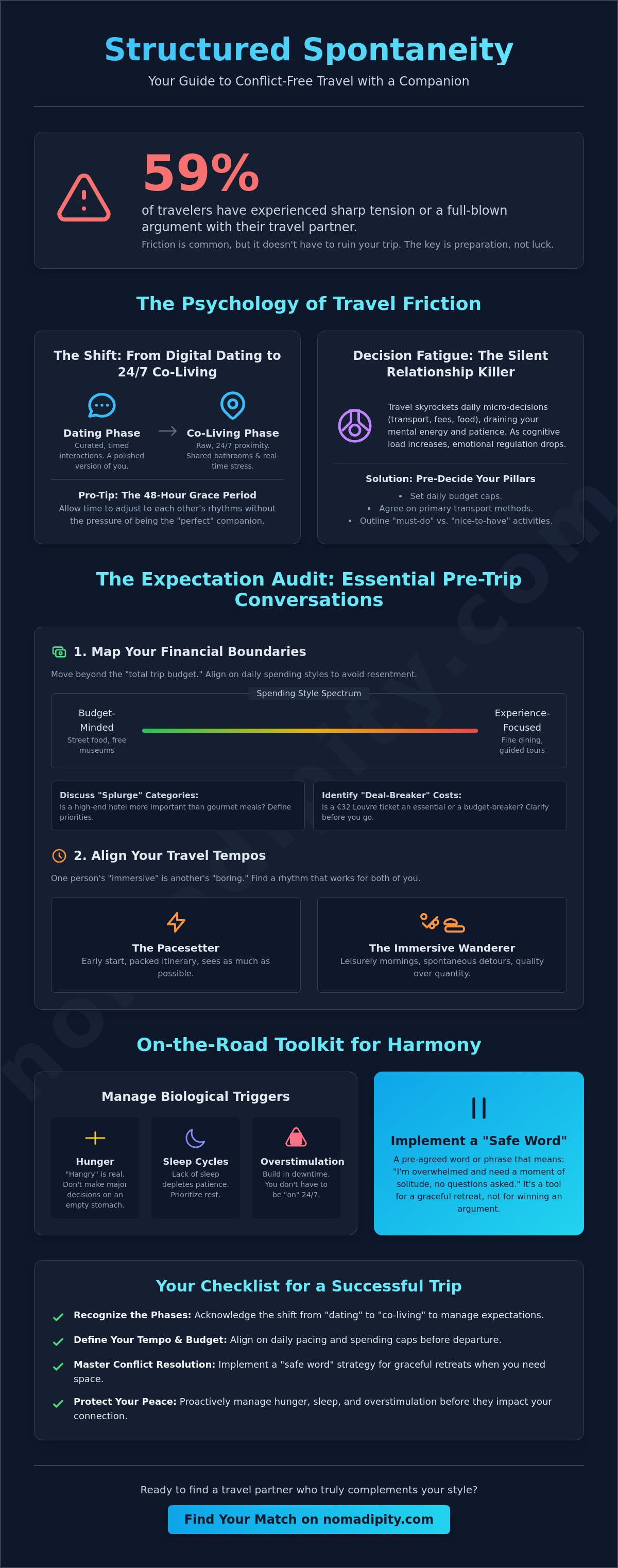
Did you know that 59% of travelers have experienced sharp tension or a full-blown argument with their companion? It’s a sobering statistic that highlights the gap between our sunset dreams and the logistical friction of the road. You want to focus on the magic of a new city, but instead, you're bickering over the new €32 Louvre entrance fee or the unexpected 5% accommodation levy in Edinburgh. We've all felt that creeping anxiety that a mismatched budget or social exhaustion might turn a dream escape into a relationship-ending ordeal. Avoiding conflict when traveling with someone new isn't about luck; it's about what we call structured spontaneity.
By establishing the right frameworks before you even pack a bag, you can facilitate those meaningful, unplanned moments that make travel worth it. This guide will teach you how to vet potential partners and align your expectations on everything from daily pacing to the latest 2026 travel regulations. We'll provide a clear framework for resolving disagreements mid-trip, ensuring you have the confidence to choose a companion who truly complements your travel style. Let's transform your next adventure from a source of stress into a masterclass in shared discovery.
Key Takeaways
- Recognize the shift between the "dating phase" and the "co-living phase" of your partnership so you don't lose your grounding when the stress of the road sets in.
- Define your "Travel Tempo" and daily spending caps before departure to ensure your financial and physical energy levels stay in sync.
- Master the art of avoiding conflict when traveling with someone new by implementing a "safe word" strategy that allows for graceful retreats when you need a moment of solitude.
- Protect your peace by learning to manage the biological triggers of travel drama, such as hunger and sleep cycles, before they impact your connection.
- Build a foundation of compatibility by utilizing our travel matchmaking to align your interests and lifestyle design with the right exploration partner.
The Psychology of Travel Friction: Why Even Great Matches Clash
Movement changes the way we interact. You might have spent weeks exchange messages and feeling a profound digital spark, but the reality of 24/7 physical proximity is a different beast entirely. We call this the shift from the Dating Phase to the Co-living Phase. In the dating phase, your interactions are curated and timed. On the road, you're sharing a single bathroom, navigating a crowded terminal, and managing the "always-on" social expectation that can drain even the most seasoned extrovert. Conflict isn't a sign that you've chosen the wrong partner. Instead, it's often a natural byproduct of growth and the intense stimulation of a new environment.
Understanding the psychology of communication helps us see that most friction doesn't stem from a lack of care. It comes from the depletion of our internal resources. When your routine is stripped away, your brain works overtime to process new sights, sounds, and social cues. This creates a baseline of emotional volatility. Avoiding conflict when traveling with someone new starts with validating this reality: you will get tired, you will get annoyed, and that is perfectly okay. The goal isn't to eliminate friction, but to build a framework that prevents it from stalling your journey.
The Transition from Digital Connection to Physical Proximity
Why does online chemistry sometimes feel strained in a hotel lobby? Digital connection allows for a delay in response and a polished version of ourselves. Physical travel is raw. We recommend establishing a 48-hour grace period at the start of every trip. This allows both parties to shed the performance anxiety of being the "perfect" companion and settle into a sustainable rhythm. It's a time to be gentle with each other as you adjust to shared bathroom etiquette and different morning energy levels. By lowering the pressure early on, you create space for a more authentic connection to emerge.
Decision Fatigue: The Silent Relationship Killer
The average person makes thousands of decisions a day, but for a traveler in an unfamiliar country, that number skyrockets. You aren't just choosing what to eat; you're navigating the 2026 UK ETA requirements or checking if you've paid the €10 last-minute Venice access fee. These micro-decisions eat away at your patience. Research into cognitive load suggests that as decision fatigue sets in, our ability to regulate emotions drops significantly. This is why hungry travelers often make the most regrettable navigational choices. We advocate for "pre-deciding" your logistical pillars, like your primary transport and daily budget caps, to save your mental energy for the moments that actually matter. Avoiding conflict when traveling with someone new is much easier when you aren't fighting over a map on an empty stomach.
The Expectation Audit: Essential Conversations Before You Book
Have you ever reached day three of a trip only to realize your partner's idea of "budget" involves street food while yours involves curated three-course meals? Avoiding conflict when traveling with someone new requires more than just good vibes; it demands a radical level of transparency before the first ticket is purchased. Engaging in essential conversations before you book creates a shared roadmap. This process turns potential flashpoints into manageable logistics, allowing your shared journey to flourish rather than flounder under the weight of unspoken assumptions.
Mapping Your Financial Boundaries
Move past the "total budget" figure and dive into daily spending caps. If you're heading to Paris in 2026, does a €32 Louvre ticket feel like an essential investment or a budget-breaker? Discuss which categories deserve a splurge. You might value a high-end hotel while your companion prefers budget stays to save for fine dining. Use shared expense apps or a "kitty" fund for communal costs, like the new €10 Venice access fee or the €2 Trevi Fountain entry. Identifying these "deal-breaker" costs early prevents resentment when the credit card finally comes out at the terminal.
Aligning Travel Tempos and Pacing
One traveler's "slow nomadic immersion" is another's "wasted time." Are you an early bird ready to beat the crowds at 7:00 AM, or a night owl who needs a slow morning? Decide on a sustainable number of activities per day to avoid the decision fatigue we discussed earlier. This is where finding a partner with a matching travel style through curated matchmaking becomes a game-changer. It ensures you aren't trying to force a high-speed sightseer into a slow-paced lifestyle, which is a recipe for social exhaustion.
The Solo-Time Contract
The Solo-Time Contract is a mutual agreement that designates specific hours for individual exploration, ensuring no one feels abandoned or socially smothered. Normalize the request for two hours of solitude. It isn't a rejection; it's a tool for trip longevity. You can even plan "parallel play" activities, like sitting in the same café while reading different books. This allows you to remain in each other's presence without the pressure of constant interaction.
Work-Life Balance and Perk Envy
For the modern remote professional, work schedules are non-negotiable. If one person has a hard deadline while the other has a free afternoon, tension is inevitable. Align on your "office hours" before you leave. Similarly, address the nuances of "perk envy." If you have lounge access or a flight upgrade via loyalty points and your partner doesn't, decide how you'll handle it. Will you sit together in economy, or will you meet at the gate? Addressing these small imbalances prevents the "second-class citizen" feeling that can quietly erode a new partnership.
Managing the "Biological Triggers" of Travel Drama
Sometimes the sharpest disagreements aren't born from a clash of personalities. They're born from a lack of snacks. When your body is depleted, your patience follows suit, often leading to friction that has nothing to do with your partner's character and everything to do with your blood sugar levels. Avoiding conflict when traveling with someone new requires you to become a detective of your own physical state. We must learn to separate legitimate grievances from the physiological revolt of a body that's tired, thirsty, or overheated. By acknowledging these biological triggers, you can prevent a temporary physical slump from becoming a permanent rift in your partnership.
Sleep Hygiene and Shared Space Etiquette
Rest is the bedrock of a harmonious itinerary. Before you share a room, have an honest conversation about your nocturnal habits. Do you snore? Are you a light sleeper who needs total silence? Discussing temperature preferences and noise tolerances beforehand is essential. We also recommend the "One Suitcase" rule for shared hotel rooms; keep your belongings contained to prevent "gear creep" from cluttering the limited floor space. Setting boundaries on morning phone usage is equally vital. The blue light and social media noise of a companion scrolling at 6:00 AM can be a major irritant for someone trying to catch those last few minutes of restorative sleep.
The 5 H’s: A Diagnostic Tool
When tensions rise, use the 5 H’s as a quick diagnostic tool to see if the fight is personal or purely physiological. Most travel drama can be traced back to one of these five triggers:
- Hunger: The simple physical need for fuel.
- Hanger: The emotional surge of irritability caused by low blood sugar.
- Humidity: The draining effect of extreme weather and physical discomfort.
- Haste: The stress of rushing to catch a flight or meet a booking deadline.
- Home-sickness: The subtle longing for the comfort and predictability of your own space.
If you find yourself snapping at your companion, call a "Biological Time-out." This is a non-negotiable pause to hydrate, eat, or simply sit in the shade. It's a moment to recalibrate before the conversation continues. Avoiding conflict when traveling with someone new becomes much simpler when you carry a "Hanger Management" kit. A handful of almonds or a protein bar can be the most effective conflict resolution tool in your arsenal. Don't underestimate the power of a quick snack to turn a looming argument into a shared laugh over a missed turn.
Maintaining physical wellness on the move is an act of kindness toward your travel partner. Drink more water than you think you need, especially when navigating the dry air of long-haul flights or the humidity of tropical locales. When you prioritize your body's basic needs, you preserve the mental clarity required to navigate the complexities of shared exploration with grace and unhurried ease.
Real-Time Resolution: How to Navigate a Disagreement Without Ruining the Trip
Even the most meticulously planned journey will encounter a bump in the road. Conflict isn't a failure of your partnership; it's a signal that a pivot is necessary. When you're avoiding conflict when traveling with someone new, the secret lies in having a pre-negotiated toolkit for the moments when the dream doesn't quite match the reality. Whether it's a missed train or a sudden realization that your budgets are drifting apart, the way you navigate these friction points determines the longevity of your travel bond.
One of our favorite low-stakes tools is the "Safe Word" strategy. Choose a word, perhaps something absurd like "pineapple" or "fjord," that either person can use to signal they've reached their social or physical limit. When the safe word is spoken, there's no judgment and no need for immediate explanation. It simply means it's time to pause, find some space, and reset. This prevents the slow simmer of resentment from boiling over into a full-blown argument in the middle of a crowded terminal.
The De-escalation Framework
When tension spikes, don't try to solve the problem immediately. Instead, follow a structured three-step approach to lower the emotional temperature. First, acknowledge your current physical state. Refer back to the 5 H’s we discussed earlier. Are you simply hungry or exhausted? Second, use "I" statements to express your needs. Saying "I feel overwhelmed by the crowds and need a quiet hour" is far more productive than accusing your partner of over-scheduling. Finally, propose a 20-minute cooling-off period. Walk around the block or sit in a park separately. This brief pause allows your nervous system to reset before you make a decision about your next move.
When to Pivot: The Graceful Split
One of the most powerful tools for harmony is the ability to walk away, if only for an afternoon. If your companion wants to spend four hours in a museum while you'd rather explore a local market, don't compromise until both of you are miserable. Instead, embrace a graceful itinerary split. Integrating solo travel into a shared trip isn't a sign of a failing connection. It’s an act of respect for each other's individual curiosity. You can reconnect over dinner to share your separate discoveries, which often injects fresh energy into your shared experience.
Managing budget discrepancies mid-trip requires a similar level of grace. If one person wants to splurge on a sunset cruise while the other is watching their daily spending cap, don't let it become a source of shame. Be honest about your limits without making the other person feel "extravagant" for their choices. By maintaining this level of transparency, you ensure that avoiding conflict when traveling with someone new remains a collaborative effort. If you find yourself constantly misaligned on these core values, it might be time to find a travel companion whose budget and style match yours from the very beginning.
Finding Your Ideal "Nomadipitian" Match: Structured Spontaneity in Action
Avoiding conflict when traveling with someone new often comes down to the quality of the initial match. While we've discussed how to navigate friction mid-trip, the most effective strategy is to align yourself with a companion who already shares your core values and travel pacing. This is the essence of structured spontaneity. By establishing a foundation of shared interests and logistical compatibility, you create the necessary framework for those magical, unplanned moments to flourish without the weight of interpersonal stress.
In the 2026 travel landscape, where navigating everything from the €20 ETIAS authorization to the 10% Hawaii tourist tax requires constant coordination, having a partner you can trust is vital. We believe in the power of the "Nomadipitian" mindset. This philosophy prioritizes genuine human connection and cultural depth over material markers of success. It's about finding value in the unexpected detour rather than just checking off a bucket list. When you prioritize the person over the itinerary, the logistics of movement become a shared joy rather than a source of tension.
Beyond the Boarding Pass: Building Meaningful Connections
Relying on luck at an airport lounge or a random social media group often leads to the mismatched expectations we've worked so hard to avoid. Instead, using matchmaking for travel buddies allows you to pre-vet companions based on specific travel styles and budgets. Niche communities play a significant role here by reducing the friction that comes from fundamentally different worldviews. Shared loyalty program affiliations, such as holding the same airline status or hotel memberships, can often predict travel style and common expectations for comfort levels. These small indicators help bridge the gap between a stranger and a reliable companion, making the goal of avoiding conflict when traveling with someone new a much more attainable reality.
Designing Your 2026 Travel Future
Living the digital nomad lifestyle requires a robust support system, especially when your office moves with you across borders. Nomadipity facilitates this through its platform by creating a space for "planned serendipity." We provide the structure through detailed profiles and mutual interest matching so you can enjoy the true spontaneity of the road. You don't have to navigate the complexities of 2026 travel alone. Join the Nomadipity community today to find your next conflict-free travel match and start your next adventure with the confidence that you're moving in the same direction.
Embracing the Road with Confidence and Connection
The world in 2026 is full of vibrant possibilities, from the historic streets of Edinburgh to the sun-drenched islands of Greece. Yet, the true beauty of movement lies in the connections we forge along the way. You now have the tools to transform potential friction into a foundation for growth. By auditing your expectations, managing biological triggers like hanger and haste, and embracing the power of a graceful itinerary split, you're doing more than just planning a trip. You're mastering the delicate art of avoiding conflict when traveling with someone new.
It's time to move beyond the anxiety of mismatched budgets or clashing tempos. With our advanced filters for budget and pacing alignment, finding a partner who shares your rhythm has never been easier. We invite you to join an exclusive community of frequent flyers and hotel rewards members who value depth and intentional living just as much as you do. Join Nomadipity and find a travel companion who matches your rhythm through our specialized matchmaking based on mutual interests and travel styles. The world is vast and welcoming. Approached with the right mindset and the right partner, every unexpected detour becomes a cherished memory.
Frequently Asked Questions
How do I tell my new travel partner I need some alone time without being rude?
Frame your need for solitude as a "social reset" rather than a rejection of their company. You might say, "I'm going to take two hours this afternoon to read at a cafe so I can be fully present for our dinner tonight." Being clear about your intentions prevents your partner from feeling abandoned and ensures you both maintain the energy needed for shared exploration.
What is the best way to split expenses when traveling with someone new?
Digital tracking apps or a communal "kitty" fund are the most efficient ways to manage shared costs. For small, frequent fees like the €2 Trevi Fountain entry or the €10 Venice access fee, a shared cash pool prevents the friction of constant payment requests. For larger expenses, record them in real-time to ensure the balance remains transparent and fair throughout the journey.
What should I do if my travel partner has a much higher budget than I do?
Be honest about your daily spending caps before the first booking is made. If your partner wants a luxury sunset cruise and you'd prefer a local market, it's perfectly acceptable to split for the afternoon. Avoiding conflict when traveling with someone new often requires acknowledging that you don't need to share every single experience to have a successful trip together.
How can we avoid arguing about where to eat or what to see?
Implement the "Three Options" rule to streamline decision making. One person suggests three restaurants or attractions, and the other person makes the final selection. This reduces the cognitive load on both parties and ensures that everyone has a voice in the itinerary. Rotating who gets to pick the "big event" of the day also maintains a sense of balance.
Is it a bad sign if we want to spend a whole day apart during the trip?
Spending a day apart is actually a sign of a healthy and secure travel partnership. It demonstrates that you both value individual curiosity and personal space over forced proximity. These solo intervals provide fresh stories to share over dinner and prevent the social exhaustion that often leads to bickering during long trips.
How do I handle a travel partner who is constantly on their phone?
Establish "digital-free" zones, such as during meals or while navigating a new neighborhood. If your companion's constant scrolling is distracting, have a gentle conversation about being present during key experiences. Suggesting specific times for catching up on emails allows both of you to stay connected to the digital world without sacrificing the magic of the physical one.
What are the biggest red flags to look for when vetting a new travel companion?
Watch for inflexibility in the planning phase or a refusal to discuss financial boundaries openly. If a potential partner is dismissive of your need for a slow day or seems stressed by minor logistical shifts, these are indicators of future friction. These red flags are essential to spot when you're focused on avoiding conflict when traveling with someone new.
Can travel dating lead to long-term relationship success?
Travel is the ultimate compatibility test because it accelerates the co-living phase of a relationship. Seeing how a partner handles a delayed flight or a confusing local regulation reveals their true character under pressure. By using a subscription to our travel matchmaking, you can find companions who already align with your lifestyle design, increasing the chances of a lasting connection.

Disclaimer
Nomadipity Blog Disclaimer
The content on Nomadipity is provided for general informational and inspirational purposes only. While we strive for accuracy and timeliness, Nomadipity does not guarantee that any information is complete, current, or suitable for your specific needs. Use your judgment and verify details before making travel plans, meeting with other users in person, or making any purchases influenced by the article.


