

What if the most dangerous part of your next adventure isn't a remote trail or a missed flight, but the person sitting in the seat next to you? It's a question every independent explorer eventually faces when they decide to share their horizon with someone else. You've likely spent years perfecting your own rhythm. The thought of compromising your pace for a mismatched budget or a conflicting morning routine feels like a high-stakes gamble. We understand that the shift from solo autonomy to shared discovery is delicate. That's why we have built this first trip with a new travel partner checklist to ensure your 2026 travels are defined by connection rather than friction.
By following this framework, you will gain a repeatable blueprint to transform potential social burnout into deep, meaningful connection. We will guide you through the logistics of intentional living on the road, from managing the new 2026 ETIAS requirements to budgeting for the 6% average travel insurance premium. It's time to stop worrying about compatibility and start engineering the kind of structured spontaneity that makes travel truly transformative. Let's ensure your next departure is the start of a harmonious duo, not just a compromise.
Key Takeaways
- Discover why the first 48 hours of planning are the ultimate litmus test for your future travel compatibility.
- Learn how to navigate budget tiers so you never have to choose between a luxury stay and a local experience.
- Use our first trip with a new travel partner checklist to implement a decompression rule that saves you from early social burnout.
- Master a structured framework for expressing frustration that prevents minor annoyances from ruining your connection.
- Learn how travel matchmaking subscriptions help you find partners who align with your specific lifestyle and budget.
The Pre-Trip Vibe Check: Aligning Your Travel Philosophies
The first 48 hours of planning are often more revealing than the trip itself. This narrow window is where logistical friction first appears. You start to see how your partner handles decision-making, compromise, and the inevitable stress of coordination. Are they decisive and proactive, or do they defer every choice to you? This phase acts as a microcosm of the journey ahead. It is the essential first entry on your first trip with a new travel partner checklist. If the initial planning feels like an uphill struggle, the trip itself will likely follow the same exhausting rhythm.
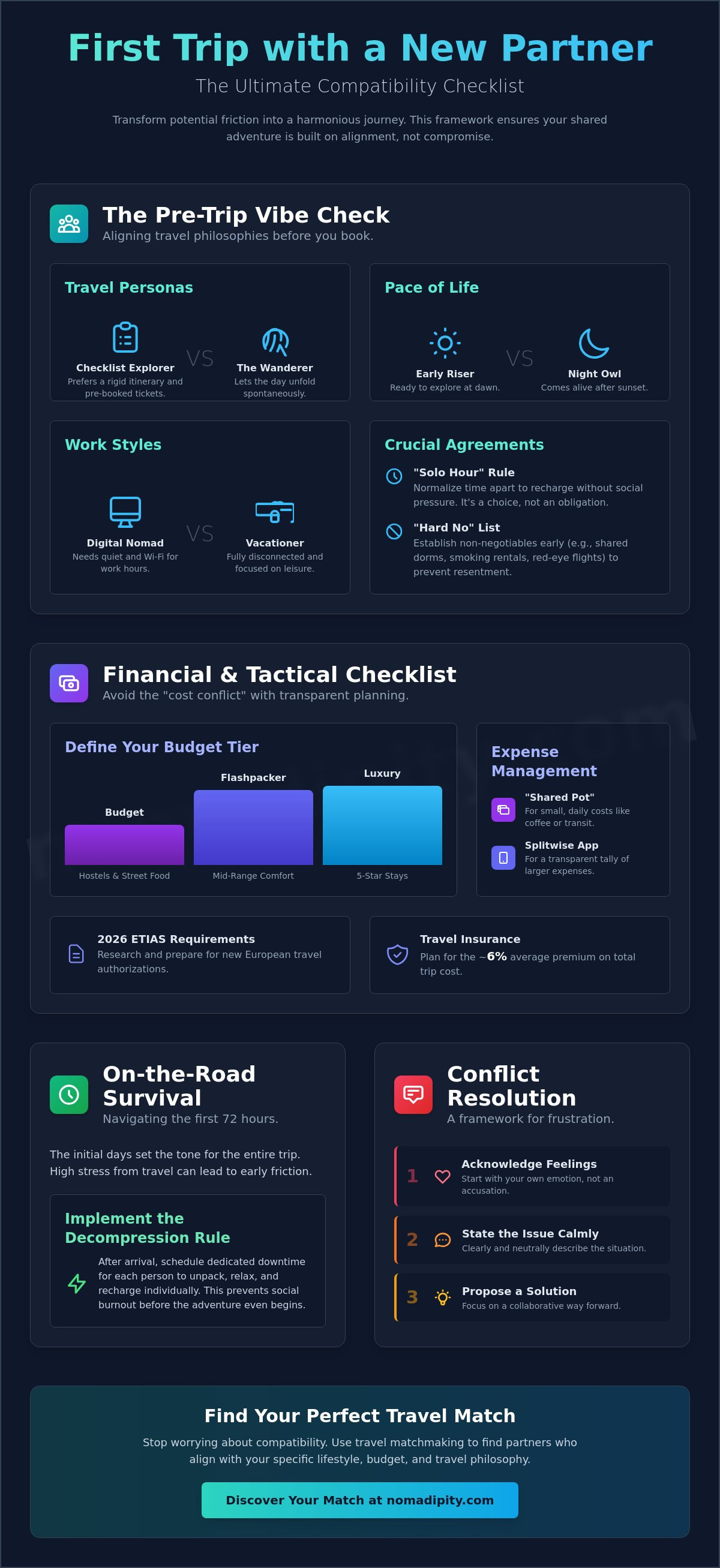
Beyond the simple logistics of booking, understanding interpersonal compatibility is about aligning your core travel personas. You might be a "Checklist" explorer who finds security in a rigid itinerary and pre-booked tickets. Your partner might be a "Wanderer" who prefers to let the day unfold based on the local weather or a random recommendation from a barista. Neither style is superior, but without alignment, one of you will feel stifled while the other feels rushed. You must also be honest about the trip’s intention. A journey intended for professional networking requires a different social battery than a romantic escape or a pure exploration of remote landscapes. Establishing your "Hard No" list early, whether it involves shared dorms, smoking-friendly rentals, or red-eye flights, prevents resentment from festering once you are on the ground.
The 'Pace of Life' Conversation
Your biological clock can make or break a travel partnership. If you need a quiet morning with three espressos before speaking, but your partner is ready to hit the trail at dawn, you have a fundamental conflict. Discuss your ideal activity density. How many "must-sees" can you actually process in a day before the experience becomes a blur? We recommend establishing a "Solo Hour" agreement before you even leave. Normalizing time apart allows each person to recharge without the pressure of constant social performance. It turns 24/7 proximity into a conscious choice rather than an exhausting obligation.
Digital Nomad vs. Vacationer
Serious friction often arises when one person is working while the other is on holiday. In 2026, geographic autonomy is the norm, but it requires strict workspace etiquette. Define your work hours clearly. If you need high-speed Wi-Fi and a quiet desk for six hours a day, your vacationing partner needs to know they are on their own during that window. Discuss whether you prefer the focus of a dedicated co-working space or the hum of a local cafe. Clarity on these digital boundaries ensures that "remote work" doesn't accidentally become "relationship work."
The Financial & Tactical Checklist: Avoiding the 'Cost Conflict'
Money is the most common source of friction on the road. It isn't just about the total cost; it is about the value you place on different experiences. One person might see a $200 dinner as a core memory, while the other sees it as four days of grocery money. To prevent these quiet resentments from boiling over, your first trip with a new travel partner checklist must include a granular budget alignment. Are you aiming for the gritty charm of hostels, the balanced comfort of "flashpacking," or the polished luxury of 5-star rewards stays? Defining these tiers early ensures you aren't constantly negotiating your comfort levels in real-time.
We recommend a hybrid approach to daily expenses. Use a "Shared Pot" for small, recurring costs like transit tickets and street food. For larger items, apps like Splitwise keep a transparent, running tally. This avoids the awkwardness of constant payment requests and keeps the focus on the journey. If one partner has a higher travel status, address the "Status Disparity" before you reach the airport. If you have lounge access but your companion doesn't, will you pay their guest fee or skip the lounge entirely? These small decisions are essentially a vacation survival guide for maintaining harmony. Pre-paying for big-ticket items like inter-city trains or major tours also helps. It locks in the cost and removes the stress of fluctuating exchange rates later. Finding someone who shares your financial frequency is easier when you use travel matchmaking services designed to pair you with like-minded nomads.
Loyalty Program Synergy
In 2026, travel is increasingly defined by how well you navigate loyalty ecosystems. Can your companion benefit from your hotel status or airline miles? Sharing perks like free breakfast or late check-outs can significantly lower the effective cost for both parties. Coordinate your itineraries to maximize point accumulation. If you are both chasing status, booking through the same portals can sometimes yield shared bonuses and upgrades that neither of you could secure alone.
The Emergency Fund Protocol
Transparency extends to the "worst-case" scenario. Agree on "The Out" protocol. If the trip needs to end early due to personal emergencies or irreconcilable differences, how will you split the remaining non-refundable costs? Alignment on travel insurance is also non-negotiable. With standard plans costing between 4% and 6% of the total trip cost in 2026, ensure you both have coverage for the same risks. Share your medical history, allergies, and emergency contacts before you depart. It is better to have these details saved in a shared note than to scramble for them during a crisis.
On-the-Road Survival: The First 72 Hours
The transition from a digital itinerary to the physical reality of a new city is the most volatile period of any journey. It is where the theoretical alignment you practiced during planning meets the friction of real-world logistics. Moving through the first few days requires a specific kind of grace. We recommend an absolute "Arrival Decompression" rule: do not plan a single activity for the first four hours after landing. With the 2026 rollout of the European Union's Entry/Exit System (EES) causing potential biometric processing delays at Schengen borders, your patience will already be tested before you even leave the airport. Give yourselves permission to simply exist, find your accommodation, and hydrate without the pressure of a ticking clock.
Once you've settled, initiate a 24-hour feedback loop. This isn't a formal meeting, but a simple check-in on energy levels and comfort. While a standard couples vacation checklist focuses on the destination, the real work happens in the gaps between the sights. Are you feeling overstimulated? Is the pace too fast? Use this time to adjust your first trip with a new travel partner checklist in real-time. To prevent the dreaded "hangry" zone, keep a pre-planned snack strategy in your day bag. Low blood sugar is the primary architect of unnecessary arguments. If sensory overload hits, use a pre-agreed "safe word" to signal you need an immediate break. It is a low-drama way to advocate for your mental clarity without needing to explain the exhaustion.
Communication During Stress
Adopting a "No-Blame" transit rule is essential for long-term harmony. Flight delays, missed trains, or GPS glitches are environmental factors, not personal failings. When stress levels rise, decision-making fatigue often follows. Combat this by alternating who is "in charge" of navigation and food for the day. This allows one person to lead while the other simply follows, resting their executive function. Practice active listening by validating your partner's concerns before jumping into problem-solving mode. Sometimes, a person just needs to be heard before they can move on.
The Art of the Lazy Day
Structured spontaneity is the secret to a repeatable travel framework. Leave intentional gaps in your itinerary to invite unplanned serendipity. If the hotel room feels more inviting than a crowded museum, embrace the "guilt-free" stay-in. The room is the destination if that is what your body requires. Decide early who handles the research for local hotspots versus tourist traps. This division of labor prevents the "what do you want to do?" loop that drains so much travel energy. By valuing the quiet moments as much as the milestones, you ensure the trip feels like a rejuvenation rather than a marathon.
Conflict Resolution: When the 'Mask Slips'
Every seasoned explorer knows the moment. It usually happens around day four, when the initial adrenaline of a new destination fades and the reality of 24/7 proximity sets in. The "mask" slips. You realize your partner's habit of humming while they pack is actually grating, or they discover your tendency to become silent when stressed. This is not a sign of failure. It is a natural part of the transition from solo autonomy to a shared rhythm. The most vital entry on your first trip with a new travel partner checklist is a plan for when the vibe inevitably shifts. Addressing the fear of "not liking each other" by day four requires radical transparency and a commitment to the "Five-Minute Vent." This is a structured, time-bound opportunity to express a frustration without it escalating into a full-blown argument. It is a release valve, not a trial.
Identifying your "Travel Triggers" is the next step in maintaining harmony. Are you susceptible to cultural overwhelm in crowded markets? Does sleep deprivation from a late-night flight make you irritable? In 2026, the added layers of digital authorizations like the UK’s ETA or Europe’s ETIAS can create unexpected bureaucratic stress. When the energy feels heavy, employ the "Pivot Strategy." If the original plan was a high-intensity museum tour but everyone is exhausted, change the itinerary. Choosing a quiet afternoon by a hotel pool over a "must-see" landmark isn't a loss. It is an investment in the relationship's longevity. You can find a partner who shares your approach to these pivots through our travel matchmaking subscriptions, which pair you with travelers based on deep-seated compatibility.
Handling Disagreements with Grace
When a sensitive topic arises, use the "Wait 20 Minutes" rule. Never discuss a conflict when you are hungry, tired, or in the middle of a transit hub. Give your nervous system time to settle before opening a dialogue. Focus on the difference between compromise and sacrifice. A compromise is finding a third way that satisfies both parties; a sacrifice is one person surrendering their needs, which eventually breeds resentment. If you find that the partnership has reached a fundamental limit, it is okay to acknowledge it. Some connections are meant for a weekend, not a month.
Socializing with Others
Avoid the trap of becoming a closed loop. An "Open Duo" policy encourages you to invite other nomads into your circle at hostels or meetups. This breaks the intensity of one-on-one interaction and provides fresh perspectives. If you are attending a professional meetup, practice networking as a pair while maintaining your individual autonomy. Introduce your partner with their professional background, but give each other the space to wander the room independently. This balance of shared experience and personal agency ensures you don't lose yourself in the duo.
Designing Your Future: The Nomadipity Match
Finding a companion for the open road is an art form that begins long before you reach the boarding gate. It starts with a mirror. To cultivate a harmonious duo, you must first understand your own travel DNA through a detailed traveler profile. This isn't just about listing your favorite cities; it is about documenting your professional rhythm, your tolerance for transit delays, and your specific comfort requirements. By using Nomadipity to match based on affiliations, budgets, and travel styles, you ensure the most critical entry on your first trip with a new travel partner checklist is addressed with data rather than guesswork. Whether you are seeking a fellow remote professional who respects "deep work" hours or an adventurer ready for a Patagonia "darecation," alignment is the foundation of every successful journey.
The power of itinerary sharing allows you to find matches for specific legs of a journey rather than committing to a month-long trek. Perhaps you want a partner for a week of culinary exploration in Rome, recently ranked the top destination for couples in 2026, but prefer to handle the next beach retreat solo. This flexibility is the essence of modern lifestyle design. Joining niche forums within the community also provides a space to vet potential partners through genuine interaction. You can observe how a person discusses challenges or shares advice, giving you a glimpse into their travel philosophy before you ever share a booking confirmation. This layer of community interaction transforms a simple search into the intentional cultivation of your path.
The Post-Trip Debrief
Once the bags are unpacked and the jet lag has faded, the work of a seasoned nomad continues. Review what worked and what didn't. Did the "Solo Hour" agreement prevent social fatigue? Did the "Shared Pot" approach to expenses keep the peace? Use these reflections to update your profile with new insights about your evolving travel style. If the journey was a success, this is the time for the "Next Trip" conversation, turning a one-off adventure into a reliable, long-term partnership that grows with every border crossing.
Finding Your Tribe
The goal is to move beyond the search for a single buddy and toward building a global network of "Nomaditians." This community offers a sense of belonging that transcends geographic boundaries, providing access to community-led travel hacks and shared wisdom on everything from 2026 ETIAS updates to the best co-working spots in Lisbon. When you surround yourself with like-minded explorers, the world feels smaller and more welcoming. Ready to stop guessing and start exploring? Discover your next great travel companion on Nomadipity.
Step Into Your Next Shared Horizon
Travel is more than a sequence of destinations; it's a mirror of our ability to connect and grow alongside another human being. By mastering the art of the pre-trip vibe check and establishing a solid financial framework, you've already mitigated the most common risks of the road. This first trip with a new travel partner checklist serves as your roadmap for navigating the transition from a solo journey to a shared story. You now have the tools to manage everything from 2026 digital authorizations to the delicate "mask slip" moments with grace and intention.
The world is waiting for your next adventure. Why leave the quality of your connection to chance? Our matchmaking subscriptions allow you to filter for specific travel styles and budgets while finding partners with shared loyalty program affiliations. You can find your perfect travel match on Nomadipity today and join a global community of Nomaditians who value depth and deliberate pacing just as much as you do. The right companion doesn't just share the view; they help you see the world in a way you never could alone. Trust the framework, embrace the unexpected, and go see what's out there.
Frequently Asked Questions
How soon is too soon to travel with a new partner?
The right timing depends more on the intensity of the trip than the length of your relationship. A weekend "micro-trip" is a perfect litmus test before you commit to a month-long international journey. If you can navigate a 48-hour getaway without significant friction, you're likely ready to tackle a more complex itinerary together.
What should we do if our travel budgets are completely different?
Radical transparency is the only way to navigate mismatched finances. Align on a "Budget Tier" early in your planning process. If one person prefers luxury while the other is "flashpacking," you might choose to splurge on shared dinners while maintaining individual autonomy for daily transit or accommodation choices to keep costs manageable for both.
How do I tell my travel partner I need some alone time?
Normalize the "Solo Hour" before you even leave for your trip. Frame it as a necessary tool to preserve your energy so you can be fully present during shared adventures. It isn't a rejection of your companion; it is a proactive strategy to prevent social burnout and maintain a harmonious duo throughout the journey.
Is it a red flag if we have our first argument on the first day?
Not necessarily, as the first 72 hours of any trip are the most volatile. Between jet lag and the 2026 rollout of biometric EES checks at European borders, stress levels are naturally higher during arrival. If you can resolve the disagreement using a "no-blame" approach, it is actually a positive sign of your long-term compatibility.
How can we use our frequent flyer miles together on a first trip?
Coordinate your loyalty program affiliations to maximize shared perks. While you usually can't merge miles without fees, you can use your status to guest your partner into airport lounges or secure complementary upgrades for both seats. This synergy is a key entry on any first trip with a new travel partner checklist for the modern nomad.
What are the best 'low-stakes' destinations for a first trip together?
Choose locations with reliable infrastructure and easy navigation to minimize logistical stress. Rome was ranked as a top destination for couples in 2026 because it offers a perfect blend of romantic attractions and accessible public transit. Avoid remote areas where a single logistical failure could put undue pressure on your new partnership.
How do I safely vet a travel partner I met online?
Safety begins with verified traveler profiles and community interaction. Use platforms like Nomadipity to match based on deep-seated interests and travel styles. Before you book a single flight, have multiple video calls and check their history in niche forums to ensure their digital persona aligns with their real-world travel philosophy.
Should we share a room or get separate rooms for the first trip?
Opt for separate beds or even separate rooms if you prioritize sleep quality and personal space. Sleep deprivation is a primary "travel trigger" that can lead to unnecessary friction on the road. While sharing a room is more budget-friendly, the extra cost for a second room is often a wise investment in the relationship's longevity.

Disclaimer
Nomadipity Blog Disclaimer
The content on Nomadipity is provided for general informational and inspirational purposes only. While we strive for accuracy and timeliness, Nomadipity does not guarantee that any information is complete, current, or suitable for your specific needs. Use your judgment and verify details before making travel plans, meeting with other users in person, or making any purchases influenced by the article.


