

Did you know that 74% of travelers in 2026 refuse to wait for a friend's "maybe" before booking a flight, yet 7 in 10 still crave deep human connection while on the road? It is a strange paradox. You value your geographic autonomy, but the surface-level small talk in hostel common rooms or the quiet sting of dining alone can make the world feel unnecessarily large. You shouldn't have to choose between your hard-won independence and a genuine sense of belonging.
Learning how to meet people traveling solo doesn't have to mean sacrificing your privacy or scrolling through sketchy apps. This guide will show you how to engineer "planned serendipity," a framework where high-quality connections with like-minded professionals happen naturally. We'll explore how to move past the repetitive "where are you from" script and use intentional systems to find travel companions who actually match your pace, budget, and purpose. It's time to transform your solitary journey into a shared experience that feels both curated and wonderfully unexpected.
Key Takeaways
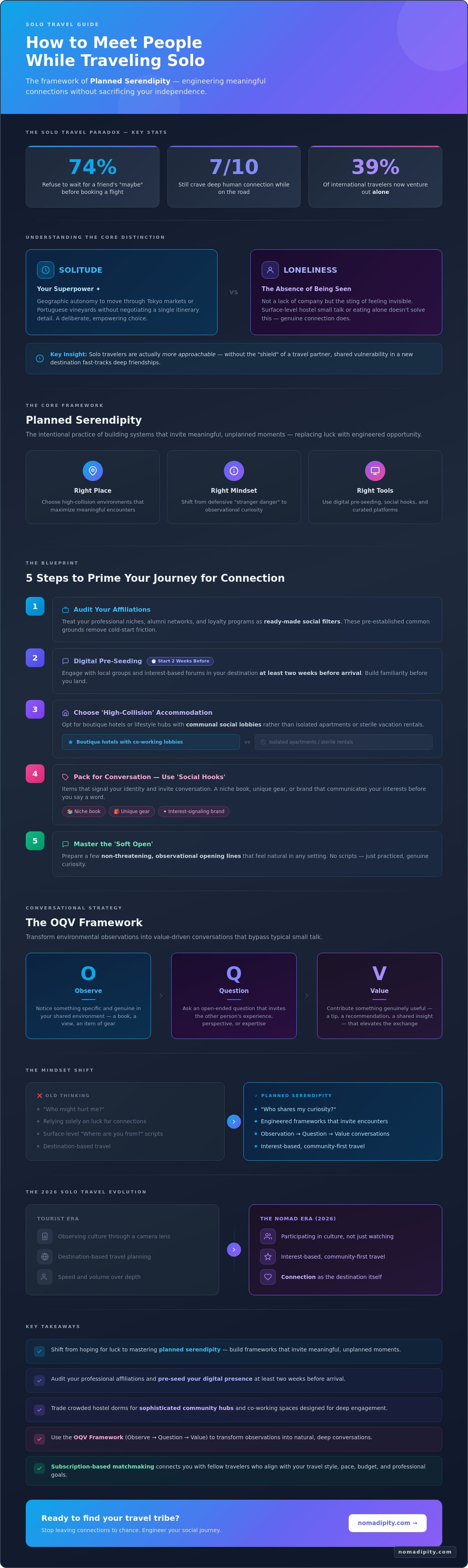
- Shift your mindset from hoping for luck to mastering "planned serendipity," the art of building frameworks that invite meaningful, unplanned moments.
- Learn how to meet people traveling solo by auditing your professional affiliations and "pre-seeding" your digital presence two weeks before touchdown.
- Trade crowded hostel dorms for sophisticated community hubs and co-working spaces that cater to deep engagement rather than just high-volume nightlife.
- Implement the OQV framework to transform simple environmental observations into natural, value-driven conversations that bypass the typical small talk.
- Discover how subscription-based matchmaking can connect you with fellow travelers who actually align with your unique travel style and professional budget.
The Psychology of Connection: Why We Seek Community on Solo Journeys
Solo travel is rarely a vow of silence. It is a deliberate choice to step into the world on your own terms, yet even the most fiercely independent explorer eventually feels the pull of the psychology of social connection. We are social animals by design. When you are navigating a foreign city, your senses are heightened and your usual social masks begin to slip. This is where "planned serendipity" takes root. It is the intentional practice of establishing a framework that invites the unexpected. You aren't leaving your social life to chance. Instead, you are choosing the specific environments and mindsets that allow meaningful encounters to flourish without forcing them.
Understanding how to meet people traveling solo begins with recognizing the vital distinction between loneliness and solitude. Solitude is your superpower. It provides the geographic autonomy to move through a bustling Tokyo market or a quiet Portuguese vineyard without negotiating a single itinerary detail. Loneliness, however, is the absence of being seen. Paradoxically, solo travel is often the best time to meet others because you are more approachable. Without the "shield" of a travel partner, you are forced to engage with your surroundings. This shared vulnerability in a new destination acts as a social catalyst. It fast-tracks deep friendships because you are both navigating the beautiful unknown together.
In 2026, we are seeing a profound shift from the "tourist" to the "nomad." You are likely no longer content just observing a culture from behind a camera lens. You want to participate. This requires moving beyond surface-level interactions and seeking genuine community. Connection becomes the destination itself.
Breaking the 'Stranger Danger' Conditioning
Your brain is wired to prioritize safety, which often manifests as a defensive "stranger danger" reflex in unfamiliar territory. To find your tribe, you must transition from a defensive mindset to an observational one. This doesn't mean ignoring your safety. It means using your intuition as a tool for networking rather than a barrier. Observe the room. Look for commonalities. When you shift from "Who might hurt me?" to "Who shares my curiosity?", the world opens up in a way that feels both safe and welcoming.
The Evolution of the Solo Traveler in 2026
The landscape of solo exploration has changed. With 39% of international travelers now venturing out alone, the focus has shifted from destination-based travel to interest-based travel. Digital connectivity allows us to find niche communities before we even pack a bag. Frequent flyers are no longer just passengers; they are part of a global, professional community that values depth over speed. You are looking for people who understand the intricacies of remote work and the quiet thrill of a slow-paced morning in a new time zone.
The Blueprint for Planned Serendipity: Preparing for Connection
Connection isn't a happy accident; it’s an engineered outcome. While the raw spontaneity of the road is beautiful, relying solely on luck often leads to missed opportunities and quiet dinners. To master how to meet people traveling solo, you must build a framework that invites high-quality interactions before you even zip your suitcase. This is the essence of planned serendipity. It is about being in the right place, with the right mindset, and the right tools to turn a passing glance into a lasting partnership. By establishing these systems, you ensure that your geographic autonomy doesn't lead to isolation.
Preparation begins with a few intentional shifts in your logistics. Consider these five steps to prime your journey for community:
- Audit your affiliations: Look at your professional niches, alumni networks, and loyalty programs as ready-made social filters.
- Digital pre-seeding: Start engaging with local groups and interest-based forums in your destination at least two weeks before you arrive.
- Choose 'High-Collision' accommodation: Opt for boutique hotels or lifestyle hubs with communal social lobbies rather than isolated apartments or sterile rentals.
- Pack for conversation: Use "social hooks" like a niche book, a unique piece of gear, or a brand that signals your interests to others.
- Master the 'Soft Open': Prepare a few non-threatening, observational opening lines that feel natural in any setting.
When you follow this structured approach, you're not just hoping to find a tribe; you're actively cultivating a path for them to find you. If you prefer a more streamlined way to find your peers, you can use curated travel matchmaking to find companions who align with your specific professional background and travel style.
Leveraging Loyalty: The Elite Traveler’s Secret
Your travel status is more than just a perk for upgrades; it is a signal of shared lifestyle. Airport lounges and premium hotel tiers serve as natural networking hubs for professional nomads. When you seek expert advice on solo travel benefits, you find that shared status creates an immediate baseline of trust and common ground. These spaces attract people with similar values regarding comfort and professional focus, making it easier to skip the small talk and engage in meaningful dialogue.
Digital Pre-Seeding Your Social Life
The "2-Week Rule" is essential for modern explorers. By joining local forums and niche interest groups fourteen days before touchdown, you can vet potential meetups and set social intentions. This period allows you to observe the group's dynamic and ensure it aligns with your safety standards and personal interests. It’s about entering a new city with a warm lead rather than starting from zero, allowing your connections to feel unhurried and intentional.
Beyond the Hostel: Finding Your Tribe in Sophisticated Spaces
The era of the sticky hostel floor is giving way to something far more refined. While traditional backpacker hubs still exist, the sophisticated traveler in 2026 seeks "community hubs" that prioritize depth over volume. If you are learning how to meet people traveling solo as a professional, you likely want more than just a drinking buddy. You want a tribe that understands the balance of a deadline and a sunset. These spaces are designed for those who value their geographic autonomy but refuse to settle for surface-level interactions.
Co-working spaces have become the office watercooler for the global nomad. In major US metros, a hot desk membership typically costs between $200 and $500 per month, while day passes range from $20 to $50. This investment isn't just for the high-speed Wi-Fi; it is for the proximity to like-minded individuals. Similarly, specialty workshops and "slow travel" retreats, which often last between 8 and 14 days, act as powerful connection catalysts. These environments strip away the superficiality of traditional tourism. You aren't just observing a destination. You are engaging with it alongside others who share your specific curiosities.
Communal dining has also evolved for the discerning traveler. The "table for ten" concept in boutique restaurants allows you to join a curated group of diners, turning a potentially lonely meal into a sophisticated social event. These spaces are designed for those who value quality conversation over crowded nightlife, making it easier to find a high-quality travel companion without the chaos of a traditional bar scene.
The Airport Lounge: The Ultimate Neutral Ground
Airport lounges offer a unique, secure environment for business networking. They are perhaps the safest and most effective places to initiate low-stakes conversations. The etiquette is simple. A subtle "lounge nod" or a brief question about a destination can open doors to professional opportunities. For those who want to take this further, these physical spaces serve as a bridge to the best social network for frequent flyers, allowing you to maintain connections long after your flight has landed.
Boutique Hotels and 'Social Lobbies'
Modern hotel design now prioritizes "collision points." Unlike a traditional lobby bar, which can feel transactional, a social lobby is engineered for lingering. These spaces often feature shared work tables, curated libraries, and open architectural layouts that encourage guests to interact naturally. They attract a more intentional, professional demographic. This ensures that the person sitting across from you is just as likely to be a potential collaborator as they are a fellow explorer.
The Art of the 'Soft Open': Conversational Strategies for Every Personality
Talking to strangers can feel like a performance you didn't audition for. While previous sections focused on where to go, mastering how to meet people traveling solo requires knowing what to say when you get there. You don't need a rehearsed monologue. You need the Observation-Question-Value (OQV) framework. This method turns your surroundings into a bridge. Start with a simple observation about the space. Follow with a curious question. Finally, add a small piece of value or a personal perspective. It's a low-pressure way to test the waters without the awkwardness of a cold open.
Your environment is your most natural icebreaker. When you're dining alone, the communal table is your best friend. Instead of hovering, try a direct script: "Mind if I join you? The menu looks incredible, and it’s always better to share the experience." If the conversation doesn't click, don't panic. A graceful exit is vital for maintaining your peace. A simple, "It was a pleasure meeting you; I’m going to focus on my meal now," is all you need. You aren't obligated to stay in a connection that doesn't serve your journey. If you want to skip the guesswork and connect with someone who already matches your travel style, subscribe to our travel matchmaking service to find your ideal companion.
Introvert-Friendly Connection Tactics
Introverts, remember that your listening skills are a superpower. Most travelers are waiting for their turn to speak. By being the one who truly hears them, you create an immediate bond. Use the "Prop Strategy" by keeping a physical book or a unique piece of tech visible. These items act as passive invitations for others to start the conversation for you. Focus on one meaningful interaction per day. It’s about the depth of the connection, not the number of contacts in your phone. This approach respects your need for solitude while still honoring your desire for community.
Moving from Small Talk to 'Big Talk'
Transitioning to "Big Talk" means moving past the repetitive loops. Try asking, "What brought you to this specific city?" or "What’s been the most unexpected part of your trip so far?" Aim for the "Rule of Three." Find three commonalities, like a shared hobby, a professional interest, or a similar travel philosophy, within the first five minutes. When it’s time to stay in touch, suggest a platform that matches the vibe. WhatsApp is usually best for immediate logistics, while professional social media profiles are better for long-term networking among global nomads.
Nomadipity: Transforming Solo Journeys into Shared Experiences
The frameworks we have discussed, from digital pre-seeding to mastering the "soft open," are powerful tools for intentional living. Yet, for the busy professional, managing these social logistics can sometimes feel like a second job. This is where Nomadipity.com steps in. We have taken the philosophy of structured spontaneity and built a system that automates the process of how to meet people traveling solo. Instead of scrolling through generic forums or hoping for a lucky encounter in a social lobby, you can rely on a curated subscription that does the heavy lifting for you. It is about establishing the right framework so you can focus on the experience itself.
Nomadipity.com moves beyond the superficial. We understand that a shared destination is just the starting point. True compatibility on the road comes from a deeper alignment of interests, budgets, and travel styles. Are you a digital nomad who needs a quiet co-working partner by day and a fine-dining companion by night? Or perhaps you're an adventurer looking for someone to share the cost of a private guide in a remote region? Nomadipity.com matches you with members who share your specific pace and professional background, ensuring that your geographic autonomy is never compromised. We find value in the unexpected by connecting you with people who are already on your wavelength.
Security is the foundation of our community. By focusing on a member-only network of frequent flyers and hotel rewards enthusiasts, Nomadipity.com creates a space where trust is established before the first message is sent. The transition from a digital match to a physical meeting becomes seamless. You might start a conversation while planning your trip and find yourself sharing a quiet coffee in an airport lounge before you even board your flight. This isn't just about finding a body to fill a seat; it's about cultivating a global community of peers who value depth over speed.
Finding Your Perfect Travel Companion
Personality is a great start, but travel style is what truly makes or breaks a journey. You can be best friends with someone and still have a miserable trip if your daily rhythms don't align. Nomadipity.com allows you to search for companions based on their specific travel DNA. Whether you are looking for high-level networking partners to discuss market trends or casual friends to explore a new city, our system helps you find the right fit. For a deeper dive into this process, check out our guide to finding a travel buddy. It is the definitive resource for how to meet people traveling solo without the usual friction.
Joining the Nomadipitian Community
Being a member of the Nomadipity.com community means joining a network that truly understands the intricacies of the "frequent flyer" lifestyle. We value human connection and personal growth over the frantic pace of traditional tourism. Our community doesn't just match you with people; it unlocks a collective wisdom of travel hacking and exclusive perks that make the world feel a little smaller and much more welcoming. It is time to stop waiting for the perfect timing and start creating it. Join Nomadipity.com today and find your next travel companion.
Engineering Your Next Great Encounter
Your solo journey is a canvas for intentionality. By auditing your professional affiliations and mastering conversational frameworks like the OQV method, you have moved from being a passive observer to an active architect of your social life. You now understand that the most rewarding connections happen when you align your environment with your professional pace and personal curiosities. Learning how to meet people traveling solo is ultimately about creating a framework where the unexpected feels right at home.
True geographic autonomy shouldn't come at the cost of genuine belonging. If you are ready to skip the surface-level small talk and find companions who truly match your rhythm, start your journey of planned serendipity with Nomadipity.com. Our member-only network connects vetted travelers and frequent flyers through interest-based matching, ensuring deep compatibility across budgets and travel styles. Don't leave your next meaningful connection to chance. The world is vast and unpredictable, but it becomes infinitely more welcoming when you approach it with the right mindset and the right tribe by your side.
Frequently Asked Questions
Is it safe to meet people I find on travel apps while traveling solo?
Safety is a priority when navigating how to meet people traveling solo through digital platforms. Always choose member-only networks that verify identities and meet in high-traffic, neutral locations like hotel lobbies or busy cafes. Share your location with a trusted friend before the meeting. Trusting your intuition is your most reliable tool; if a situation feels off, you have the geographic autonomy to leave without explanation.
How do I deal with social anxiety when trying to meet people abroad?
Dealing with social anxiety abroad starts with lowering the stakes of each interaction. Focus on "one meaningful connection" per day rather than trying to work the whole room. Using the Prop Strategy, like carrying a physical book or unique tech, allows others to initiate the conversation. Remember that most travelers are just as eager for connection as you are, which makes the world feel much more welcoming.
What are the best apps for meeting people that aren't for dating?
The best apps for non-romantic connection in 2026 focus on professional networking and niche interests. Look for platforms that cater specifically to digital nomads, frequent flyers, or alumni networks. These spaces attract individuals who value career growth and cultural depth over casual dating. Subscription-based matchmaking services are particularly effective because they filter for travelers who are committed to high-quality, long-term travel partnerships.
How can I find a travel buddy who has the same budget as me?
Budget alignment is critical for a frictionless journey, as financial discrepancies are a leading cause of travel partner conflict. You can find a compatible buddy by using matchmaking services that require users to state their preferred spending tier, from budget hostels to premium boutique hotels. This ensures you won't end up in a situation where one person wants street food while the other expects fine dining.
What should I do if I feel lonely during a solo trip?
Loneliness is a natural but temporary part of the solo experience. When it hits, shift your environment to a community hub like a co-working space or a communal dining table. Sometimes, the best cure is to lean into the solitude by journaling or practicing slow travel. This often provides the mental clarity needed to re-engage with the world. Remember that feeling lonely doesn't mean you've failed; it's just a signal to seek a new collision point.
How do I meet locals instead of just other tourists?
To move beyond the tourist bubble, engage with locals through specialty workshops or neighborhood-specific forums. Instead of visiting major landmarks, spend time in local co-working spaces or attend a community-led class on regional crafts. By participating in the local rhythm rather than just observing it, you create organic opportunities for genuine cultural engagement. This approach transforms you from a transient visitor into a temporary member of the community.
Can I find professional networking opportunities while traveling solo?
Solo travel is an exceptional time for professional networking, especially in high-value spaces like airport lounges and boutique hotel lobbies. These environments are the modern office watercoolers for the global nomad. By using the OQV framework, you can turn a low-stakes observation into a conversation about industry trends or market insights. Many professionals find that some of their most lucrative collaborations began in a neutral, international setting.
What are the 'red flags' I should look for when meeting a potential travel partner?
Identifying red flags early saves you from difficult situations on the road. Be wary of potential partners who are vague about their budget, inconsistent in their communication, or unwilling to meet in a public space first. A lack of respect for your geographic autonomy or personal boundaries is a significant warning sign. Vetted, member-only communities help mitigate these risks by ensuring all participants adhere to a shared code of conduct.
Disclaimer
Nomadipity Blog Disclaimer
The content on Nomadipity is provided for general informational and inspirational purposes only. While we strive for accuracy and timeliness, Nomadipity does not guarantee that any information is complete, current, or suitable for your specific needs. Use your judgment and verify details before making travel plans, meeting with other users in person, or making any purchases influenced by the article.


