

Did you know the average cost of a trip for Americans reached a record high of $7,257 in early 2026? While dreaming of a sunset over the Mediterranean is effortless, discussing who covers the rental car deposit often feels decidedly less romantic. You likely agree that nothing sours a journey faster than the quiet resentment of lopsided spending or the invisible weight of booking logistics. To protect both your peace and your connection, using a thoughtful travel companion agreement template is the most effective way to ensure your shared path stays clear of financial friction.
You're about to master the art of transparent budgeting so you can share expenses without sacrificing your friendship or your wanderlust. This guide provides a grounded roadmap for financial harmony, offering tools for real-time tracking and clever ways to account for loyalty points. We'll show you how to build a framework for structured spontaneity, allowing you to focus on the magic of the unexpected rather than the math of the invoice.
Key Takeaways
- Discover why the "money talk" is your most vital itinerary item to prevent resentment and ensure your values align before the journey begins.
- Learn how to utilize a travel companion agreement template to navigate different splitting models, from simple 50/50 divisions to income-proportional contributions.
- Master the delicate balance of "points versus cash" to ensure both partners feel valued when one traveler uses loyalty rewards or elite status perks.
- Identify the best real-time tracking apps to maintain transparency and avoid the common traps of currency conversion or "bad exchange rate" fees.
- Explore how intentional matchmaking can simplify your life by connecting you with companions who already mirror your budget and travel style.
Why the "Money Talk" is Your Most Important Itinerary Item
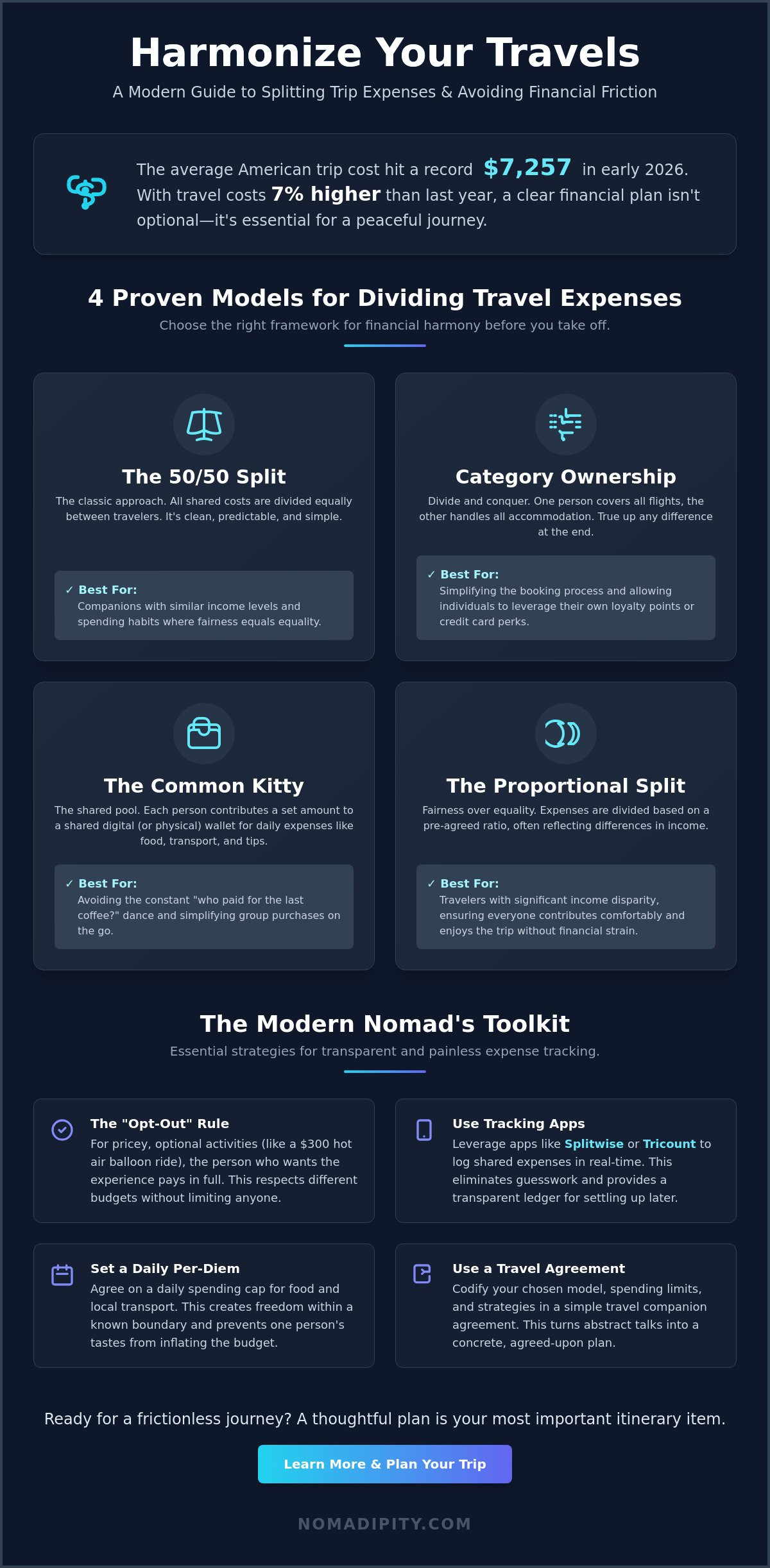
Financial compatibility in 2026 isn't just about having identical bank accounts. It's about a shared philosophy of value. With average trip costs reaching record highs of $7,257 this year, a mismatch in spending habits can quickly transform a dream vacation into a source of deep friction. Traveler resentment often stems from small, unvoiced frustrations. One person wants a $25 artisanal cocktail; the other prefers a quiet park bench. By establishing a travel companion agreement template before you book, you create a container for what we call structured spontaneity. This framework ensures that your logistics are handled, leaving your mind free to absorb the magic of the journey.
Transparency is the ultimate foundation for genuine cultural engagement. When you know exactly how the bills are being split, you stop performing a mental audit every time your friend orders an extra appetizer. Looking at the history of travel companion services, it's clear that sharing costs has always been a primary driver for collective exploration. Today, with travel costs sitting 7% higher than just a year ago according to NerdWallet, that conversation is no longer optional. It's the most vital piece of gear in your suitcase.
Setting the Stage for an Honest Conversation
Timing is everything. Don't wait until you're standing at a crowded check-in counter to discuss who pays the baggage fee. Choose a neutral, non-travel-related setting for your "Budget Boundary" session. This is the time to distinguish between your "Must-Haves" and "Nice-to-Haves." Perhaps a private room is a non-negotiable for your mental clarity, while luxury dining feels like an unnecessary splurge. Identifying your individual splurge triggers early prevents the pressure to overspend in the heat of the moment. One person might value a high-speed train over a budget bus, while another prioritizes a specific guided tour. Write these down. Use your travel companion agreement template to codify these preferences so they don't become points of contention later.
Defining Your Travel Style and Spending Limits
Concrete numbers provide comfort. Establish a daily per-diem cap for food and local transport to keep your expectations grounded. This isn't about restriction; it's about freedom within a known boundary. You should also discuss the "what-if" scenarios that rarely make it into the brochures. What happens if a flight is canceled or a medical emergency arises? Agreeing on an emergency fund strategy ensures you aren't scrambling for a credit card in a crisis. Finally, set a maximum price for core bookings like flights and stays. When you both agree on a ceiling for the big-ticket items, you eliminate the guilt of booking and the fear of a surprise invoice.
4 Proven Models for Dividing Travel Expenses
Choosing how to slice the bill is as much about psychology as it is about arithmetic. While the default is often to split everything down the middle, your specific itinerary might demand more nuance. These four models offer a starting point for your discussions, providing a framework that you can easily document in your travel companion agreement template. You can find seven tips for handling finances that help refine these choices. Each approach has its own rhythm and logic.
The 50/50 Split works beautifully for companions with similar income levels and shared tastes. It is clean, predictable, and requires the least amount of mental labor. Category Ownership, on the other hand, allows one person to cover all flights while the other handles accommodation. This simplifies the booking process, though it requires a quick audit at the end to ensure the totals are roughly equivalent. For daily expenses like street food and metro tickets, the Common Kitty is a favorite. Each person contributes a set amount to a shared digital wallet, and you pay from that pool until it's empty. This avoids the dance of who paid for the last coffee entirely.
When the 50/50 Split Fails
Equality doesn't always equal fairness. If you're a light eater traveling with a foodie who orders the entire menu, a strict 50/50 split can quickly lead to irritation. We recommend the "Opt-Out" rule for expensive optional activities. If one friend wants a $300 hot air balloon ride and the other is happy with a hike, the person choosing the luxury item pays in full. This keeps the trip accessible for both budgets without limiting anyone's experience. Recognizing these friction points early allows you to adjust before the first bill arrives.
The Proportional Split: Fairness Over Equality
When income levels vary significantly, the Proportional Split is often the most compassionate choice. Instead of fixed numbers, you contribute based on a percentage of your take-home pay. This ensures that the trip is a similar financial "weight" for both travelers. Framing this in your travel companion agreement template helps remove the "charity" dynamic, positioning it instead as a strategic alignment of resources. If you're looking for someone whose financial outlook matches your own, you can find a travel buddy through our matchmaking service who already aligns with your spending style.
Finding the right person to share these costs with is the secret ingredient to a stress-free journey. If you're tired of the awkwardness of mismatched budgets, consider joining a community designed for intentional travel. You can find your next partner through Nomadipity's matchmaking subscriptions, where we prioritize budget compatibility just as much as shared interests.
Navigating Income Inequality and Loyalty Rewards
Modern exploration often relies on digital currency as much as physical cash. If you're traveling with a "Points Pro," the financial math gets complicated fast. How do you split the cost of a hotel suite that was technically free? If one person uses 60,000 miles for a flight while the other pays $1,217 in cash, the sense of equity can vanish. This is why your travel companion agreement template should explicitly address the value of loyalty rewards. Without a clear plan, the person with the points may feel like they're subsidizing the trip, while the person paying cash feels the sting of the 2026 travel price hikes.
A "Value Exchange" is often the most elegant solution for these scenarios. If one partner provides the accommodation through points, the other might cover all ground transportation and shared meals. This keeps the out-of-pocket expenses balanced without requiring a complex bank transfer. It is essential to have a money talk before the first booking confirmation hits your inbox. Discussing these nuances early ensures that elite status perks, like lounge access or late checkouts, are enjoyed as shared gifts rather than points of contention.
Valuing Points and Miles in a Shared Budget
To keep things fair, agree on a "Cent per Point" (CPP) value before you depart. Many seasoned travelers use a baseline of 1 to 1.5 cents per point to calculate a fair reimbursement or trade. This turns abstract miles into a concrete number you can track. Understanding how travel rewards programs can bridge the gap between different budget levels is a game changer. It allows a traveler with more points than liquid cash to contribute high-value perks that their companion might otherwise pay a premium for.
Income Inequality: The "Host vs. Guest" Mindset
When one partner earns significantly more, it's easy to slip into a "Host and Guest" dynamic. This can create an uncomfortable power imbalance that lingers long after the trip ends. We suggest the "Neutral Territory" rule: choose destinations and activities that are comfortably affordable for the person with the lower budget. This prevents the higher earner from feeling like a benefactor and the lower earner from feeling like a burden. Your travel companion agreement template should include a section for "Budget Comfort Zones." If a splurge feels too heavy, it's always better to graciously decline than to harbor resentment over a bill you can't truly afford.
The Modern Nomad Toolkit: Apps for Painless Splitting
Spreadsheets are the ghosts of travels past. While they served us well in the era of paper maps, they often feel like a chore that pulls you away from the present moment. In 2026, the logistical reality of unconventional living demands tools that are as mobile and fluid as we are. You've already established your boundaries in your travel companion agreement template. Now, you need the digital infrastructure to make those agreements effortless. With travel costs rising 7% in April 2026 compared to the previous year, precision in your tracking isn't just about fairness; it's about protecting your travel fund from the "bad exchange rate" trap.
Real-time expense tracking allows you to settle the tab as you go, preventing that dreaded end-of-trip audit. By using automated tools, you move from the role of an accountant back to the role of an explorer. These apps handle the heavy lifting of currency conversion and math, ensuring that your "Common Kitty" or "50/50 Split" remains accurate across borders and time zones.
Top Apps for 2026 Travel Expense Management
The landscape of bill-splitting has matured significantly. Splitwise remains a staple, with its Pro subscription costing $4.99 per month or $39.99 per year as of April 2026. This version is particularly useful for multi-currency trips because it offers receipt scanning and ad-free tracking. If you're wary of subscription fatigue, which affected 41% of consumers by 2025, you might prefer "splitty." This app costs $9.99 per year or a one-time lifetime purchase of $24.99, providing a straightforward alternative for those who prefer a single payment. For instant settlement without the wait of bank transfers, Revolut and Wise offer shared vaults. These allow you to contribute to a digital pot in real-time, paying for group dinners or train tickets directly from a collective balance. Tricount continues to be a favorite for those who value visual budget breakdowns, showing exactly who is "in the red" with simple, intuitive graphs.
Managing the "Mental Load" of Bookkeeping
Even with the best apps, the labor of inputting data can become a burden. We recommend rotating the "Treasurer" role every few days. This prevents one person from feeling like the group's designated bookkeeper while the other remains blissfully unaware of the budget. Use the "Snap and Forget" method: take a photo of every receipt immediately and let the app's OCR technology do the work. Finding a partner who values this level of organization is half the battle. This is why the social network for frequent flyers is the best place for tech-savvy partners to connect. When you match with someone who already uses these tools, the friction of finance disappears.
Ready to skip the awkward math and get back to the adventure? You can find travel companions who share your budget style and tech preferences through Nomadipity's matchmaking subscriptions.
Beyond the Bill: Matching with Partners Who Share Your Budget Style
Finding a travel partner is often compared to dating. You're looking for someone whose rhythm matches yours, whose curiosity mirrors your own, and, most importantly, whose wallet speaks the same language. Financial alignment is a core pillar of our philosophy because we've seen how mismatched expectations can drain the joy from a journey faster than a lost passport. This is why our matchmaking process prioritizes budget tiers alongside travel styles. When you start with a baseline of financial compatibility, the logistics of your travel companion agreement template become a bridge rather than a barrier to connection.
Structured spontaneity relies on a foundation of trust. If you're constantly worrying about whether your companion can afford the next excursion, you aren't truly present. Transitioning from a digital connection to a shared bankroll requires a leap of faith, but it's a leap taken with a safety net. We recommend starting with a smaller weekend trip before committing to a month-long trek. This "test run" allows you to see if the theory of your financial plan holds up in practice. Does your partner actually log their expenses? Do they respect the boundaries you established together? These small observations are the true indicators of a successful long-term partnership.
Vetting for Financial Values
Before you commit to a shared itinerary, you must peel back the layers of your financial values. It's not enough to say you want to travel "cheaply" or "luxuriously." These terms are entirely subjective. One person's budget hostel is another person's nightmare, while a "reasonable" hotel in 2026 might cost significantly more than it did just a few years ago. Use our solo travel guide to define your own baseline first. Knowing your own non-negotiables allows you to spot red flags in others. If a potential partner is vague about their spending limits or hesitant to discuss a daily cap, it's a sign that your journey might be headed for friction. Ask direct questions: "What's your maximum daily spend for food?" or "How do you feel about splitting the cost of a rental car?"
Join the Nomadipity Community
At Nomadipity, we believe that the right framework facilitates meaningful, unplanned moments. By subscribing to our matchmaking service, you gain access to a community where the "money talk" has already been initiated. We help you find your match based on mutual interests and budget tiers, ensuring you aren't stuck negotiating with someone whose financial reality is worlds apart from yours. You can access exclusive forums for discussing travel logistics and refine your travel companion agreement template with advice from seasoned nomads. Don't leave your financial harmony to chance. You can find your financially compatible travel companion on Nomadipity and start building a journey based on shared values rather than just shared destinations.
Cultivating Connection through Clear Boundaries
Financial harmony is the quiet engine that powers a truly transformative trip. By defining your budget boundaries and utilizing a travel companion agreement template, you've built the framework for structured spontaneity. You now have the tools to navigate income gaps and loyalty points without losing sight of the human connection at the heart of your movement. Mastery of these logistics ensures that when you're standing before a mountain range or a bustling night market, your mind is present rather than preoccupied with a mental ledger.
Why leave your next adventure to the whims of a mismatched budget? You can find your perfect travel match on Nomadipity, where we connect you with a vetted community of frequent flyers and loyalty members who share your specific budget tier and travel style. Finding a partner who values transparency as much as you do is the final piece of the puzzle. The world is vast and welcoming when you're walking beside someone who shares your vision. It's time to stop worrying about the invoice and start leaning into the unexpected magic of the road.
Frequently Asked Questions
What is the fairest way to split travel costs?
The fairest way is the one that respects both parties' financial comfort zones. While a 50/50 split is simple, proportional splitting based on income often feels more equitable for long-term journeys. By documenting your choice in a travel companion agreement template, you ensure that both travelers feel like equal partners regardless of the actual dollar amount contributed to the pot.
How do you handle a travel companion who has a much higher budget than you?
Address this by setting a cap for shared essentials like housing and transport based on the lower budget. If the higher-budget traveler wants a luxury upgrade, they should cover the price difference as a personal splurge. Openly discussing these splurge triggers early prevents the lower-budget traveler from feeling pressured to overspend or falling into debt to keep up.
Should you split everything 50/50 even if one person eats or drinks more?
No, you shouldn't feel obligated to subsidize a companion's expensive tastes. It's much better to pay for what you individually order or use a shared kitty for communal items like appetizers while keeping main courses and alcohol separate. This prevents the cocktail tax where a non-drinker ends up paying for their partner's premium wine or artisanal spirits.
How do you account for hotel points or airline miles when splitting a trip?
Value points by establishing a cash equivalent before you leave. If one person provides a room using loyalty rewards, the other can cover an equivalent amount in ground transport or meals. This value exchange keeps out-of-pocket costs balanced and acknowledges the real-world worth of those miles. It's a sophisticated way to travel well while keeping the math transparent and fair.
What are the best apps for splitting travel expenses in 2026?
Beyond standard tracking tools, look for banking apps that offer shared vaults or digital pots. These allow you to pool money for group expenses in real-time without waiting for bank transfers. Choosing a partner who is comfortable with these digital tools is a vital part of finding a compatible match through intentional travel matchmaking services that prioritize budget alignment.
How do you bring up the money conversation with a new travel partner?
Start the conversation during the initial dreaming phase by framing it as a way to protect the friendship. Ask open-ended questions about their travel style and daily spending limits to gauge compatibility. Using a travel companion agreement template provides a neutral, professional structure for this talk, making it feel like a standard logistical step rather than a personal interrogation.
Is it better to settle debts daily or at the end of the trip?
Settling debts every few days is generally more effective than waiting until the final day. It keeps the mental load of bookkeeping manageable and prevents an overwhelming bill from casting a shadow over your departure. Real-time settling also helps you stay aware of your remaining per-diem so you can adjust your spending for the rest of the journey.
What happens if a travel companion cannot pay their share during the trip?
This is why an emergency fund discussion is a non-negotiable part of your planning. If a companion hits a financial snag, refer to the "what-if" scenarios you outlined before departing. Having a clear plan for unexpected costs, such as a temporary loan or shifting to lower-cost activities, protects the journey from coming to an abrupt and stressful halt.

Disclaimer
Nomadipity Blog Disclaimer
The content on Nomadipity is provided for general informational and inspirational purposes only. While we strive for accuracy and timeliness, Nomadipity does not guarantee that any information is complete, current, or suitable for your specific needs. Use your judgment and verify details before making travel plans, meeting with other users in person, or making any purchases influenced by the article.


