

What if the secret to a truly spontaneous, life-changing journey isn't leaving everything to chance, but actually signing a document before you even pack your bags? While interest in solo travel has declined by 13 percent since late 2022, the desire for shared experiences is surging. You likely feel that familiar pull toward the horizon, yet you worry about the friction of mismatched budgets or safety concerns when meeting someone new. It's exhausting to imagine your trip turning into a constant negotiation over dinner prices or daily schedules.
By creating a travel companion agreement, you aren't building a legal cage. You're crafting a framework for structured spontaneity that ensures your expectations align perfectly before the first flight takes off. This guide will show you how to protect your friendship and your finances through radical transparency. We will explore how to navigate everything from Splitwise etiquette to safety protocols, ensuring your 2026 adventures feel less like a logistical puzzle and more like the soulful exploration you deserve.
Key Takeaways
- Define your journey with a shared vision statement that transforms potential friction into a foundation for deeper cultural engagement.
- Master the art of creating a travel companion agreement by establishing clear "Pacing Clauses" and financial boundaries before you board.
- Identify whether your specific trip requires a formal contract for long-term stays or a simple "social handshake" for weekend escapes.
- Follow a structured two-step workshop to bridge the gap between your wildest bucket-list dreams and the practical realities of daily travel habits.
- Learn how to leverage intentional matchmaking to find a partner whose travel style and core values already align with your personal path.
What is a Travel Companion Agreement and Why Does Every Nomadipitian Need One?
Imagine standing in a sun-drenched plaza in Lisbon, only to realize your companion wants a four-course lunch while you're itching to hike to a hidden viewpoint. These tiny fractures in expectation can quickly turn a dream trip into a series of polite frustrations. Creating a travel companion agreement isn't about bureaucracy; it's about drafting a shared vision statement for your journey. It serves as a compass, ensuring that when the road gets dusty or the train is delayed, you both already know how to react. For every Nomadipitian, this document acts as a declaration of intent, prioritizing the quality of the experience over the mere logistics of the move.
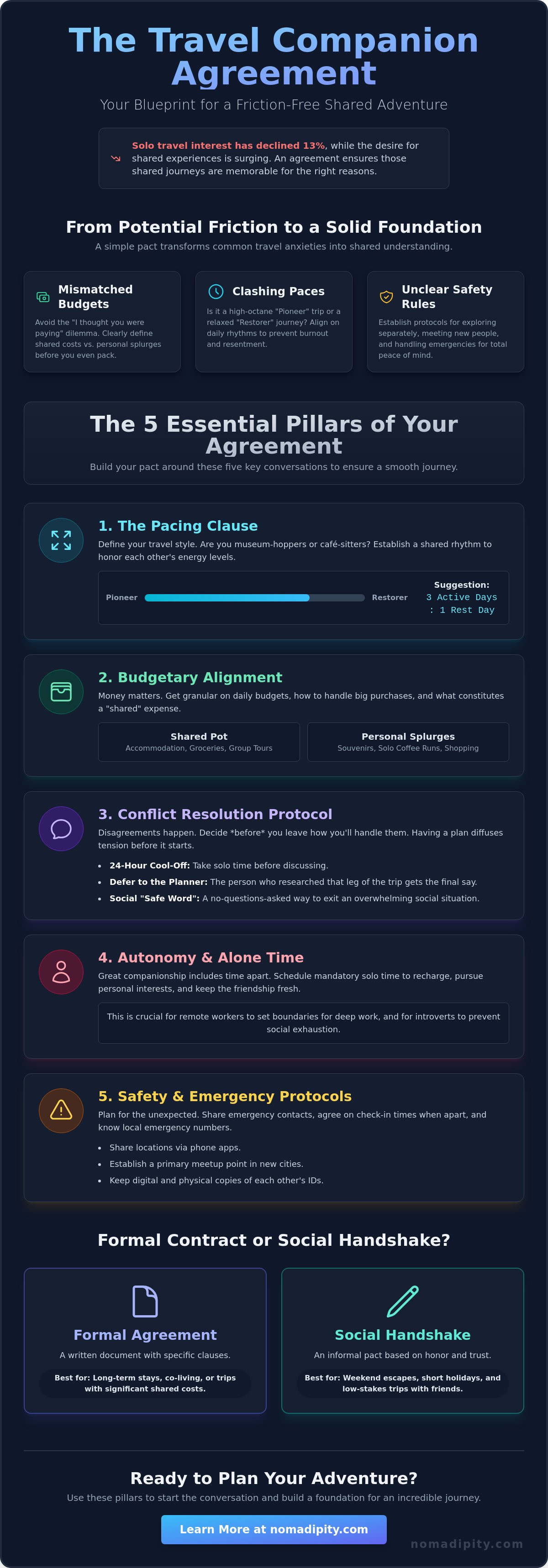
Even lifelong friends discover that sharing a childhood bedroom is nothing like sharing a cramped sleeper car in Thailand. Travel strips away our social filters and reveals our rawest habits. A formal check-in before you board prevents the "I thought you were paying for this" conversations that can sour a sunset. Psychologically, this framework is a gift to your future self. Travel requires thousands of micro-decisions every day. By pre-settling the big questions, you eliminate decision fatigue, leaving you with the mental clarity to actually engage with the culture around you. A well-crafted agreement typically settles three core anxieties:
- Financial transparency regarding "shared pots" versus individual splurges.
- Agreed-upon daily rhythms, including wake-up times and activity levels.
- Safety protocols for when you choose to wander separately or meet new people.
The Shift from Legal Contract to Social Pact
We prefer to think of this as an informal social handshake. It isn't a weapon to use against each other, but a pact of intentionality based on honor. Some worry that structure kills the magic of travel, but the opposite is true. When you know your budget and pace are aligned, you can lean into serendipitous moments without guilt. This process builds a foundation of trust, allowing for a deeper human connection because you've already cleared the logistical hurdles that usually trip people up.
Protecting Your Most Valuable Asset: Your Time
Time is the only currency you can't earn back while wandering. Mismatched expectations are the primary thieves of this asset, often leading to wasted hours in hotel lobbies debating the day's itinerary. The process of creating a travel companion agreement forces you to confront these realities before they become emotional burdens. By establishing a "Pacing Clause," you honor each other's needs for rest or high-intensity exploration. This also facilitates geographic autonomy; you don't have to be joined at the hip. A mandatory alone time clause ensures you both stay sane. For the remote professional, it sets clear boundaries for deep work, ensuring that professional obligations don't bleed into your shared cultural rituals.
The Essential Pillars of a Strong Travel Partnership Agreement
A shared dream needs a solid foundation. While the initial spark of a trip is often fueled by late-night Pinterest boards and hushed conversations about remote beaches, the longevity of that joy depends on the practicalities you settle before departure. When you begin creating a travel companion agreement, you're essentially building the guardrails for your adventure. It's about moving beyond the "vibe" and into the granular realities of daily life on the road. While these are social pacts rather than legal documents, looking at professional definitions for The Essential Pillars of a Strong Travel Partnership Agreement can help you define roles and responsibilities with more clarity.
The first pillar is the Pacing Clause. We often assume our friends travel at the same speed we do, only to realize one person is a "pioneer" who wants to see every museum in Rome, while the other needs "rest" days to simply sip coffee and watch the world go by. Establishing a ratio, perhaps three active days for every one restorative day, prevents burnout and resentment. Equally vital is a pre-planned conflict resolution protocol. Decide now how you'll handle a disagreement. Will you take 24 hours of solo time to cool off? Will you defer to the person who did the most research for that specific leg of the trip? Having a "safe word" for social exhaustion can save a friendship in a crowded train station.
Budgetary Alignment: Beyond Splitting the Bill
Money is the most common friction point in any partnership. Discuss "Budget Creep" early. This is the slow, silent inflation of daily costs that happens when you're tired and just want a taxi instead of the bus. Set a hard daily ceiling and agree on a "Shared Pot" for communal expenses like accommodation and fuel. In 2026, nuances like rewards points and lounge access matter. If you have elite status and your partner doesn't, will you pay for their guest pass or meet them at the gate? Addressing these small imbalances prevents quiet bitterness. To ensure you're starting on the right foot, consider finding a partner with a pre-verified budget range through nomadipity.com.
Lifestyle and Biological Rhythms
Your biological clock doesn't reset just because you've crossed a time zone. If you're an early bird who wants to hit the trails at 6:00 AM and your companion is a night owl, you must negotiate a "start of day" time. Respecting these rhythms is a form of care. Similarly, discuss your social batteries. One of you might seek out local hotspots every evening, while the other needs a quiet night in to recharge for the next day's move. Don't forget dietary non-negotiables. If one of you is a dedicated foodie and the other views food as mere fuel, your daily itinerary will look very different. Mapping these habits out ensures your journey feels like a collaborative dance rather than a constant tug-of-war.
Choosing Between a Formal Contract and an Informal Social Handshake
The weight of your agreement should mirror the stakes of your journey. When you are creating a travel companion agreement, the first question is often one of format. Does this need to be a signed PDF that could stand up in a small claims court, or is it a shared note in a digital folder? For a low-stakes weekend getaway to a nearby city, an "Email Summary" usually suffices. This is a simple, bulleted list sent after a coffee date that confirms the big three: who is driving, how the hotel bill is being split, and what time you plan to head home. It provides a searchable paper trail without the heaviness of a legal document.
High-stakes travel demands more structure. If you are planning a three-month digital nomad stint in Bali or renting a luxury villa in Tuscany, the "handshake" approach is risky. Formalizing the agreement becomes necessary when shared deposits, long-term property rentals, or expensive gear are involved. At Nomadipity, we champion a "Planned Serendipity" approach. This means documenting the "why" as much as the "what." By writing down your shared purpose, you create a touchstone for when the travel blues inevitably hit. It reminds you both why you chose this path in the first place, turning a logistical document into a source of inspiration.
The Case for the Written Word
The phrase "we will just figure it out" is the most dangerous sentence in travel. It is the primary cause of travel breakups because it assumes your version of "figuring it out" is identical to your partner's. Writing things down reveals subconscious assumptions you didn't know you had. You might assume "budget-friendly" means street food, while your partner thinks it means a mid-range bistro. Putting pen to paper forces these nuances into the light. Treat the agreement as a living document. It should evolve as you cross borders, allowing you to adjust your "Pacing Clause" or budget as you learn more about each other's needs.
Legal Considerations for High-Stakes Travel
While most travel pacts are social, some elements involve real-world liability. Shared deposits for vacation rentals can be a major friction point if one person needs to cancel last minute. Your agreement should clearly state the "exit strategy" and who bears the cost of non-refundable bookings. If you are sharing a rental vehicle, decide how insurance deductibles will be split in the event of an accident. Integrating your travel rewards programs into the safety plan is also a smart move. If one partner has premium travel insurance through a credit card, clarify if that coverage extends to the companion or if both need independent policies. This clarity ensures that a physical mishap doesn't lead to a financial disaster.
Drafting Your Agreement: A Step-by-Step Workshop for Partners
The process of creating a travel companion agreement is a journey in itself. It is an unhurried dialogue that builds a bridge of trust between two people, whether they are relative strangers or lifelong friends. Instead of simply filling in blanks on a sterile corporate form, this workshop approach focuses on the human nuances that make or break a trip. It turns the planning phase into a collaborative ritual that honors both your shared goals and your individual autonomy.
Begin with a "Dreaming Session." This is a judgment-free space where you both share your ultimate bucket lists for the trip. Do you want to find a hidden jazz club in Tokyo or spend three days silent in a temple? By voicing these desires early, you ensure that the "magic" isn't lost in the logistics. Once the dreams are on the table, move into the "Reality Check." This is the time for radical honesty about your budget, your deepest travel fears, and those tiny pet peeves that usually only surface after three days of rain. Discussing these now prevents them from becoming points of resentment later.
With the dreams and realities aligned, you can begin documenting your "Pillars." These are your non-negotiables, from your "Shared Pot" financial rules to your agreed-upon pacing. A vital but often overlooked step is creating a "Safe Word." This is a simple, neutral signal that either partner can use when their social battery is drained and they need immediate space without explanation. Finally, conduct a "Final Review." Read the entire pact aloud together before you book that first flight. This act of vocalizing your commitment ensures that creating a travel companion agreement feels like a promise of mutual respect rather than a list of restrictions.
The Interview Phase: Vetting Your Companion
Before you sit down to draft, you must ensure you are at the right table. The planning stages often reveal more about a person than their social media profile ever could. Ask questions that dig into their "travel shadow." How do they react when a flight is canceled? What is their relationship with their phone while exploring? Learning how to vet a potential travel companion safely is the necessary prelude to any agreement. Watch for red flags like a lack of financial transparency or a refusal to compromise on small itinerary details during these initial chats.
Using Technology to Facilitate the Pact
Technology should serve your connection, not distract from it. Shared digital notes are excellent for evolving pacts, but dedicated travel planning apps can help synchronize your "planned serendipity" moments. You can set up shared calendars that mark out "Pioneer" days versus "Rest" days, ensuring no one is surprised by a 5:00 AM wake-up call. If you're looking for inspiration on how to structure your specific journey, you can use Nomadipity’s niche travel community forums to see how other intentional travelers have handled similar stays. Explore our travel matchmaking subscriptions to find a partner who is already aligned with your values and ready to sit down for this workshop.
Beyond the Paper: Finding a Match Worth Signing For
The most meticulously drafted document cannot bridge a fundamental gap in human values. While creating a travel companion agreement provides the structural integrity for your trip, the soul of the journey lies in the person sitting across from you at the train station. You can agree on a budget down to the last cent, but if one person finds joy in quiet mountain solitude while the other craves the neon energy of a night market, the friction will eventually wear thin. The agreement is a tool for alignment; it isn't a cure for a personality clash. It works best when it serves as a shared manifesto for two people who already see the world through a similar lens.
Finding that lens is where intentionality beats luck. In 2026, the shift toward "vibe-based" travel means we are no longer just looking for someone with a plane ticket; we are looking for a co-author for our experiences. Transitioning from a digital connection to a real-world partner requires a leap of faith, but it's a leap that can be measured. Use the agreement process as a final litmus test. If a potential partner bristle at the idea of discussing finances or boundaries, they've already given you the only answer you need. The right companion will see the act of creating a travel companion agreement as a sign of respect for the relationship and the journey ahead.
The Nomadipity Matchmaking Advantage
We believe that compatibility starts long before the first draft of a pact. By leveraging mutual affiliations and deep-seated interests, Nomadipity pre-filters for travelers who already value depth over speed. Whether you are seeking a quiet digital detox in the Irish countryside or a high-energy "coolcation" in Alaska, our matchmaking connects you with those who share your ethical and travel standards. For some, travel dating adds another layer of intimacy to the companion agreement, requiring even more delicate navigation of shared space and personal growth. Finding a partner who understands that geographic autonomy is just as important as shared rituals is the key to a lasting bond.
Next Steps: From Agreement to Adventure
Presenting the idea of a formal pact to a new match doesn't have to feel intense or overly clinical. Frame it as a way to protect the "serendipity" you both want to experience. You might say, "I value this trip so much that I want to make sure we've handled the boring stuff now so we can focus on the magic later." Before committing to a three-month trek, suggest a "Starter Trip." A simple weekend getaway to a nearby city acts as a low-stakes laboratory for your agreement. It allows you to test your "Safe Words" and your "Pacing Clauses" in a real-world setting. If you're ready to find someone who shares your vision for intentional movement, Join Nomadipity to find a travel buddy who is worth signing for. Remember, the agreement is the map, but the companion is the journey.
Stepping Into a World of Structured Serendipity
True freedom on the road isn't found in a lack of planning; it's found in the clarity that comes when the difficult questions are already answered. By creating a travel companion agreement, you aren't just protecting your budget or your schedule. You're making a conscious choice to prioritize your peace of mind and the health of your shared connection. You've learned how to define your pacing, settle financial boundaries, and vet your partners with intentionality. Now, the only thing left is to find the person who is ready to walk that path with you.
Don't leave your next great story to chance. Find your next compatible travel companion on Nomadipity and leverage our advanced filters for travel style and budget to ensure a perfect match. From exclusive access to airport lounge networking to our niche travel community forums, we provide the ecosystem you need to move from digital connection to real-world adventure. The world is vast and unpredictable, but it's also manageable and welcoming when you have the right partner by your side. Your next shared discovery is waiting just beyond the horizon. Go find it.
Frequently Asked Questions
Is a travel companion agreement legally binding?
Most travel companion agreements are informal social pacts rather than legally binding contracts. They rely on the honor system and mutual respect to function effectively. However, if your agreement includes specific clauses about shared financial deposits or rental liabilities, those sections might intersect with general contract law. For most travelers, the value lies in the clarity it provides rather than its enforceability in a courtroom.
What is the most important thing to include in a travel buddy contract?
The most vital element is a clear conflict resolution protocol. While budgets and itineraries are important, knowing how you'll handle a disagreement when you're both tired and lost is what actually saves a trip. Creating a travel companion agreement that includes a "cooling-off period" ensures that a small misunderstanding doesn't escalate into a trip-ending argument. It preserves the friendship by removing the heat from the moment.
How do we handle shared expenses if one person has a much higher budget?
Establish a "baseline budget" that reflects the comfort level of the partner with the lower spending limit. All shared expenses, like basic accommodation and local transport, should fit within this cap. If the higher-budget partner wants to splurge on a five-star dinner or a private tour, they can choose to pay the difference or enjoy those experiences during scheduled solo time. This ensures no one feels financial pressure or resentment.
What should I do if my travel partner breaks the agreement during the trip?
Address the breach immediately and calmly using your pre-agreed communication framework. Refer back to the written document to remove the emotion from the conversation. If the behavior continues to jeopardize your safety or your enjoyment, it's time to enact your "geographic autonomy" clause. You can choose to travel separately for a few days to reset your personal boundaries and regain your mental clarity.
Can we create an agreement for a group trip, or is it only for two people?
Group agreements are actually more important than one-on-one pacts because the social dynamics are more complex. For groups, the agreement should focus on how decisions are made, whether by a majority vote or a rotating daily leader. This prevents the "groupthink" that often leads to hours of indecision. It allows the group to maintain a steady, purposeful pace without the friction of constant negotiation.
How do I bring up the idea of a travel agreement without offending my friend?
Frame the conversation around your desire to protect the friendship rather than a lack of trust. You might say, "I value our time together so much that I want to make sure we've handled the logistics now so we can be fully present on the road." Creating a travel companion agreement is a sign of respect for your shared journey and each other's individual needs for space and autonomy.
Should we include a "termination clause" in our travel pact?
Yes, every strong agreement needs an "exit strategy" that outlines how to part ways gracefully. This clause should specify how non-refundable shared costs, like car rentals or apartments, will be handled if someone decides to head home early or change their route. Having this plan in place actually reduces anxiety. It allows you to focus on the joy of the present moment knowing the "what-ifs" are settled.
What are the best apps for managing a travel companion agreement on the go?
Digital tools make it easy to keep your pact accessible and actionable. Use Splitwise for tracking shared daily expenses and Stippl for managing your collaborative itinerary. A simple shared folder in a cloud-based note app is often the best place to keep the actual text of your agreement. This ensures you can both reference your shared vision whenever a question about your pace or budget arises.

Disclaimer
Nomadipity Blog Disclaimer
The content on Nomadipity is provided for general informational and inspirational purposes only. While we strive for accuracy and timeliness, Nomadipity does not guarantee that any information is complete, current, or suitable for your specific needs. Use your judgment and verify details before making travel plans, meeting with other users in person, or making any purchases influenced by the article.


