

What if the friend you enjoy grabbing coffee with every Tuesday is the same person who will make your two-week journey through Europe feel like an exhausting chore? It's a painful reality many discover too late. With travel spending expected to hit $1.37 trillion in 2026, the stakes for your precious time and your budget have never been higher. You deserve a companion who shares your vision for intentional movement. Finding that person starts with knowing the right questions to ask a potential travel buddy before you ever head to the airport.
We all want our adventures to feel effortless, yet we often ignore the friction that arises from misaligned expectations or different paces. Whether it's discussing how to handle the new €20 ETIAS fee for your Mediterranean escape or deciding if a $50 checked bag fee fits the plan, transparency is vital. This guide provides a clear framework for vetting your next companion. We'll explore 35 critical inquiries that reveal true compatibility, helping you move away from social anxiety toward a trip characterized by genuine connection and structured spontaneity.
Key Takeaways
- Learn why alignment on your travel pace and personal values matters more than simply sharing the same bucket list destinations.
- Establish a clear financial comfort zone by using specific questions to ask a potential travel buddy about budgets, hidden fees, and selective splurges.
- Discover how to balance professional responsibilities and exploration by setting firm boundaries for remote work and loyalty perk usage.
- Prepare for the unexpected by creating a "Bad Day" protocol and using short trial runs to ensure your compatibility holds up under pressure.
Why Compatibility is More Than a Shared Bucket List
You both want to see the sunset over the Amalfi Coast. You both have a list of must-visit cafes in Tokyo. While these shared interests are a lovely starting point, they aren't enough to sustain a partnership across thousands of miles. True travel compatibility is a functional partnership where two individuals align on financial boundaries, emotional baselines, and logistical rhythms to ensure a cohesive journey. It is less about where you are going and more about how you intend to exist in that space together. Without a shared framework, even the deepest friendships can crumble under the pressure of a missed flight or a rainy afternoon in a foreign city.
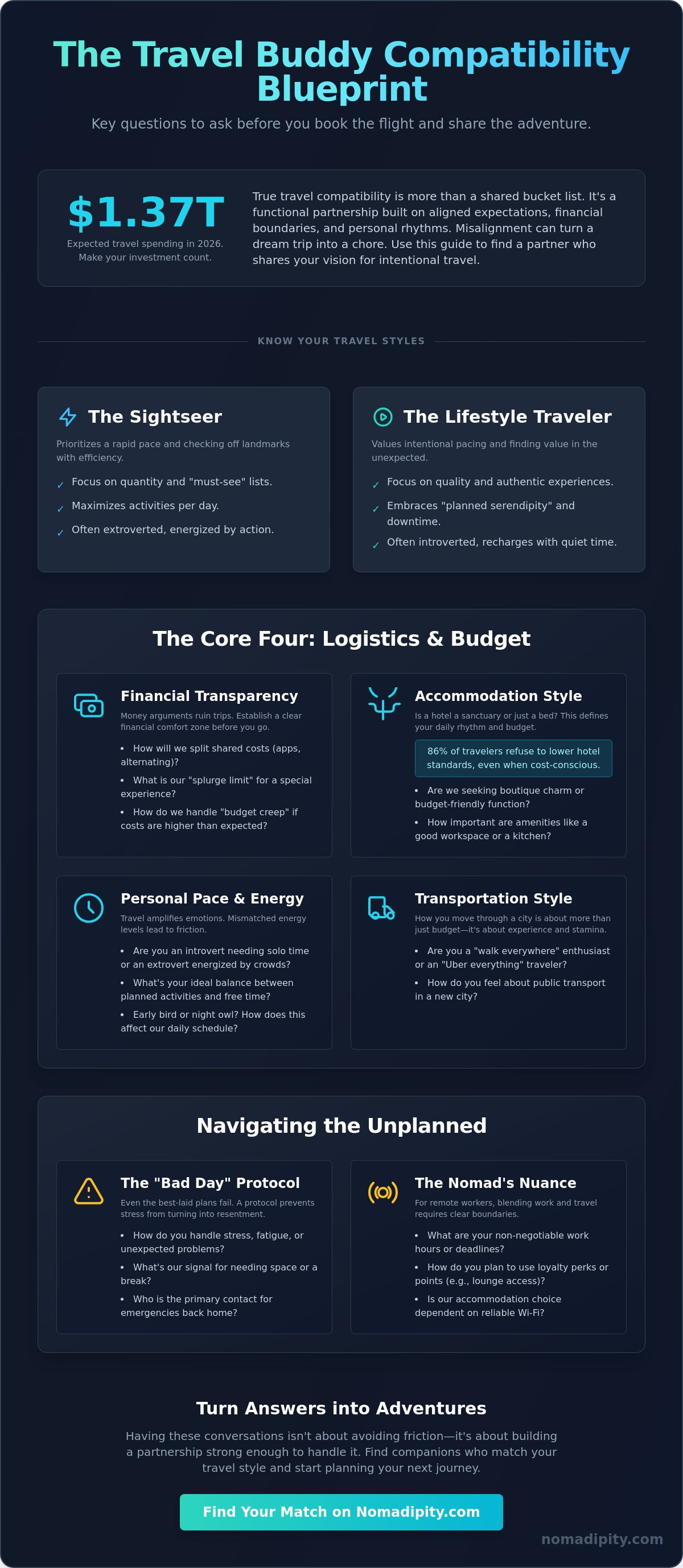
At the heart of this alignment is understanding interpersonal compatibility and how it shifts when you leave your comfort zone. In 2026, we see a growing divide between the traditional "sightseer" and the modern "lifestyle traveler." The sightseer often prioritizes a rapid pace, checking off landmarks with efficiency. The lifestyle traveler, however, values geographic autonomy and intentional pacing. They want to find value in the unexpected, a core pillar we prioritize at Nomadipity. To bridge this gap, you need specific questions to ask a potential travel buddy that dig beneath the surface of a simple itinerary.
The Psychology of Shared Movement
Travel is an emotional amplifier. It heightens joy, but it also magnifies stress and fatigue. Because of this, your companion needs to match your "emotional baseline." If you are someone who finds peace in quiet reflection after a day of exploring, but your partner needs constant external stimulation, friction is inevitable. It's vital to identify your energy recharge needs early on. Are you an introvert who requires solo time to process the day, or an extrovert who draws energy from the crowd? Successful pairs often embrace "planned serendipity." This is the practice of establishing a solid logistical foundation so that you both feel safe enough to lean into unplanned, meaningful moments when they arise.
Vetting for Depth Over Speed
When you start the vetting process, "How many countries have you been to?" is often the wrong first question. It focuses on quantity rather than quality. Instead, pivot the conversation toward the "why" behind their movement. Do they travel to escape, to learn, or to work? Understanding their motivation helps you see if your paths actually lead to the same destination. In 2026, where 74% of Millennials and Gen Z view travel as a non-negotiable expense, the stakes are too high for "maybe." Using targeted questions to ask a potential travel buddy allows you to move past the superficial and find a partner who values depth over speed, ensuring your shared journey is as restorative as it is adventurous.
The Core Four: Essential Logistics and Budget Alignment
Money has a way of stripping the romance from a sunset if you're arguing over the price of the cocktail in your hand. Establishing a Financial Comfort Zone isn't about counting pennies. It's about ensuring neither of you feels restricted or resentful when the bill arrives. Resentment is a heavy suitcase to carry. If you want to know how to pick the perfect travel buddy, you must start with the unglamorous details of the wallet. In 2026, with US carriers charging between $45 and $50 for a first checked bag, even small logistical choices add up quickly. These questions to ask a potential travel buddy help flush out those friction points before they become arguments in a foreign language.
Accommodation is another silent dealbreaker. One traveler might view a hotel as merely a place to sleep, while another sees it as a sanctuary. Currently, 86% of travelers refuse to lower their standards for hotel quality, even when they are cost-conscious. Are you looking for boutique charm, or are you comfortable with an airport lounge nap to catch an early flight? Similarly, consider your transportation style. The "walk everywhere" enthusiast will clash with the "Uber everything" traveler within forty-eight hours. These differences aren't just about money. They're about physical stamina and how you choose to experience the pulse of a new city.
Financial Transparency Questions
How do you plan to split shared costs? Apps like Splitwise are standard, but alternating rounds can feel more organic for some. Ask about the "splurge limit" early on. If a once-in-a-lifetime hot air balloon ride appears, is a $400 price tag a "yes" or a "hard no"? You should also address "budget creep." When exchange rates shift or local prices surprise you, does the trip continue as planned, or do you scale back? Understanding the difference between a daily spending limit and an emergency fund is what separates a prepared traveler from a stressed one.
The Daily Rhythm and Pace
A morning person and a night owl can travel together, but only with a plan. If you're at the museum when it opens and they're just hitting the snooze button, frustration builds. We often suggest the "One Big Thing" rule. Pick one non-negotiable activity per day. Everything else is a bonus. This leaves room for the 87% of travelers who crave spontaneity and unexpected discoveries. How much down time do you need to stay sane? Some need a two-hour nap to recharge, while others want to go until they drop. Finding this level of alignment is exactly why we built our travel matchmaking community, connecting you with people who already share your financial and logistical wavelength.
The Nomad’s Nuance: Questions for Frequent Flyers and Remote Professionals
For the modern professional, movement isn't a vacation. It's a lifestyle that requires a specific logistical infrastructure. When your office is a laptop and your boardroom is a cafe in Lisbon, your companion must understand the gravity of a deep work session. They need to respect the silence required for a focused sprint. This is where many casual pairings fail. They treat travel as a 24/7 party, while you're trying to hit a deadline. These nuanced questions to ask a potential travel buddy ensure your professional life doesn't suffer for your wanderlust. You aren't just looking for a friend. You're looking for a co-pilot who understands that the laptop opens as often as the passport.
Connectivity is the lifeblood of this existence. A good Wi-Fi signal isn't enough. You need high-speed, reliable access that won't drop during a client call. Before booking a shared villa, ask about their backup plans. Do they carry a personal hotspot? Do they prioritize co-working spaces over trendy but loud cafes? If your goals include local networking, clarify that early. Some travelers want to stay in a bubble of two. Others want to integrate into the local tech or creative scenes. Aligning on these networking goals prevents the friction of one person feeling ignored while the other builds a global professional network.
Status and Perks Compatibility
Loyalty programs are the hidden currency of frequent travel. If you've spent years building status with a specific airline alliance, you likely enjoy the sanctuary of a lounge or the ease of priority boarding. But what happens if your partner doesn't? Discussing which alliances you prioritize prevents awkward gate-side goodbyes. Ask if they have guest passes or if they're willing to pay for lounge access during long layovers. This is why finding a social network for frequent flyers is so valuable. It helps you find companions who already move within the same reward ecosystems, making the journey as comfortable as the destination.
The Digital Nomad Work-Travel Balance
Timezone management is a delicate dance. If your clients are in New York but you're in Bangkok, your deep work hours will likely happen at night. Does your buddy mind if the lights are on late? Or do they expect you to be up for a 7:00 AM hike? Establishing these boundaries is essential for a sustainable digital nomad lifestyle. According to a 2025 survey, 72% of digital nomads now prefer matching based on mutual interest and professional alignment rather than just location. This shift highlights a growing need for partners who respect the unhurried movement of a professional life on the road.
Navigating the Unplanned: Conflict and Emergency Preparedness
Even the most meticulously curated itineraries eventually face the reality of a missed connection, a sudden downpour, or a lost passport. It is in these moments of high friction that the true nature of your partnership is revealed. While previous sections focused on the logistics of work and wealth, this stage of vetting is about emotional resilience. You need a "Bad Day" protocol. This is a pre-negotiated agreement on how you will handle the inevitable stress of the road. Finding the right companion means finding someone whose reaction to chaos complements your own, rather than escalating it. These questions to ask a potential travel buddy serve as a stress test for your future adventures.
Conflict is not a sign of a failed trip; it is a natural byproduct of two independent people sharing a confined space. The danger lies in how that conflict is managed. Do you prefer to address issues immediately with a candid conversation, or do you need to "stew" and process your thoughts before speaking? Misaligned resolution styles can lead to weeks of silent resentment. Similarly, you must establish an "Alone Time" agreement. The "Alone Time" agreement is the structural support that allows a partnership to breathe, transforming a potentially suffocating experience into a series of shared and solo discoveries. It should be perfectly acceptable to spend a day apart without explanation or guilt.
The Stress Test Questions
How do you react when the unexpected happens? Ask your potential partner to describe their last travel disaster. If they blame everyone else or shut down completely, take note. You should also inquire about their "social battery" limit. In a world where 87% of travelers want room for unexpected discoveries, you need to know when your partner has reached their capacity for external stimulation. Do they need total silence to recharge, or can they find peace in a crowded cafe? Knowing these limits helps you navigate the unhurried movement we advocate for at Nomadipity.
Health and Safety Logistics
Safety is the one area where you cannot afford to be vague. In 2026, a comprehensive travel insurance policy typically costs between 4% and 8% of your total prepaid trip cost. For a $5,000 journey, a younger traveler might pay around $204, while someone over 65 could expect to pay $394 or more. Does your buddy have active coverage? You must also share emergency contacts and discuss a plan for serious illness or injury. If you want to skip the guesswork and find a partner who takes these preparations as seriously as you do, subscribe to our travel matchmaking community to connect with vetted, like-minded explorers.
Turning Answers into Adventures: Vetting Your Match on Nomadipity
Gathering your list of questions to ask a potential travel buddy is only the first step of the journey. The real magic happens when you move from digital dialogue into real-world movement. At Nomadipity, we believe that the right framework facilitates the most meaningful, unplanned moments. By using our matchmaking filters, you can bypass the awkwardness of initial misalignment. You can search for companions based on specific travel styles, professional affiliations, and even loyalty program status. This ensures that the person you're chatting with already exists within your general financial and logistical orbit.
Vetting is not a one-time event; it's a process of layered discovery. Beyond the initial profile match, we encourage our members to engage in our niche forums. Seeing how a potential companion interacts with the broader community provides invaluable insight into their personality and problem-solving approach. If you're looking for a comprehensive roadmap to starting this process, our find a travel buddy guide offers the ultimate 2026 perspective on shared adventures. It's about finding a partner who values depth over speed, just as you do.
How to Use Nomadipity for Vetting
Leverage our traveler profiles to look beyond the curated photos. Check their past itineraries and see if their pacing matches your own. Do they prefer the "slow travel" movement, or are they constantly on the go? In 2026, where 65% of travelers see their journeys as an expression of personal identity, finding a match who understands your "why" is essential. Use the platform to schedule a video call early on. A face-to-face conversation, even through a screen, reveals nuances in conversational flow that text simply cannot capture. It's your first opportunity to see if the "vibe" matches the data.
The Pre-Trip 'Vibe Check'
Never underestimate the power of a trial run. Before committing to a month-long excursion, plan a local meetup or a simple weekend trip. This is the ultimate vetting tool. It allows you to test your questions to ask a potential travel buddy in a low-stakes environment. If you can navigate a delayed train or a mediocre dinner together at home, you're far more likely to handle the complexities of a global adventure with grace. During this time, discuss your "deal-breakers" candidly. Transparency now saves both time and money later.
Finalize your partnership with a "Travel Contract." This doesn't need to be a formal legal document, but a clear, verbal agreement on the non-negotiables. Confirm your budget for the €20 ETIAS fees, your stance on the $50 baggage charges, and your boundaries for remote work. Once the logistics are settled, you can let go of the stress and embrace the unexpected. Trust your intuition. If the answers are right but the energy feels off, keep looking. Your perfect travel companion is out there, and the right vetting process will lead you directly to them.
Your Next Great Adventure Starts with a Conversation
True travel compatibility is far more than a shared interest in the same coastline or city. It is the quiet confidence that comes from aligning your financial rhythms, professional boundaries, and emotional baselines before the first flight is even booked. By utilizing intentional questions to ask a potential travel buddy, you transform a risky social experiment into a sustainable partnership. This process isn't about avoiding every challenge; it's about ensuring you have the right co-pilot to navigate them with grace.
Finding a companion who values depth over speed doesn't have to be a matter of chance. Our community is designed for those who seek meaningful connections through advanced traveler search filters and seamless loyalty program integration. Whether you're looking for a fellow remote professional or a seasoned frequent flyer, you can find your perfectly matched travel companion on Nomadipity today. Join our vetted community and step into your next journey with the clarity and excitement you deserve. The world is waiting, and it is much better when shared with someone on your wavelength.
Frequently Asked Questions
What is the most important question to ask a potential travel buddy?
The most critical question centers on how your partner responds to high-stress situations. Ask them to recount a specific time a flight was canceled or a reservation was lost. Their answer reveals their emotional baseline and whether they escalate chaos or remain calm. These are the essential questions to ask a potential travel buddy because they uncover the resilience needed for long-term journeys. Shared interests are great, but shared problem-solving is the foundation of a successful trip.
How do I tell someone I don’t think we’re a good travel match?
Honesty is the kindest path when you realize a travel style mismatch. You can say, "I've really enjoyed our conversations, but looking at our daily rhythms, I think our travel styles are too different for this specific trip." Focus on the logistics, like your preference for slow travel versus their desire for a packed itinerary. This keeps the rejection professional and preserves the friendship without the baggage of a failed adventure abroad.
Is it weird to ask about a travel buddy's budget right away?
Financial transparency is never weird; it is a prerequisite for a stress-free journey. In 2026, with rising costs like the €20 ETIAS fee and increased baggage rates, you must know if your budgets align. Discussing your "Financial Comfort Zone" early prevents the awkwardness of one person wanting street food while the other eyes a Michelin star. It is better to have a difficult conversation at home than a resentful argument in a foreign city.
What should I do if my travel buddy and I have different loyalty status?
Address loyalty status differences before you reach the airport gate. If you have lounge access and your partner doesn't, decide if you'll guest them in, pay for their entry, or simply meet at the boarding area. Many frequent flyers prefer to spend that hour catching up on emails in the lounge. As long as you both agree on the plan, there is no need for guilt or frustration over separate pre-flight experiences.
How can I find a travel partner who also works remotely?
Finding a remote-work-compatible partner requires looking in specialized spaces. General travel groups often attract vacationers who don't understand the "deep work" requirements of a digital nomad. Platforms like Nomadipity allow you to filter for travelers who share your professional needs and timezone constraints. This ensures you find someone who understands that the laptop stays open for specific hours, making the balance between work and exploration feel entirely natural.
Should we sign a travel agreement before leaving?
A verbal or written "Travel Contract" is a smart way to establish structured spontaneity. It doesn't need to be legally binding, but it should cover non-negotiables like budget caps, work hours, and emergency protocols. Putting these agreements in writing helps prevent selective memory later on. It serves as a grounded reference point if expectations start to drift, allowing you both to return to your original shared vision for the journey.
How do I handle it if my travel buddy wants to spend more money than me?
Establishing a "Splurge Limit" helps manage different spending habits without causing friction. Agree on which costs are shared and which are individual. If your buddy wants a luxury upgrade you can't afford, it's perfectly fine to stay in different accommodations or meet for specific activities. The key is to ensure neither person feels pressured to overspend or restricted by the other's budget. Clear boundaries allow for independent choices within a shared trip.
What if we realize we don't get along once the trip has already started?
Lean on your pre-arranged "Alone Time" agreement if the vibe shifts during your trip. Sometimes, a day or two of solo exploration is all you need to reset the dynamic. If the conflict is deeper, don't be afraid to discuss an early travel breakup where you finish the trip separately. It's better to spend your travel budget on a solo experience you love than to waste it on a shared one that feels draining.

Disclaimer
Nomadipity Blog Disclaimer
The content on Nomadipity is provided for general informational and inspirational purposes only. While we strive for accuracy and timeliness, Nomadipity does not guarantee that any information is complete, current, or suitable for your specific needs. Use your judgment and verify details before making travel plans, meeting with other users in person, or making any purchases influenced by the article.


