

What if the person you love most is actually the one thing standing between you and the trip of a lifetime? It is a heavy realization to have while standing before the Sagrada Família or navigating a bustling market. You have likely spent months planning and braving the 19.9 percent spike in airfares we have seen throughout 2026, yet you find yourself bickering over transit routes instead of soaking in the sunset. It is exhausting to feel a loss of interest in world-class sights just because the social friction has become too loud. You are not a bad partner for wanting space. Usually, this tension stems from a simple misalignment in travel style compatibility rather than a fundamental flaw in your connection.
You can restore your sense of wonder. This guide helps you identify the subtle signs of travel partner burnout before they boil over. We will walk through a framework of structured spontaneity designed to de-escalate tension and ensure your journey remains deeply restorative.
Key Takeaways
- Learn to distinguish between simple physical fatigue and the more complex social battery depletion that often masks deeper friction between partners.
- Discover how to implement a 24-hour No-Guilt Solo Reset to reclaim your individual perspective and restore your genuine sense of adventure.
- Understand the role of travel style compatibility in preventing burnout and how to use intentional filters to align with partners before you book.
- Master the framework of structured spontaneity to build deliberate pacing and non-negotiable downtime into any 2026 itinerary.
Identifying the Friction: Why Travel Style Compatibility Fails Mid-Trip
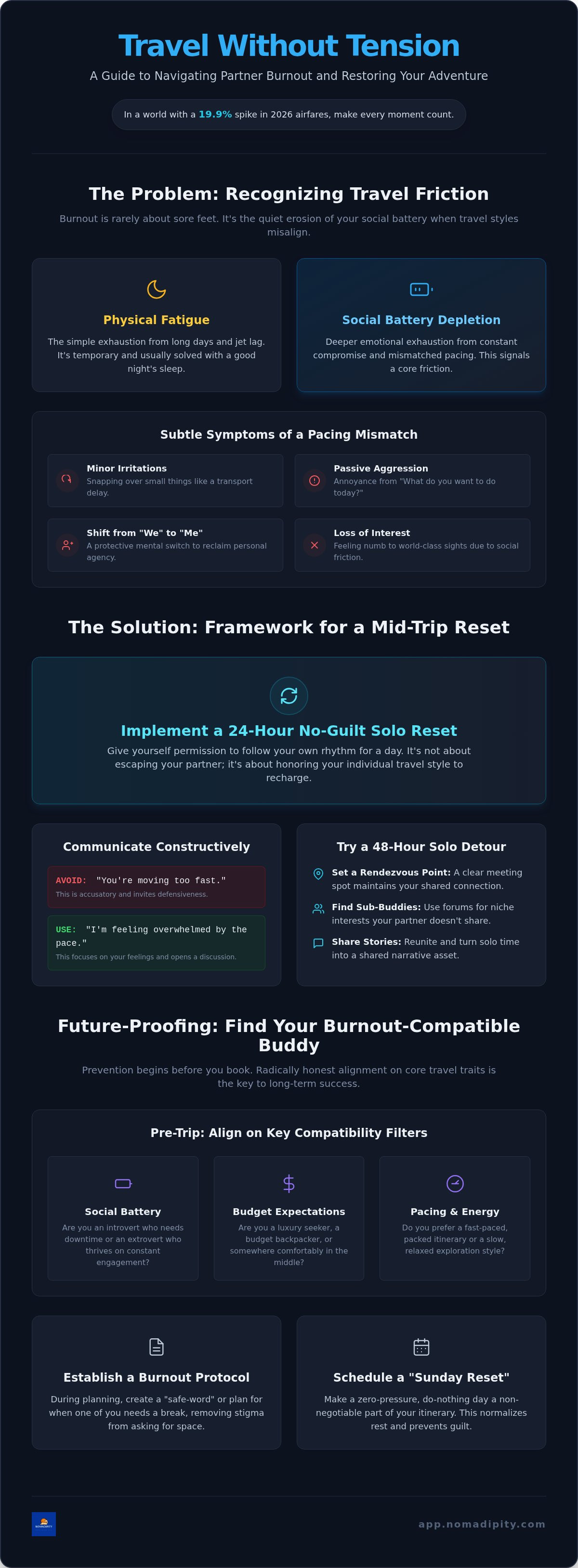
Travel burnout is rarely about sore feet. It is about the quiet erosion of your social battery. In a shared 2026 itinerary, the line between physical fatigue and emotional depletion is incredibly thin. One of you might be eager for a third museum tour, while the other is mentally calculating how many rewards points it takes to hide in the hotel lounge for the afternoon. This disconnect often signals a fundamental gap in travel style compatibility that only reveals itself once you are far from home.
The pressure of digital storytelling adds a heavy psychological weight to these moments. We are constantly surrounded by curated reels of perfect duos, making any internal friction feel like a personal failure. When your expectations don't match your partner's reality, your brain often switches from a "we" mindset to a "me" focus as a protective response. This shift is an attempt to reclaim personal agency when your sense of geographic autonomy feels threatened by a partner's differing pace.
Understanding your partner's conflict management styles can help you decode these tensions. Often, the "cultural deep-diver" and the "luxury seeker" aren't actually at odds; they are just speaking different travel languages. Recognizing this allows you to address the pacing mismatch before it turns into a permanent resentment.
The Subtle Symptoms of a Partner Pacing Mismatch
It starts with minor irritations. You might find yourself snapping over a local transport delay or feeling a surge of passive-aggressive annoyance when they ask, "What do you want to do today?" These small sparks are indicators that your social batteries are draining at different rates. Travel partner burnout is a temporary misalignment of energy and intent, not a character flaw. Identifying these symptoms early allows you to pivot toward a solution before the joy of the journey is lost entirely.
Strategic Interventions: The Framework for Structured Spontaneity
Saving a journey requires more than just grit; it needs a framework. Implementing a 24-hour No-Guilt Solo Reset is a powerful way to restore your individual perspective. By stepping away for a full day, you give yourself permission to follow your own rhythm. This isn't about escaping your partner. It is about honoring your individual travel style compatibility. Restructuring your remaining itinerary with deliberate pacing ensures you don't cancel existing bookings but rather adjust the energy required to meet them.
When you speak up, use "I" statements. Say, "I feel overwhelmed by the pace," rather than "You are moving too fast." This prevents defensiveness and keeps the focus on your internal needs. You can rediscover your personal agency by applying principles from our solo travel guide. These strategies help you navigate the transition from shared logistics to planned serendipity without losing your connection to the shared adventure.
The Solo Detour: How to Spend Time Apart to Stay Together
Try a 48-hour detour. Establish a clear rendezvous point, like a specific cafe or a hotel lobby, to maintain the thread of your shared trip while you pursue separate interests. If there is an activity you love but your partner hates, check the Nomadipity.com group forums to find temporary sub-buddies. This allows you to find like-minded companions for niche adventures without pressuring your main partner. When you reunite, sharing your separate stories turns solo time into a shared narrative asset, enriching your bond through the value of the unexpected.
Future-Proofing: Finding a Burnout-Compatible Travel Buddy
Preventing burnout begins long before you reach the airport. It starts with a radical honesty about how you actually recharge. Generic social groups might help you find someone who likes the same cities, but a dedicated social network for frequent flyers allows you to filter for deeper, more meaningful traits. By using Nomadipity.com matchmaking filters, you can align on social batteries and budget expectations, ensuring high travel style compatibility from day one. Establishing a Burnout Protocol during the initial find a travel buddy phase creates a safe space to discuss needs before any friction starts.
One of the most effective tools for longevity is The Sunday Reset. This is the practice of scheduling a full day of zero-pressure downtime as a non-negotiable part of your itinerary. It isn't about being lazy; it is about sustainable movement. By normalizing rest, you remove the guilt that often triggers bickering when one person needs to pause while the other wants to push forward. This proactive boundary setting ensures that your geographic autonomy remains intact even within a shared journey.
Vetting for Compatibility Beyond the Bucket List
To truly gauge travel style compatibility, move past the "where" and ask about the "how." Ask potential partners to describe their worst travel day. Their answer reveals how they handle stress and whether they lean into isolation or community when things go wrong. For those of us balancing professional lives, aligning on Work-from-Roam schedules is vital. Ensuring your partner respects your deep-work windows prevents resentment and protects your mental clarity. Join the Nomadipity.com community to connect with travelers who value depth over speed and understand that a quiet afternoon in a local library is just as valuable as a mountain trek.
Reclaiming the Joy of the Open Road
The road is too long to spend your journey in a state of quiet resentment. While the logistical reality of travel in 2026 demands careful planning, the emotional landscape requires even more intentionality. By moving beyond the surface of bucket lists and embracing the frameworks we've discussed, you transform travel partner burnout from a trip-ending crisis into an opportunity for personal growth. True travel style compatibility is found in the delicate balance between shared wonder and the freedom of geographic autonomy. You're now equipped to navigate the unhurried movement you crave, whether that means a solo detour or a communal Sunday Reset. Find a travel companion who matches your pace on Nomadipity.com and join a global community of frequent flyers who prioritize meaningful connection over mere convenience. The world is vast and unpredictable, but with the right mindset and the right partner, it is always welcoming.
Frequently Asked Questions
How do I tell my travel partner I need space without hurting their feelings?
The best approach is to frame the request around your own energy levels rather than your partner's actions. Use "I" statements to explain that you need a solo reset to recharge your social battery. Emphasize that taking a few hours apart will make your shared time more meaningful. Honest communication about your needs is the bedrock of long-term travel style compatibility.
Is it normal to feel lonely even when traveling with a partner?
It's entirely normal to feel a sense of isolation when your internal rhythms don't match your companion's pace. Loneliness often stems from a lack of shared purpose or misaligned pacing rather than a lack of company. If you're rushing through sights while your partner wants to linger, the emotional distance can feel vast. This highlights the importance of travel style compatibility.
What are the first signs that travel burnout is starting to affect our relationship?
The earliest indicators are usually small, uncharacteristic flashes of resentment over logistical details. You might find yourself snapping over a dinner choice or feeling a heavy sense of dread during morning planning sessions. When the "we" mindset shifts into a protective "me" response, it's a clear signal that the psychological weight of constant proximity is becoming unmanageable.
Can a solo detour actually save a failing travel partnership?
A planned solo detour can be the most effective way to preserve a partnership under strain. By spending 24 to 48 hours pursuing separate interests, you reclaim your individual sense of agency and geographic autonomy. This space allows you to gather new stories to share. When you reunite, you'll often find your mutual enthusiasm for the journey has been completely restored.

Disclaimer
Nomadipity Blog Disclaimer
The content on Nomadipity is provided for general informational and inspirational purposes only. While we strive for accuracy and timeliness, Nomadipity does not guarantee that any information is complete, current, or suitable for your specific needs. Use your judgment and verify details before making travel plans, meeting with other users in person, or making any purchases influenced by the article.


