

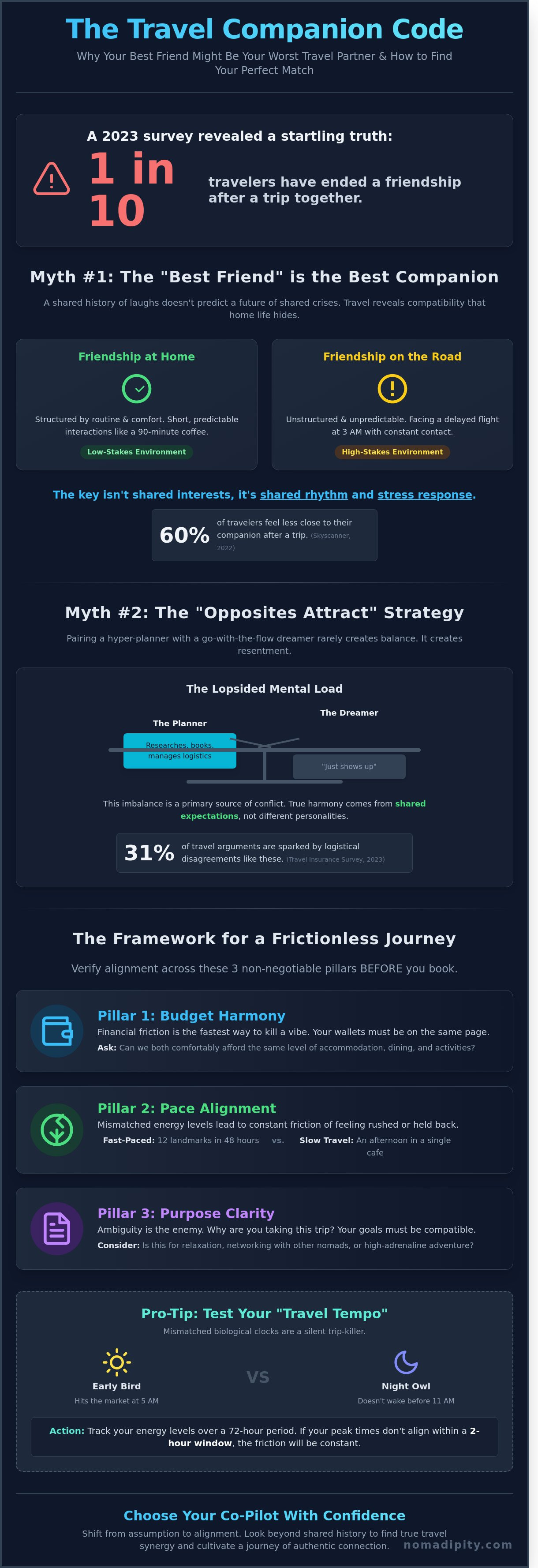
Your best friend might be the worst person to bring on your next flight. It sounds harsh, but a 2023 survey by a leading travel publication revealed that 1 in 10 travelers have actually ended a friendship after a shared vacation. We often assume that because we share a deep history or a similar sense of humor, we will naturally excel at choosing a travel partner who shares our vision for the road ahead. You likely want your journey to feel like a seamless flow of planned serendipity, not a series of awkward negotiations over dinner bills or mismatched wake-up calls.
It is perfectly normal to worry that social friction could ruin an expensive trip or that differing energy levels will leave you feeling drained. You deserve to move through the world with someone who enhances your experience rather than complicates it. In this article, you'll discover why your closest confidant might be your most challenging companion and learn the art of finding a partner who truly complements your rhythm. We are going to break down five common myths that lead to travel burnout and provide a clear framework for vetting your next co-pilot with confidence.
Key Takeaways
- Understand why deep-rooted friendships often struggle under the pressure of travel and how to identify your specific behavioral compatibility before you book.
- Recognize the hidden resentment that builds when logistics and budgets are misaligned, ensuring your financial styles complement rather than conflict.
- Master the art of choosing a travel partner by looking past the itinerary to test for emotional resilience during the inevitable "3 AM airport" moments.
- Explore how to cultivate serendipity by shifting your search from social media to intentional, affiliation-based matching that aligns with your professional and lifestyle goals.
- Learn to design a journey that prioritizes authentic human connection over a rigid checklist, allowing your shared experiences to foster true personal growth.
The Myth of the "Best Friend" Travel Companion
You've known them since second grade. You share a love for dark roast coffee and 90s hip-hop. Naturally, you assume they're the perfect person for a month in Vietnam. This is a dangerous leap. Choosing a travel partner requires a different lens than choosing a Friday night dinner date. Domestic comfort often masks fundamental differences in how we handle the unknown. A shared history doesn't guarantee a shared future in a foreign land.
Think about the last time you grabbed coffee with your closest friend. It likely lasted ninety minutes and involved a comfortable exchange of stories in a familiar setting. Now, compare that to a delayed flight at 3:00 AM in a terminal where you don't speak the language. The skills required to navigate a menu are not the same as those needed to navigate a foreign transit system under sleep deprivation. This distinction is vital when choosing a travel partner because your history of shared laughs does not predict your future of shared crises.
Friendship vs. Travel Synergy
Home life is structured by routines that minimize friction. On the road, these structures vanish. A 2022 survey by Skyscanner revealed that 60% of travelers have returned from a trip feeling less close to their companion than when they left. Your home version friend might be punctual, but their travel version could be paralyzed by a missed train in Tokyo. Shared interests are superficial; what matters is your shared rhythm.
The High Stakes of Emotional Proximity
Constant contact turns small habits into massive stressors. If your partner forgets to charge their phone, you'll notice it ten times more during a 14-hour layover in Dubai. Successful pairs practice independent togetherness, where it's okay to wander separate streets for an afternoon. Travel compatibility is the alignment of logistical needs and stress-response systems. Without this, your history won't save you from a breakdown in a crowded bazaar.
Realizing this myth is the first step toward intentional living on the road. You must look beyond the comfort of the familiar to find someone who handles chaos with grace. This mindset is how you cultivate planned serendipity. By setting up the right expectations early, you open the door to those magical, unplanned moments that define slow travel. Choosing a travel partner based on their reaction to a crisis is far more effective than choosing one based on their favorite movie.
Debunking the "Opposites Attract" Travel Strategy
We've been told for decades that opposites balance each other out. In the context of choosing a travel partner, this myth suggests that a Type-A hyper-planner and a "go-with-the-flow" dreamer make the perfect team. The theory is that one handles the gritty details while the other provides the soul of the adventure. In reality, this dynamic often leads to a lopsided mental load that breeds quiet resentment. When one person spends 4 hours researching the best neighborhood in Lisbon while the other simply shows up, the partnership stops being a collaboration and becomes a service. A 2023 survey by a major travel insurance provider found that 31% of travel-related arguments are sparked by these exact logistical disagreements. True harmony doesn't come from being different; it comes from shared expectations.
Alignment is the foundation of every successful journey. Before you book that non-refundable flight, you must verify your compatibility across three mandatory pillars:
- Budget: Can you both comfortably afford the same level of accommodation and dining? Financial friction is the fastest way to kill a mood.
- Pace: Do you want to see 12 landmarks in 48 hours, or would you rather spend a Tuesday afternoon in a single cafe?
- Purpose: Is this trip about total relaxation, or are you looking for a community of fellow digital nomads to expand your network?
The Friction of Mismatched Rhythms
Biological clocks are rarely negotiable. If you're an early bird who wants to hit the Tokyo fish market at 05:00 and your partner is a night owl who doesn't wake before 11:00, you'll spend half your trip waiting or feeling rushed. This mismatch kills the "slow travel" vibe many of us crave. You can identify your "Travel Tempo" by tracking your energy levels over a standard 72-hour period. If your peaks don't align within a 2-hour window, the friction will be constant. You can explore our guide on intentional living to better understand how your daily habits translate to life on the road.
Defining Your Travel Purpose
Ambiguity is the enemy of a good trip. Entering a journey with the mindset of "just seeing where it goes" sounds romantic, but it usually results in wasted days and missed connections. Are you seeking deep cultural immersion or a quiet place to finish a freelance project? Without a defined purpose, you risk drifting into someone else's agenda. We call the middle ground The Art of Planned Serendipity, where you set a clear intention while leaving space for the unexpected. When choosing a travel partner, ensure their "why" mirrors yours, or you'll find yourselves walking the same streets with entirely different destinations in mind.
The Budget Harmony Fallacy: Why Wallets Must Align
Many travelers believe a "spender" and a "saver" can balance each other out. It is a dangerous assumption that often leads to quiet resentment at the dinner table. When choosing a travel partner, you aren't just picking a companion; you are selecting a financial co-pilot for a high-stakes journey. If your bank accounts speak different languages, the friction will eventually drown out the joy of exploration. A 2023 survey by Bankrate revealed that 27 percent of travelers feel pressured to overspend when traveling with others, a statistic that highlights the hidden stress of mismatched resources.
Modern travel introduces a strange social hierarchy through the "Points vs. Cash" dynamic. One partner might book a business class seat using 80,000 miles earned through location independence and strategic spending. The other might pay $1,200 in hard-earned cash for an economy seat. This creates a lopsided experience where one person feels the sting of every transaction while the other operates in a gamified economy. Without a shared "Financial Comfort Zone," the person paying cash may feel constant guilt for "holding back" the points-rich traveler, while the points-traveler may feel limited by their partner's budget constraints.
The Loyalty Status Gap
Imagine arriving at the airport three hours early. You have elite status that grants access to a quiet lounge with complimentary meals and showers. Your partner does not. Do you leave them at a crowded gate or do you pay the $50 guest fee? These moments create a social awkwardness that erodes the serendipity of the trip. Matching with fellow Nomadipitians who hold similar rewards tiers ensures that perks like 4:00 PM late check-outs or room upgrades don't become points of contention. When your statuses align, the logistics of luxury become a shared benefit rather than a source of division.
Transparent Budgeting Conversations
Avoid the trap of "we'll figure it out there." Deeply personal views on money require a structured approach before the first bag is packed. Discussing daily spending limits helps you cultivate a trip that feels sustainable for both parties. Consider these three pillars for financial alignment:
- Agree on Splurge Categories: Decide if you'll prioritize a $150 tasting menu or a $300 boutique hotel stay. Knowing where you both value "authenticity" prevents mid-trip arguments.
- The Emergency Fund: Agree on a $500 "buffer" per person for missed trains or medical needs. This ensures that a crisis doesn't lead to a blame game.
- Daily Caps: Set a baseline for mundane costs like coffee and local transport to keep expectations grounded.
Design your financial boundaries early. It's the only way to ensure that when you're choosing a travel partner, you're choosing someone who enhances your experience rather than someone who makes you count every penny in frustration.
Beyond the Itinerary: Testing Emotional Resilience
It's a common misconception that a meticulously planned Google Sheet prevents friction. In reality, a 2023 survey of frequent flyers indicated that 48 percent of travel arguments stem from unexpected delays rather than the activities themselves. Choosing a travel partner isn't about finding someone who loves the same museums; it's about finding someone whose nervous system aligns with yours when the world gets messy. A perfect itinerary is just a piece of paper. It won't help you when a monsoon hits or a booking disappears from the system.
Think of this as the 3 AM Airport Test. When a flight is canceled in a city where you don't speak the language, does your companion become a teammate or a liability? You need to understand how they navigate high-stress moments before you're stuck in a terminal for 12 hours. Cultivating a sense of planned serendipity requires a companion who can laugh when the map leads to a dead end. To ensure you're looking for the right traits, read our guide on How to Vet a Potential Travel Companion Safely before booking your tickets.
The Vetting Process: A Step-by-Step
- Step 1: The "Coffee Interview" – Ask about their worst travel disaster. If they blame everyone else for a 2021 missed train in Italy without taking any personal responsibility, that's a red flag. Look for stories that show resilience and humor.
- Step 2: The "Trial Weekend" – Spend 48 hours in a nearby city. This micro-trip reveals more about their morning energy and decision-making habits than six months of texting ever could.
- Step 3: The "Logistics Audit" – Compare your digital needs. If you require high-speed Wi-Fi for remote work while they want to go off-grid, you'll face immediate friction. Discuss your tech chargers and packing styles early.
Conflict Resolution on the Road
Understanding communication styles is vital for long-term harmony. Are they "Silent Seethers" who hold grudges for days, or "Explosive Communicators" who flare up and then move on? Neither style is inherently wrong, but mismatched patterns create a toxic atmosphere in a small hotel room. You must establish how you'll handle the inevitable fatigue that comes with slow travel.
Implement a "Safe Word" for your social battery. Use a word like "Quartz" to signal that you need two hours of solo time without any questions or hurt feelings. A good travel partner isn’t someone who never gets stressed, but someone who communicates through it. This transparency allows you to navigate the world with a sense of quiet confidence, knowing you have each other's backs when the path gets steep.
Ready to design your next journey with clarity? Explore our guide to location independence to find your rhythm on the road.
Cultivating Serendipity through Intentional Matchmaking
Traditional social media is often a poor tool for finding companions. These platforms prioritize the "where" and the "when" while ignoring the "how" and the "why." A 2023 industry report on digital nomadism found that 45% of remote workers experience persistent loneliness because their digital interactions lack genuine depth. You don't just need a random person to split a taxi fare. You need someone who understands the weight of a looming deadline and the quiet joy of a slow morning in a foreign city. Choosing a travel partner requires looking past a filtered profile picture and into the logistical reality of shared values.
We believe in the power of affiliation-based matching. When you connect through shared loyalty programs or specific work styles, you eliminate the friction of mismatched expectations. This is the core of how Nomadipity turns "luck" into a designed system for connection. We help you close the gap between finding a buddy to fill a seat and cultivating a connection that thrives across multiple borders. It's about moving from accidental encounters to planned serendipity.
The Nomadipity Advantage
Our platform uses advanced filters to ensure you aren't just meeting people, but meeting your people. By designing your travel life around shared values and authenticity, you create a foundation for a trip that feels effortless. Nomadipity provides the tools to find this alignment through:
- Advanced filtering: Narrow your search by budget tiers, niche interests, and specific loyalty status to avoid financial or logistical tension.
- Strategic meetups: Connect through airport lounge gatherings or specialized forums before you even board the plane.
- Lifestyle design: Match with others who prioritize slow travel and location independence over rapid, exhausting sightseeing.
Your Next Step: Designing the Journey
Stop settling for "available" partners who happen to be in the same zip code. Start seeking "aligned" explorers who share your vision of a life well-lived. Your travel time is your most precious currency; it's too valuable to spend on a partnership of convenience. Choosing a travel partner should be an act of intentional lifestyle design, not a desperate last resort. Join our community of like-minded explorers who value depth, work-life harmony, and the magic of the unexpected. Find your aligned travel partner on Nomadipity and begin the journey you've actually been dreaming of.
Design Your Journey Through Intentional Connection
Your next trip shouldn't be a gamble on compatibility. We've moved past the myth that a lifelong friendship automatically translates to a seamless journey through the Atlas Mountains. Success relies on intentional matchmaking; a 2023 survey by Skyscanner revealed that 40% of travelers cite conflicting budgets as their primary source of trip tension. By prioritizing financial transparency and testing emotional resilience before you board, you transform a potential disaster into a masterclass in slow travel.
The process of choosing a travel partner is a deliberate act of lifestyle design. It's about finding that rare individual who shares your appreciation for local authenticity and your specific airline status. You don't have to navigate this search alone or settle for "good enough" when you can cultivate planned serendipity.
Join Nomadipity and design your next adventure with the perfect companion. Our platform utilizes advanced filters for 15+ loyalty programs and strict budget alignment to ensure your goals are in sync. You'll join an exclusive community of frequent flyers and digital nomads, supported by safety-first verification for meaningful global connections. The world is waiting for you to explore it with someone who truly understands your pace.
Frequently Asked Questions
How do I tell a friend I don’t want to travel with them?
Be honest and frame the refusal as a difference in travel styles rather than a personal rejection of the friendship. You might say your goals for this specific trip don't align with their pace. A 2023 study by the Journal of Travel Research found that 42% of travel disputes arise from mismatched expectations. Suggest a different way to connect, like a weekend dinner, to keep your bond strong.
What are the biggest red flags when choosing a travel partner?
The biggest red flag is a refusal to discuss logistics or "what if" scenarios before you book your flights. If a potential companion avoids talking about money or daily rhythms, you're likely headed for friction. In a 2022 survey of 1,500 travelers, 30% cited poor communication as the reason for trip fallout. When choosing a travel partner, watch for those who demand total control or show zero interest in the local culture.
Is it better to travel with someone who has the same budget or the same interests?
Prioritize budget alignment over identical interests to avoid the most common source of friction on the road. While you can visit different museums or cafes, constant tension over the cost of a dinner or a hotel room will erode your joy. Data from a 2021 financial wellness report indicates that 1 in 4 travelers feel pressured to overspend by companions. You can always meet up for sunset after pursuing separate hobbies.
How can I find a travel partner if I don’t want to go solo?
Look for companions on verified platforms like GAFFL or specialized communities such as "Female Digital Nomads," which currently boasts over 70,000 members. These communities allow you to vet potential companions based on past trips and shared values. Start with a short test trip to a nearby city for 48 hours. This low stakes trial helps you practice choosing a travel partner who understands your need for both adventure and quiet moments of reflection.
Should we share all expenses or pay for things separately?
Pay for individual meals separately but use an app like Splitwise to manage shared costs like lodging or car rentals. This method keeps the financial record transparent and prevents the awkwardness of constant bank transfers. According to 2023 user data from expense tracking apps, users who settle debts daily report 15% higher trip satisfaction. It allows you to focus on the serendipity of the road rather than a growing pile of receipts.
What happens if we realize we aren’t compatible halfway through the trip?
Initiate a calm conversation immediately and suggest spending at least four hours a day exploring independently. If the friction persists, it's perfectly acceptable to split the itinerary and meet at the final destination. A 2022 travel psychology report suggests that taking a 24 hour solo break can resolve 60% of interpersonal conflicts. You aren't failing; you're simply choosing to preserve your mental clarity and the integrity of your journey.

Disclaimer
Nomadipity Blog Disclaimer
The content on Nomadipity is provided for general informational and inspirational purposes only. While we strive for accuracy and timeliness, Nomadipity does not guarantee that any information is complete, current, or suitable for your specific needs. Use your judgment and verify details before making travel plans, meeting with other users in person, or making any purchases influenced by the article.


