

The most important item in your suitcase for 2026 isn't a passport or a universal adapter; it's a conversation you haven't had yet. You crave the magic of shared discovery, but you likely also worry about the silent tension of a split bill or the anxiety of being left behind in a crowded terminal. It's a common fear that often stifles the potential for deep, geographic autonomy. We believe that clarity is the ultimate fuel for spontaneity. This guide shows you how to craft a travel companion agreement that protects your friendship and your freedom. You'll learn to align your spending habits, synchronize your daily rhythms, and build a practical plan for when the unexpected happens. By establishing these intentional frameworks now, you ensure your journey is defined by genuine connection rather than logistical friction. Let's design a blueprint that lets you both breathe easy and explore deeply.
Key Takeaways
- Understand why even the closest friends need a documented social contract to navigate the complexities of global travel together.
- Learn how to draft a travel companion agreement that establishes clear budget tiers and grants guilt-free permission for solo time.
- Discover how leveraging detailed traveler profiles can streamline the vetting process and ensure your travel styles are truly compatible.
- Build a practical framework for the unexpected, ensuring that logistical hiccups never overshadow the shared joy of your 2026 adventures.
What is a Travel Companion Agreement and Why Does It Matter?
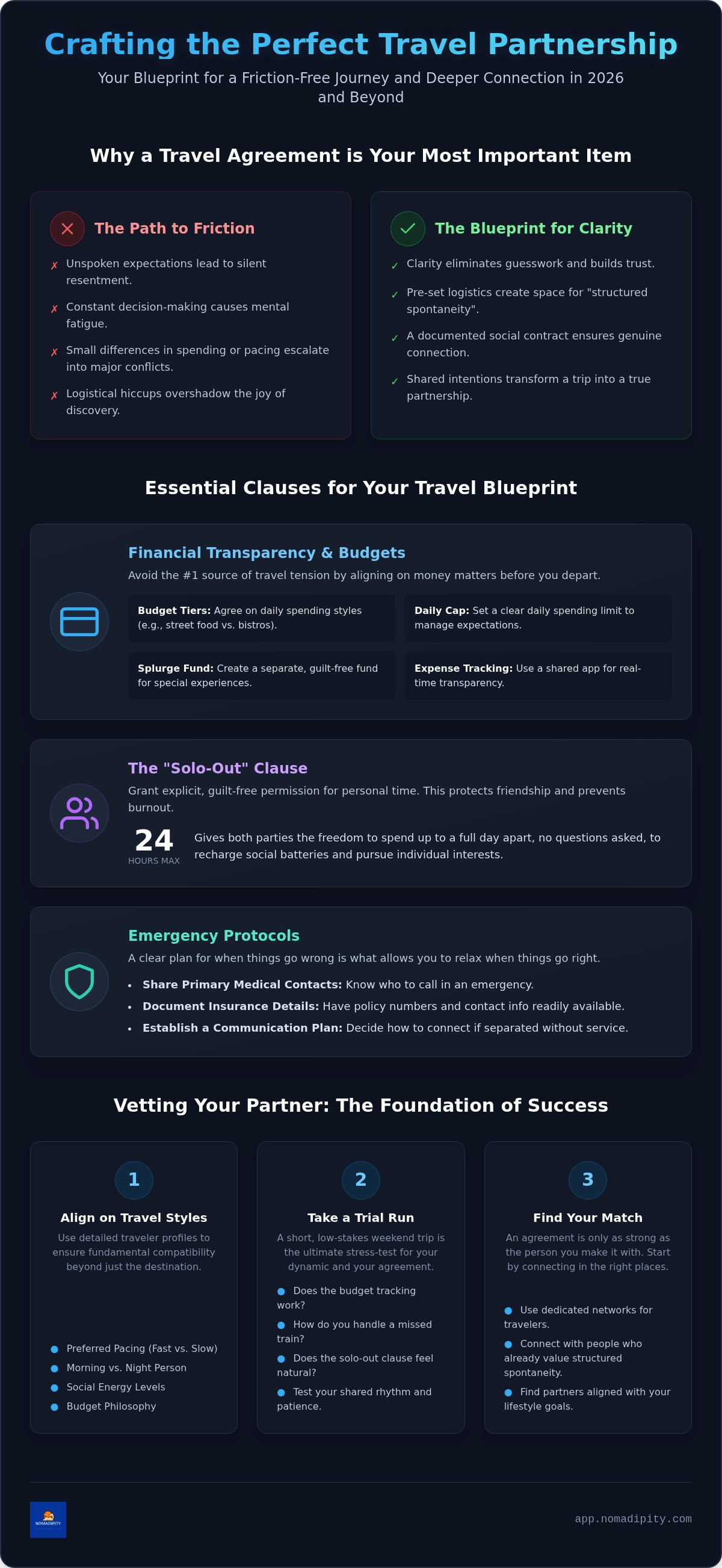
Think of your travel companion agreement as the invisible architecture of a great trip. While many people view "traveling companions" through the narrow lens of insurance policies or emergency contact forms, we see it as a conscious social contract. It is the difference between a journey plagued by silent resentment and one fueled by genuine connection. Even the deepest friendships can fray under the weight of constant decision-making in unfamiliar territory. By documenting your shared intentions before you ever reach the airport, you eliminate decision fatigue. This clarity creates space for structured spontaneity; when the logistics are settled, your mind is free to wander.
We often assume we know our friends' rhythms because we've shared dinners or weekend outings. But twenty-four hours a day in a foreign city is a different beast entirely. Without a travel companion agreement, small differences in pacing or spending can quickly escalate into trip-defining conflicts. It provides a steady anchor in the unpredictable flow of global movement.
Social Expectations vs. Legal Protections
In the world of fine print, organizations like Law Insider often define a companion simply as a named individual on a policy to trigger specific benefits. However, a true agreement goes deeper than a liability waiver. It's an alignment of values that addresses the quiet parts of exploration. It defines how you handle silence, how you share costs, and how you ensure neither person feels lonely while together. Documenting these expectations transforms a shared itinerary into a partnership of geographic autonomy. It's not about rigid rules; it's about the intentional cultivation of a shared path.
Essential Clauses for Your 2026 Travel Blueprint
A successful travel companion agreement isn't a list of restrictions; it's a set of permissions. By defining the boundaries of your shared experience, you create the safety net required for true exploration. Start with the logistical pillars that often cause friction: money, space, and safety. When these are settled, you can lean into the rhythm of your journey with a light heart.
Financial Transparency and Shared Budgets
Money is the most common source of travel tension. To avoid it, establish clear budget tiers for daily life. Will you prioritize local street food or sit-down bistros? Setting a daily cap helps manage expectations, while a separate splurge fund allows for those unexpected moments of luxury without guilt. Use real-time expense tracking apps to maintain transparency and prevent end-of-trip bill shock. You can even synchronize your travel rewards programs to maximize shared perks like lounge access or room upgrades, turning your collective loyalty into tangible comfort. This intentionality ensures that every dollar spent contributes to your mutual joy.
Beyond the wallet, consider the "Solo-Out" clause. This gives both parties explicit permission to spend up to 24 hours apart, no questions asked. It's a vital tool for recharging your social battery and pursuing individual curiosities without feeling like you've abandoned your partner. Finally, document your emergency protocols. Know each other's primary medical contacts and insurance details. Having a plan for when things go wrong is exactly what allows you to relax when things go right. If you're still searching for someone who values this level of clarity, you can connect with compatible travelers who naturally align with your specific pacing and lifestyle goals.
Vetting Your Partner: Where the Agreement Begins
A travel companion agreement is only as strong as the person sitting across from you at the departure gate. You can't contract your way out of a fundamental personality clash. This is why the vetting stage is the most critical phase of your blueprint. Think of it as the research phase of your intentional living design. When you leverage Nomadipity.com, you're not just browsing names; you're accessing a depth of data that simplifies your alignment. The traveler profiles on the platform are designed to pre-fill nearly half of your agreement's travel style section. They cover everything from morning coffee habits to preferred pacing, ensuring you're not starting from zero.
Before you commit to a month in Lisbon, consider the trial run. A simple weekend trip is the best way to stress-test your agreement in a low-stakes environment. Does the solo-out clause feel natural? Is the budget tracking actually happening? Seeing how you both handle a missed train or a rainy day provides more clarity than a dozen video calls. It is the ultimate test of your shared rhythm and patience.
Vetting and Matchmaking: Starting on the Right Foot
Finding the right partner starts with being in the right rooms. By using a dedicated social network for frequent flyers, you connect with individuals who already value geographic autonomy and structured spontaneity. During the vetting process, ask the hard questions: How do you handle stress? What's your social battery limit? Transitioning from a digital match to a real-world companion should be a gradual, deliberate pacing of trust. Start in public spaces, share a short excursion, and let the connection breathe before finalizing your shared blueprint.
Step Into Your Next Chapter with Confidence
Your 2026 adventures deserve more than just a shared itinerary; they deserve a foundation of mutual respect and clarity. By formalizing your expectations through a travel companion agreement, you transform potential friction into a catalyst for deeper connection. You've learned how to align your budgets, protect your solo time, and vet your partners with intentionality. Now, it's time to find the person who shares your vision for geographic autonomy. At Nomadipity.com, we provide a secure platform and advanced search filters to help you find matches based on specific travel styles and budgets. You can even network with fellow frequent flyer and hotel rewards members to maximize your collective perks. Find your perfectly aligned travel match on Nomadipity.com today. The world is vast and welcoming when you have the right person by your side. Let's start building your blueprint for serendipity.
Frequently Asked Questions
Is a travel companion agreement legally binding?
A travel companion agreement is generally a social contract rather than a legally binding document. Its primary strength lies in psychological alignment and mutual commitment rather than courtroom enforcement. While it won't settle a legal dispute over a missed train, it acts as a vital anchor for your partnership. It ensures you both start the journey with shared expectations and a clear understanding of each other's boundaries.
What happens if my travel partner breaks our agreement during the trip?
When a partner breaks the terms, use the document as a neutral reference point to restart the conversation. The agreement should include a specific re-alignment clause for these moments. It allows you to address friction without making it personal. If the breach involves fundamental issues like safety, refer to your pre-arranged exit strategy to protect your own experience and peace of mind.
How do I bring up the idea of an agreement without sounding untrusting?
Position the travel companion agreement as a tool for freedom rather than a lack of trust. Settling logistics now makes space for spontaneity later. You're not guarding against them; you're guarding the friendship against travel fatigue. Frame it as a shared blueprint that ensures you both return home with your bond stronger than when you left.
Should we include a clause for 'dating' or romantic interests in the agreement?
Including a clause for romantic interests is wise, particularly when sharing living spaces. Discussing boundaries around guests or spontaneous dates prevents awkwardness and ensures no one feels abandoned in a foreign city. Agree on how much solo time is acceptable for individual pursuits. This transparency keeps the focus on your shared adventure while respecting the personal autonomy of each traveler.

Disclaimer
Nomadipity Blog Disclaimer
The content on Nomadipity is provided for general informational and inspirational purposes only. While we strive for accuracy and timeliness, Nomadipity does not guarantee that any information is complete, current, or suitable for your specific needs. Use your judgment and verify details before making travel plans, meeting with other users in person, or making any purchases influenced by the article.


