

What if the three hours you spent scrolling through emails at the Heathrow lounge on a rainy Tuesday in 2025 wasn't a void in your schedule, but the most strategic networking opportunity of your year? For most of us, the time spent between gate changes and hotel check-ins feels like a necessary tax on our ambition. You've likely sat in those sterile armchairs, feeling the weight of "dead time" while your next major collaborator sits just a few feet away, equally isolated. It is a quiet drain on your potential that we have all accepted as part of the job.
It is time to stop leaving your professional growth to chance. This guide will teach you how to master networking for business travelers by applying the principles of planned serendipity. We are moving past the awkward, forced introductions of the past. Instead, you will learn how to design a system that unlocks exclusive insider circles in any city and transforms travel fatigue into a sustainable source of social energy. We will explore the exact frameworks needed to cultivate authentic relationships across time zones without it ever feeling like a second job.
Key Takeaways
- Transform your transit time from a logistical hurdle into a strategic asset by shifting from outdated card-swapping to intentional, tech-enabled matchmaking.
- Design a digital presence that acts as a beacon for networking for business travelers, allowing you to signal availability and share real-time itineraries with ease.
- Navigate high-value hubs like lounges and co-working spaces using a refined etiquette guide that helps you identify the perfect moment to transition from deep work to deep connection.
- Implement a five-step framework for authentic connection, moving beyond formal introductions to master the art of situational icebreakers and pre-arrival research.
- Learn how to automate "planned serendipity" by using sophisticated matchmaking tools that align your journey with a global tribe of like-minded professionals.
What is Networking for Business Travelers in 2026?
Gone are the days when networking for business travelers meant awkwardly hovering near a hotel bar or collecting a stack of glossy business cards that eventually gather dust in a desk drawer. By 2026, the landscape has shifted toward a proactive, design-forward strategy where every transit point becomes a curated opportunity for connection. It’s no longer about the quantity of hands you shake; it’s about the quality of the ecosystem you build while you’re on the move.
The "old way" relied on random chance, a chaotic spray-and-pray approach to meeting people in airport lounges. Today, we embrace intentional, tech-enabled matchmaking that leverages data to put you in the right room with the right people. This evolution serves as the ultimate antidote to the "loneliness of the long-distance traveler," turning isolated layovers into vibrant collaborative sessions. Planned Serendipity is the intersection of digital preparation and physical presence.
Modern Business networking has evolved from a stiff formality into a fluid, lifestyle-integrated practice. Instead of transactional pitches, 2026 professionals prioritize shared values and genuine curiosity. You aren't just looking for a lead; you're looking for a peer who understands the nuances of the nomadic life and the specific pressures of global commerce.
The Shift from Transactional to Relational
Authenticity is the currency of the modern traveler. In 2026, 74% of professionals report they are more likely to partner with someone they met in an informal setting rather than a boardroom. Shared interests, like a mutual love for high-altitude trekking or a shared status in a specific loyalty tier, often serve as the strongest icebreakers. By focusing on these human elements, you cultivate a global career that transcends geographical boundaries, making the world feel like a small, interconnected neighborhood.
The ROI of Travel-Based Networking
Quantifying your social capital is essential. A single, focused conversation in a lounge can outweigh ten generic Zoom calls because the physical presence builds trust faster. Research indicates that 85% of high-level positions are filled through personal connections rather than public job boards. Beyond the financial gain, the psychological benefits are immense. Meaningful connection reduces travel-related burnout by providing a sense of belonging, ensuring you return home with more energy than when you left.
Designing Your Digital Presence for Planned Serendipity
Your digital footprint is the silent signal you send into the world before your plane even touches down at Heathrow or Changi. In the world of networking for business travelers, your online presence shouldn't just list what you've done; it must broadcast where you're going. This isn't about shouting into the void or appearing desperate for a coffee date. It's about signaling availability through intentional design. By 2026, the most successful nomads have moved away from broad, noisy platforms toward curated signals that attract high-value peers who are moving at the same speed.
Updating your itinerary in real-time is no longer a vanity project. It's a logistical necessity. When you share that you'll be at the O'Hare Polaris Lounge on Tuesday, you aren't just bragging about your upgrade. You're opening a window for a peer to say, "I'm there too." Learning how to Build a Strong Professional Network while in transit requires this shift from passive observation to active, digital broadcasting. A 2025 survey by the Global Business Travel Association indicated that 68% of frequent flyers now use location-based updates to facilitate face-to-face meetings during layovers.
Optimizing Your Professional Signal
Your bio needs to function as a filter. Use precise keywords like "location independent," "slow traveler," or "frequent flyer" to attract people who understand the unique rhythm of life on the move. Instead of a generic title, try a structure like "SaaS Consultant | Currently in Lisbon | Q4: Tokyo." This tells a potential connection exactly when and where your paths might cross. If you want to dive deeper into specific platforms that cater to this lifestyle, check out our guide on the best social network for frequent flyers to see where the community is gathering this year.
The 2026 Networking Tech Stack
The "random" encounter is being replaced by AI-driven matchmaking. New apps now scan your professional expertise and cross-reference it with your airline loyalty status. Linking your Marriott Bonvoy or Delta SkyMiles tier to your social profiles helps you find "peers" in the same tier who likely share your travel habits and professional ambitions. This creates an immediate foundation of common ground.
- Niche Communities: Focus on industry-specific Slack channels or Discord servers rather than broad LinkedIn posts.
- AI Matchmaking: Use tools that suggest connections based on your upcoming flight manifests or hotel stays.
- Privacy First: Manage your digital footprint by using "delayed posting" for specific locations to ensure safety while meeting strangers.
As you curate your digital journey, remember that safety is just as important as connectivity. Use obfuscation tools for your exact home address and leverage the verified nature of loyalty-linked profiles to vet new acquaintances. Trust is the currency of the road, but it's built on a foundation of smart, secure systems that allow serendipity to happen on your own terms.
Beyond the Boarding Pass: High-Value Networking Hubs
In 2026, the geography of connection has shifted. Effective networking for business travelers is no longer about handing out cards at a crowded conference. It's about being where the decision-makers are during their "in-between" moments. Data from a 2025 Global Business Travel Association report shows that 68 percent of executive-level connections are now initiated in transit hubs rather than formal offices. The airport lounge remains the apex of this ecosystem, followed by high-end hotel bars and exclusive member clubs.
High-value serendipity requires a tiered approach to your environment. While a hotel bar is excellent for late-night rapport, the airport lounge offers a shared context of movement that makes starting a conversation feel natural. You're both going somewhere; you're both part of the same global tribe. This shared reality lowers the barrier to entry for meaningful dialogue.
Mastering the Airport Lounge
Modern lounges have evolved into sophisticated dual-purpose environments. You'll find clearly demarcated "Networking Zones" near the bar or communal harvest tables, and "Quiet Zones" where noise-canceling headphones are the universal signal for deep work. If you're a solo traveler, the communal table is your best asset. Sitting there signals openness. You can use tools like the airport lounge networking app to see who is nearby before you even clear security. It's about digital vetting paired with physical presence.
Even the flight itself is a curated meeting space. If you're in a premium cabin, a simple "Heading home or heading to work?" during the pre-departure drink often opens doors that would be closed on the ground. Use the 30,000-foot view to discuss high-level strategy rather than granular logistics.
Co-working and Member Clubs
Member clubs like Soho House or The Wing have become the new global boardrooms. They offer a level of vetting that public spaces can't match. For those without a global membership, using day passes at local co-working spaces is a strategic way to tap into a city's specific business pulse. This is where the "Slow Travel" philosophy pays dividends. By choosing to stay in one neighborhood for ten days rather than three, you move from being a transient visitor to a temporary local. You start to recognize the same faces at the espresso machine. You begin to understand the local market nuances.
This intentionality is the heart of networking for business travelers who value depth over volume. Hotel lobbies in "bleisure" hotspots now function as intersection points where the local elite and global travelers naturally collide, often over a shared interest in design or innovation. Position yourself in these hubs and let the architecture of the space do the heavy lifting for you.
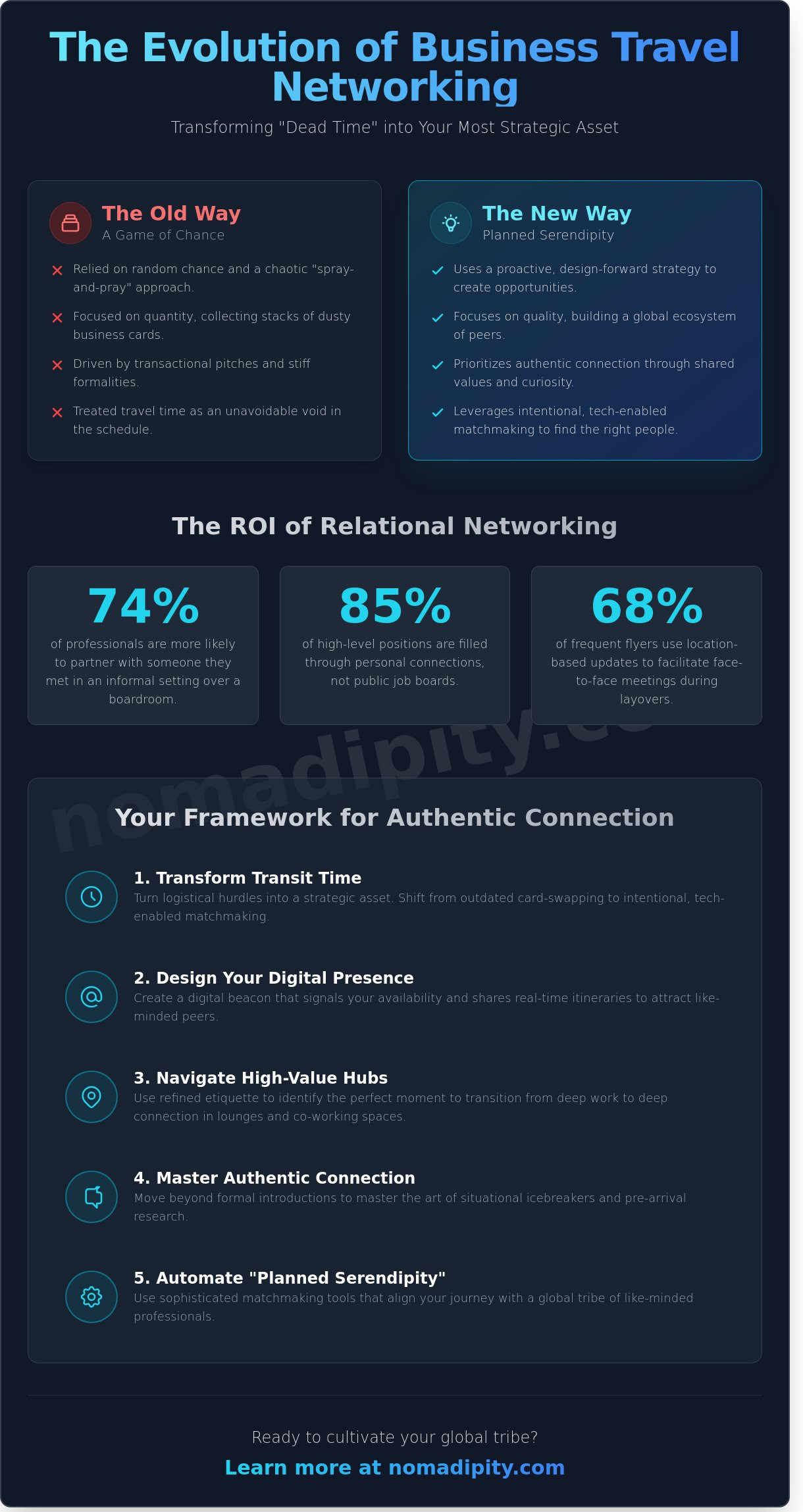
The 5-Step Framework for Authentic Connection on the Move
Networking for business travelers isn't about collecting a stack of digital business cards that gather dust in your cloud storage. It's about designing a system where serendipity becomes a frequent guest. By January 2025, data from the Global Business Travel Association showed that 68% of executive travelers prioritize "meaningful human interaction" over traditional corporate mixers. To cultivate these moments, you need a repeatable framework that turns a flight delay or a coffee queue into a strategic opportunity.
Step 1: Research and Pre-Engagement. Your networking begins forty eight hours before you depart. Use LinkedIn’s "Nearby" feature or city-specific Slack channels to see which peers are currently grounded in your destination. If you're heading to a hub like Dubai or New York, check the digital guestbook of your co-working space or lounge. Knowing who is in the room before you enter it removes the friction of the unknown.
Step 2: Situational Icebreakers for 2026
The "What do you do?" question is a conversational dead end. It feels like an interview, not an encounter. Instead, try asking, "What brings you to Tokyo this week?" This open-ended prompt allows the other person to share a project, a passion, or even a travel mishap. You can also use your environment. A unique travel accessory, like a high-end mechanical keyboard or a limited-edition tech pouch, often acts as a silent signal to fellow enthusiasts. Practice the "Power of Three": listen for three specific details in their response before you offer your own story. This creates a psychological bond of being heard, which is rare in the frantic pace of global transit.
Step 3: The Value Exchange. Authenticity thrives when you lead with a "give." Instead of wondering how a contact can help your career, listen for a problem they're facing. Maybe they need a recommendation for a reliable fixer in Berlin or a specific software solution you've already tested. By offering a solution first, you establish yourself as a resource rather than a solicitor.
Step 4: The Digital Handshake. Don't wait until you get back to the hotel. Use a traveler-specific platform or a quick QR scan to connect immediately. This ensures your profile is fresh in their mind while the physical interaction is still vibrant. It's the digital equivalent of a firm handshake, locking in the connection before the next boarding call interrupts the flow.
Step 5: Maintaining a Borderless Network
A global network is only as strong as its maintenance. Use a personal CRM tool to log small details: their favorite espresso bar in Milan, the name of their startup, or their upcoming travel dates. When you're planning your next trip, use the "Next City" check-in. Send a brief message to old connections in that hub to let them know you'll be in town. You can keep a network warm by engaging in low-stakes interactions, such as sharing a relevant article or reacting to their recent milestone, which ensures you aren't only reaching out when you need a favor.
Ready to transform your next trip into a series of intentional encounters? Learn how to master the art of planned serendipity with our latest guides.
Cultivating Your Global Tribe with Nomadipity
Nomadipity automates the "Planned Serendipity" process, removing the friction from global connections. For busy professionals, time is the most precious commodity. You shouldn't have to choose between a productive work trip and a meaningful human connection. The platform’s matchmaking engine analyzes your mutual interests, professional affiliations, and even your preferred pace of travel to suggest encounters that feel like destiny but are actually the result of smart data. This is how networking for business travelers evolves into something more profound. You stop collecting digital business cards and start building a tribe of peers who understand your world.
Moving from a simple business contact to a travel companion changes the trajectory of your career. It's about social capital. A 2025 study by the Global Business Travel Association found that 64 percent of travelers feel isolated on the road, which directly impacts mental clarity and decision-making. By curating your network through a dedicated platform, you ensure your time in transit is spent with people who challenge and inspire you. A premium subscription isn't just a recurring fee; it's a strategic investment in your global network that pays dividends in shared insights and collaborative opportunities.
Find Your Peers, Not Just Your Leads
Connecting with people who share your budget and travel style ensures that your social interactions don't create logistical friction. If you value the quiet focus of a premium lounge or the efficiency of a high-end boutique hotel, you'll be matched with those who share those standards. This alignment makes it easy to move from a digital chat to a real-world dinner. You can use Nomadipity forums to join niche industry groups, such as "AgriTech in South America" or "Venture Capitalists in Lisbon." These spaces allow you to find a travel buddy who isn't just a peer, but a partner in exploration who understands the nuances of your specific industry.
Your Next Step in Location Independence
The transition from a traditional business traveler to a fully realized digital nomad happens through community support. When you have a global network, location independence feels less like a risk and more like a logical progression. You can take agency over your schedule by organizing your own meetups at airport lounges in major hubs like Singapore Changi or London Heathrow. These micro-events turn dead time into productive strategy sessions. The world is vast, but it becomes manageable and welcoming when you have friends in every time zone. It's time to design a life where work and exploration coexist. Join the Nomadipitians and start networking better to claim your place in this global community.
Design Your Global Future Through Planned Serendipity
The professional landscape of 2026 demands more than just being present; it requires a strategy for intentional connection. You now have the tools to transform a standard itinerary into a series of high-value encounters by using the 5-step framework for authenticity. High-impact networking for business travelers relies on the systems you build before you ever reach the gate. By optimizing your digital presence and identifying high-value hubs, you turn every departure into a door for new opportunities.
Nomadipity provides the infrastructure for these magical moments. Our platform is an exclusive community of frequent flyers and hotel rewards members who value depth over speed. We use matchmaking based on mutual interests and budgets to ensure your connections are as practical as they are inspiring. This system was designed by travelers for travelers to foster the kind of planned serendipity that changes careers. You don't have to leave your professional growth to chance when you have a tribe that moves with you.
Join Nomadipity to find your next business travel match and start building your global network today. Your next great partnership is waiting somewhere between here and your next destination. Keep exploring.
Frequently Asked Questions
Is it unprofessional to network in an airport lounge?
It is professional to network in an airport lounge if you respect the unspoken cues of your fellow travelers. According to 2025 business etiquette surveys, 68% of frequent flyers view the lounge as a legitimate workspace for low-impact socializing. You should look for communal work tables rather than private sleeping pods to signal your availability for conversation.
If someone has noise-canceling headphones on or is focused on a screen, they are off-limits. Instead, wait for natural transitions at the espresso station or buffet. These brief, organic moments often lead to more authentic connections than forced introductions in a boardroom.
How do I network if I am an introvert who gets travel fatigue?
You can manage travel fatigue by scheduling serendipity windows of exactly 60 minutes instead of trying to be "on" all day. Introverts often find success by focusing on one high-quality interaction rather than a crowded mixer. Data from the 2024 Global Business Travel Association suggests that 42% of travelers experience burnout, so prioritizing deep, quiet conversations is a sustainable way to handle networking for business travelers.
What are the best apps for networking for business travelers in 2026?
The top apps for 2026 include Lunchclub for AI-driven introductions and Bumble Bizz for local professional proximity. NomadList remains a primary hub for digital nomads seeking curated meetups in over 1,200 cities worldwide. These platforms allow you to filter for specific industry interests, ensuring that your limited time on the ground is spent with the most relevant peers.
How can I stay safe when meeting business contacts in a foreign city?
You stay safe by always choosing public, high-traffic venues like hotel lobbies or well-reviewed cafes for first meetings. Use the "Rule of Three" by sharing your live GPS location with three trusted contacts via apps like WhatsApp or Find My. Verify the person’s professional identity on two separate platforms, such as LinkedIn and a company website, before you agree to meet in person.
Should I use LinkedIn or a niche traveler app for networking on the road?
You should use LinkedIn for maintaining long-term visibility and niche apps like FlyerTalk or The Marque for immediate, location-based connections. While LinkedIn hosts over 1 billion users, niche apps provide a 40% higher engagement rate for travelers in specific sectors like tech or finance. Use LinkedIn to research the person, but use the niche app to initiate the "planned serendipity" of a real-world meeting.
How do I follow up with someone I met briefly during a flight?
You should send a follow-up message within 24 hours of landing to ensure the connection stays fresh. Mention a specific detail from your conversation, such as a book recommendation or a shared opinion on a 2026 industry trend. This personal touch differentiates you from the automated spam that 82% of executives report receiving after major conferences or long-haul flights.
Can networking while traveling actually help my career if I am not in sales?
Networking while traveling helps your career by exposing you to cross-industry innovations that 90% of office-bound employees never see. Even if you aren't in sales, these global perspectives can lead to 15% faster problem-solving in operations or creative roles. You are building a knowledge bank that makes you a more versatile leader and a more attractive candidate for international assignments.
What is the "Golden Rule" of networking in hotel bars?
The Golden Rule is the "Two-Seat Buffer" which dictates that you should leave space between yourself and others unless invited to sit closer. Effective networking for business travelers in bars relies on being approachable but not intrusive. Position yourself at the corner of the bar, as this 90-degree angle makes it natural to start a conversation without forcing a direct, intimidating face-to-face confrontation.
Disclaimer
Nomadipity Blog Disclaimer
The content on Nomadipity is provided for general informational and inspirational purposes only. While we strive for accuracy and timeliness, Nomadipity does not guarantee that any information is complete, current, or suitable for your specific needs. Use your judgment and verify details before making travel plans, meeting with other users in person, or making any purchases influenced by the article.


