

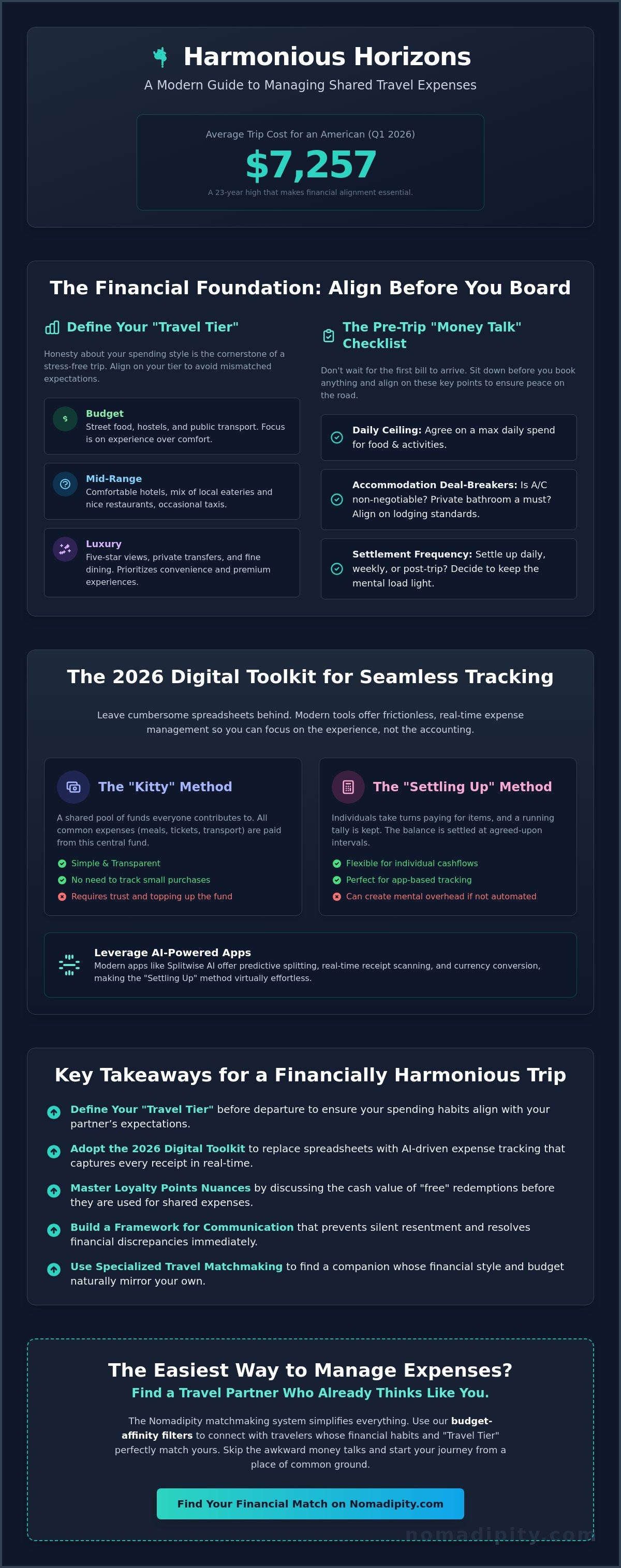
Did you know the average cost of a trip for an American hit a 23-year high of $7,257 in the first quarter of 2026? When the price of exploration reaches those heights, the invisible weight of a shared bill can easily pull you away from the magic of the moment. You want to focus on the salt air and the local culture, not the mounting tally of espresso shots and train tickets. Learning how to manage shared travel expenses with a travel partner is no longer just a courtesy; it's a vital skill for anyone pursuing an intentional, adventurous life. It's awkward to ask for a reimbursement while you're supposed to be soaking in a new horizon, and we've all felt that slight sting when spending habits don't quite align.
You deserve a journey defined by connection rather than ledger lines. We'll show you how to achieve total financial harmony on the road through proven systems, modern tech tools, and a framework for that essential "money talk" before you even pack a bag. This guide explores the best ways to distribute costs equitably so you can return home with your partnership and your savings intact. We'll look at everything from the latest budgeting apps to the art of structured spontaneity, ensuring your next global escape is as stress-free as it is memorable.
Key Takeaways
- Define your "Travel Tier" before departure to ensure your spending habits align perfectly with your partner’s expectations.
- Adopt the 2026 digital toolkit to replace cumbersome spreadsheets with AI-driven expense tracking that captures every receipt in real-time.
- Master the nuances of how to manage shared travel expenses with a travel partner when navigating the complex world of loyalty points and "free" redemptions.
- Build a framework for open communication that prevents silent resentment and resolves financial discrepancies before they impact your friendship.
- Discover how to use specialized travel matchmaking to find a companion whose financial style and budget preferences naturally mirror your own.
The Financial Foundation: Aligning Budgets Before You Board
Money is the uninvited guest that can either ground your dreams or give them wings. Most travel partnerships don't end because of a missed flight or a rainy day in Rome; they dissolve because of mismatched expectations at the dinner table or the hotel lobby. To truly understand how to manage shared travel expenses with a travel partner, you must first acknowledge that your relationship with money is as personal as your passport. Are you a "street food and hostels" wanderer, or does your soul crave "five-star views and private transfers"?
Defining your "Travel Tier" early is the cornerstone of what we call structured spontaneity. Whether you land in the Budget, Mid-range, or Luxury category, being honest about your limits allows for a journey without the shadow of debt. We also recommend setting aside a "Planned Serendipity" fund. This is a small, agreed-upon pool of cash meant specifically for the unexpected; that local jazz club you stumbled upon or a sudden boat rental in a hidden cove. It's the buffer that keeps the "yes" easy and the resentment low. By baking these costs into your initial plan, you protect the magic of the unplanned.
The Pre-Trip "Money Talk" Checklist
Don't wait for the first bill to arrive to decide who's paying. Sit down before you board and run through these essentials to keep the peace:
- Daily Ceiling: Agree on a maximum daily spend for food and activities to avoid "budget creep."
- Accommodation Deal-Breakers: Is air conditioning non-negotiable? Do you need a private bathroom? Align on these before booking anything.
- Settlement Frequency: Decide if you'll settle up every evening, once a week, or at the end of the trip to keep the mental load light.
Budget Matchmaking: Finding Your Fiscal Twin
Learning how to manage shared travel expenses with a travel partner is much simpler when you start from a place of common ground. The most effective way to manage expenses is to choose a companion who already thinks like you. When you find a travel buddy through the Nomadipity.com matchmaking system, use the budget-affinity filters to skip the awkwardness. These filters ensure you're paired with someone whose personal budgeting principles mirror your own.
Watch for red flags during your initial chats. If a potential partner is vague about their limits or dismissive of your "must-haves," it's a sign of future friction. It's better to find a mismatch now than in the middle of a bustling market in Tokyo. Remember, a great travel partner respects your boundaries on shared costs while still allowing you the freedom for your own "treat yourself" moments. By setting these boundaries early, you transform money from a source of stress into a tool for freedom.
The 2026 Digital Toolkit for Seamless Expense Tracking
Manual spreadsheets are the enemy of unhurried movement. They tether you to a screen when you should be watching the sunset over the Amalfi Coast. In 2026, the mental load of tracking every cent is a relic of the past. If you're still scribbling totals on napkins, you're missing out on the intentionality that modern travel demands. Learning how to manage shared travel expenses with a travel partner is now a frictionless process thanks to AI-driven scanning. Imagine snapping a photo of a receipt in a bustling Marrakech market and having the app instantly convert the currency, split the tax, and log it to your shared total.
We see two main schools of thought: the "Kitty" method and the "Settling Up" method. The "Kitty" involves a shared pool of funds used for everything common, while "Settling Up" tracks individual spends to be balanced later. Both have merits, but they require a high level of trust and clarity. It's often helpful to look for expert advice on sharing finances to decide which structure fits your partnership. By using multi-currency digital wallets, you can hold local tender without the sting of hidden exchange fees, making the "Kitty" method more efficient than ever.
Top Apps for Shared Expenses in 2026
The landscape has shifted toward predictive tech. Splitwise AI now offers predictive splitting, anticipating who usually pays for coffee versus who covers the museum tickets. For those seeking real-time visibility, Revolut and Wise Shared Pockets allow both partners to see a live balance in a joint digital vault. If your journey involves multiple stops and varied currencies, Tricount remains a powerhouse for its simplicity in handling complex, multi-leg itineraries. These tools ensure that when you connect with a travel companion who shares your style, the logistics remain invisible.
Setting Up Your Shared Digital "Kitty"
A centralized prepaid card is the ultimate friction-reducer. Instead of debating who pays for every meal, you both contribute an initial "buy-in" amount to a shared account. This fund covers essentials like groceries, transport, and communal dining. Automating top-ups when the balance hits a certain floor ensures you never have those awkward "who owes what" conversations over a bottle of local wine. It's about building a framework that facilitates joy, letting the technology handle the math while you handle the memories.
The Points Dilemma: Splitting Costs with Rewards Enthusiasts
The term "free travel" is a beautiful illusion. For the rewards enthusiast, those points represent hundreds of hours of strategic spending, meticulous planning, and brand loyalty. When you're figuring out how to manage shared travel expenses with a travel partner, digital currency like miles and hotel points can complicate the ledger. If one partner books a five-star suite in Bali using 80,000 points while the other pays for the flights in cash, a simple 50/50 split no longer works. You need a framework that respects the value of those points without making the non-enthusiast feel like they're paying a premium for luxury they didn't ask for.
Transparency is your best tool here. The goal isn't necessarily to match every point with a dollar. Instead, aim for a balance where both parties feel the distribution of "real world" cost is fair. This might mean the cash partner covers all the on-the-ground meals to offset the points used for lodging. It could also mean establishing a "buy-in" price for those points. By treating points as a shared asset rather than a private hoard, you unlock higher tiers of travel that might otherwise be out of reach. It turns a potential conflict into a shared victory.
Miles vs. Cash: A Fair Exchange Framework
To avoid the "silent resentment" trap, you must agree on a valuation for your digital currency. In 2026, with dynamic pricing and the general devaluation of miles, the "cents per point" (cpp) value fluctuates wildly. A Fair Value Exchange is an agreed-upon monetary rate for rewards points that balances the cash value of a booking with the effort and opportunity cost required to earn those points. If you're staying in a room that costs $500 or 50,000 points, you might agree that the points are worth 1 cent each. The non-points partner then pays $250 to the points holder, and both of you enjoy a half-price luxury stay.
- Calculate the CPP: Divide the cash price by the points required to see the true value.
- Status Perks: If one partner has elite status that grants free breakfast or lounge access, decide if that "value" is a gift or a shared expense.
- Maximize Group Spend: Put all communal expenses on the partner's card that earns the highest rewards for that category, then split the bill later.
Loyalty Program Synergy
Efficiency thrives on coordination. Many modern loyalty programs allow for pooling points or "Guest of Honor" bookings, which extend elite benefits to a travel companion even if they have no status. By linking your travel rewards programs, you can ensure that every dollar spent by the pair contributes to a future "free" trip. This collaborative approach is a key part of how to manage shared travel expenses with a travel partner effectively. It shifts the focus from individual gain to collective experience, ensuring that the perks of the road are enjoyed by both, regardless of who holds the titanium card.
Navigating Financial Discrepancies and Conflict
Even the most sophisticated AI-driven apps can't prevent the human element of friction. Resentment is a slow poison in any travel partnership. It often starts with a small, unrecorded coffee and grows into a heavy cloud that obscures the beauty of your destination. Understanding how to manage shared travel expenses with a travel partner means knowing how to clear that cloud before it becomes a storm. When you notice a pattern of overspending or a string of "I forgot my wallet" moments, the worst thing you can do is stay silent. Address the imbalance immediately; your friendship is worth more than the cost of a dinner.
We recommend the 24-hour rule for any financial dispute. If a discrepancy arises, commit to resolving it within a single day. This prevents small grievances from festering into long-term baggage. If one partner consistently exceeds the agreed-upon "daily ceiling" we discussed earlier, it's time for a gentle but firm recalibration. Travel is a dance of compromise, but that compromise shouldn't leave one person feeling financially drained or exploited.
Scripts for Hard Conversations
Finding the right words in the heat of a trip is difficult. Use these simple frameworks to keep the vibe intact while protecting your budget:
- The Unpaid Debt: "Hey, I noticed the app hasn't synced our last few meals. Let's take five minutes to update the ledger so we're both clear on where we stand."
- The Budget Correction: "I've realized I'm hitting my limit faster than I expected. Can we look for some lower-cost activities for the next few days to balance things out?"
- The Grace Limit: Agree on a "buffer zone," perhaps $10, where small incidental costs aren't tracked. This reduces the mental load of logging every single bottle of water.
When Budgets Don’t Align Mid-Trip
Sometimes, despite your best efforts, you realize your spending styles are drifting apart. One of you wants the tasting menu; the other wants a grocery store picnic. The "Solo Afternoon" is a perfect solution for this. By spending a few hours apart, you each have the freedom to spend at your own level without guilt or pressure. This space allows you to maintain mental clarity and return to the partnership refreshed rather than resentful.
If the gap is significant, adjust the itinerary to prioritize free experiences like local hikes or public markets. Remember, the goal is shared experience, not just shared spending. To avoid these mid-trip headaches entirely, you can find a travel partner who is vetted for financial compatibility before you ever leave home.
The Nomadipity Way: Finding Your Perfect Financial Match
The most elegant way to manage shared travel expenses with a travel partner is to ensure you never have to argue about them in the first place. You can have the most advanced AI-driven apps and a perfect "money talk" framework, but these are merely tools. The real magic happens when you stand on the same side of the fiscal fence. We believe that financial compatibility is the foundation of geographic autonomy. When you aren't constantly negotiating the cost of a train ticket or a boutique stay, you free up mental space for the unexpected moments that define true travel.
This is where our philosophy of structured spontaneity comes into play. By using the budget-affinity filters at Nomadipity.com, you're doing more than just picking a price point. You're selecting a companion who shares your philosophy on value. Do you both believe that a $200 dinner is a cultural investment, or do you both prefer the raw authenticity of a $5 street stall? When you find a partner whose travel style mirrors your own, the logistics become a quiet hum in the background rather than a loud, discordant note. It's the difference between a trip that feels like a series of transactions and one that feels like a shared evolution.
Beyond the Spreadsheet: Shared Values
True alignment goes deeper than a daily ceiling. It’s about prioritizing experiences over material markers of success. When you craft your profile on Nomadipity.com, be explicit about your "why." Are you traveling to find stillness, or are you looking for high-intensity adventure? Fiscally compatible partners are often drawn to the same underlying purpose. If you both value the slow, unhurried movement of intentional living, you'll naturally agree on the costs associated with that lifestyle. You won't need to explain why you're spending more on a long-term apartment rental with a kitchen; your partner will already be at the local market buying the ingredients.
- Prioritize Depth: Focus on partners who value cultural engagement over tourist traps.
- Be Authentic: Highlight your true spending habits on your profile to attract like-minded souls.
- Shared Goals: Align on the big-picture "must-haves" before the first booking is made.
Join the Nomadipitian Community
Movement is medicine for the soul. But when that movement is weighed down by the heavy anchor of financial friction, the healing stops. You don't have to navigate these waters alone. We've built a space where rewards-savvy travelers and global nomads can connect without the traditional barriers of mismatched budgets. You can find your next companion on our social network for frequent flyers, a place where the boarding pass is just the beginning of the conversation.
Mastering how to manage shared travel expenses with a travel partner is ultimately about respect; respect for your own boundaries and respect for your partner’s journey. By establishing the right frameworks and choosing the right people, you facilitate a trip where the only thing you're counting is the number of times you felt truly alive. Ready to find your fiscal twin and start the next chapter? Start your next adventure with Nomadipity.com today and experience the peace of a perfectly matched partnership.
Your Next Horizon is Within Reach
Movement is a gift, and it shouldn't be weighed down by the heavy baggage of financial stress. By embracing the 2026 digital toolkit and honoring the true value of rewards points, you've already simplified the path ahead. You now understand that the most resilient partnerships are built on a foundation of open communication and the beauty of structured spontaneity. These frameworks ensure that your focus remains on the salt air and the local culture rather than the numbers on a screen.
The most important lesson in how to manage shared travel expenses with a travel partner is that the right person makes the math feel effortless. Why spend your energy negotiating every meal when you can start with someone who already shares your fiscal vision? We invite you to find your fiscally compatible travel match on Nomadipity.com. With our advanced budget-affinity filters and a community of rewards-savvy frequent flyers, you can focus on the unhurried, intentional exploration you crave.
The world is waiting for your next "yes." Step into it with a partner who values the journey as much as you do.
Frequently Asked Questions
What is the best app for splitting travel expenses in 2026?
Splitwise and Finny are the leading choices for 2026. Finny costs $1.99 per month and offers specialized travel budgeting features, while Splitwise Pro is available for $5 per month and includes advanced AI-driven receipt scanning. These tools handle complex math and currency conversions in the background so you can stay present in the moment.
How do you split a hotel room if one person used points?
You should agree on a "cash-equivalent" rate for the points used before you book. If a room costs $300 per night but is booked for 30,000 points, the non-points partner can pay $150 directly to the points holder. This ensures both travelers benefit from a discounted stay while the points holder is fairly compensated for their digital currency.
Should I use a shared credit card with a travel partner?
Opening a joint credit card is rarely advisable for a single trip due to the long-term credit risks and legal ties involved. A better alternative is a shared digital wallet or a "Shared Pocket" in apps like Revolut. This allows you to how to manage shared travel expenses with a travel partner with real-time visibility without risking your personal credit score.
What is the "Kitty" method for travel budgeting?
The "Kitty" method involves both partners contributing an equal "buy-in" amount to a central fund at the start of the journey. This shared pool of cash or digital funds covers all communal costs like local transport, groceries, and shared meals. It effectively eliminates the need to track dozens of tiny transactions, keeping your daily rhythm unhurried and focused on connection.
How do we handle different currency conversions when splitting costs?
Use an expense-tracking app that integrates live API exchange rates to ensure every entry is converted accurately in real-time. If you are using cash in a country with high inflation or fluctuating rates, log the expense immediately to capture the exact value of that day. This prevents "conversion creep" from creating discrepancies in your final settlement.
What happens if my travel partner can’t afford an activity I want to do?
The most graceful solution is to plan a "Solo Afternoon" where you each pursue activities at your own price point. You might head to a high-end gallery while your partner explores a free local market. This approach respects individual budget boundaries and prevents the resentment that builds when one person feels pressured to overspend or hold the other back.
How often should we settle our shared travel debts?
Settling up once a week or at the end of each major destination stop provides the best balance between accuracy and ease. Waiting until the very end of a month-long journey can make the final total feel overwhelming and lead to forgotten cash expenses. Regular check-ins keep the ledger manageable and ensure that financial harmony remains intact throughout the trip.
Is it better to split everything 50/50 or by individual consumption?
Split fixed communal costs like accommodation and car rentals 50/50, but track variable costs like expensive meals or solo excursions by individual consumption. This hybrid model is the most equitable way to how to manage shared travel expenses with a travel partner fairly. It ensures that a partner who orders a simple salad isn't subsidizing another’s three-course steak dinner.

Disclaimer
Nomadipity Blog Disclaimer
The content on Nomadipity is provided for general informational and inspirational purposes only. While we strive for accuracy and timeliness, Nomadipity does not guarantee that any information is complete, current, or suitable for your specific needs. Use your judgment and verify details before making travel plans, meeting with other users in person, or making any purchases influenced by the article.


