
What if the greatest risk to your career isn't leaving your desk, but staying at it until the walls feel like they're closing in? You've likely spent hours scrolling through curated sunsets, wondering how to become a digital nomad while simultaneously dreading the tax forms and the "where do I find friends?" reality of it all. It's normal to worry that a life of travel means sacrificing professional growth or ending up isolated in a beautiful place. You want the freedom, but you also want the stability that keeps you grounded.
This guide shows you exactly how to make that transition by 2026 without losing your mind or your momentum. We'll replace the chaos of "winging it" with a framework for planned serendipity, balancing the logistics of global living with the human need for genuine connection. You'll learn how to design a 180 day exit plan that feels steady rather than scary. We'll dive into the 54 digital nomad visas currently available and explore how to cultivate a community before your plane even touches the tarmac. Let's build your bridge to a life of intentional movement.
Key Takeaways
- Redefine your perspective on location independence by shifting from a temporary "backpacker" mindset to a sustainable, lifestyle-first design.
- Learn how to become a digital nomad by auditing your professional value and choosing the income stream that best fits the 2026 economy.
- Navigate the complexities of global residency with a practical guide to modern Digital Nomad Visas and strategies to avoid the trap of double taxation.
- Master the "One-Month Rule" to design a route that prioritizes slow travel, allowing you to cultivate professional stability alongside global exploration.
- Engineer community into your journey by creating intentional systems that foster human connection and replace isolation with planned serendipity.
What is a Digital Nomad in 2026? Redefining Location Independence
The sun-bleached image of a traveler typing from a hammock is a relic of 2015. By 2026, the identity of a Digital nomad has matured into something far more sustainable and intentional. It is no longer just about the job you do; it is about the life you choose to design. You aren't merely escaping a cubicle. You are cultivating a state of location independence where professional output and personal exploration exist in a symbiotic loop. This evolution relies on the concept of "Planned Serendipity." You build robust systems, from automated business workflows to global health coverage, so that when a chance invitation to a co-working retreat in the mountains of Georgia arrives, you can say yes without hesitation. Freedom isn't the absence of structure. It is the reward for it.
Digital Nomad vs. Remote Worker
A remote worker might never leave their home office in the suburbs. A nomad treats the entire globe as a potential workspace. To truly understand how to become a digital nomad, you must embrace the philosophy of "Slow Travel." This means staying in one city for 90 days rather than nine. You stop being a tourist and start being a temporary resident. You find a favorite local cafe, join a neighborhood run club, and establish a routine that protects your deep work hours. Your mindset shifts from consuming a destination to actually living within it. This grounded approach ensures your career grows even as your passport fills up.
The 2026 Nomad Landscape
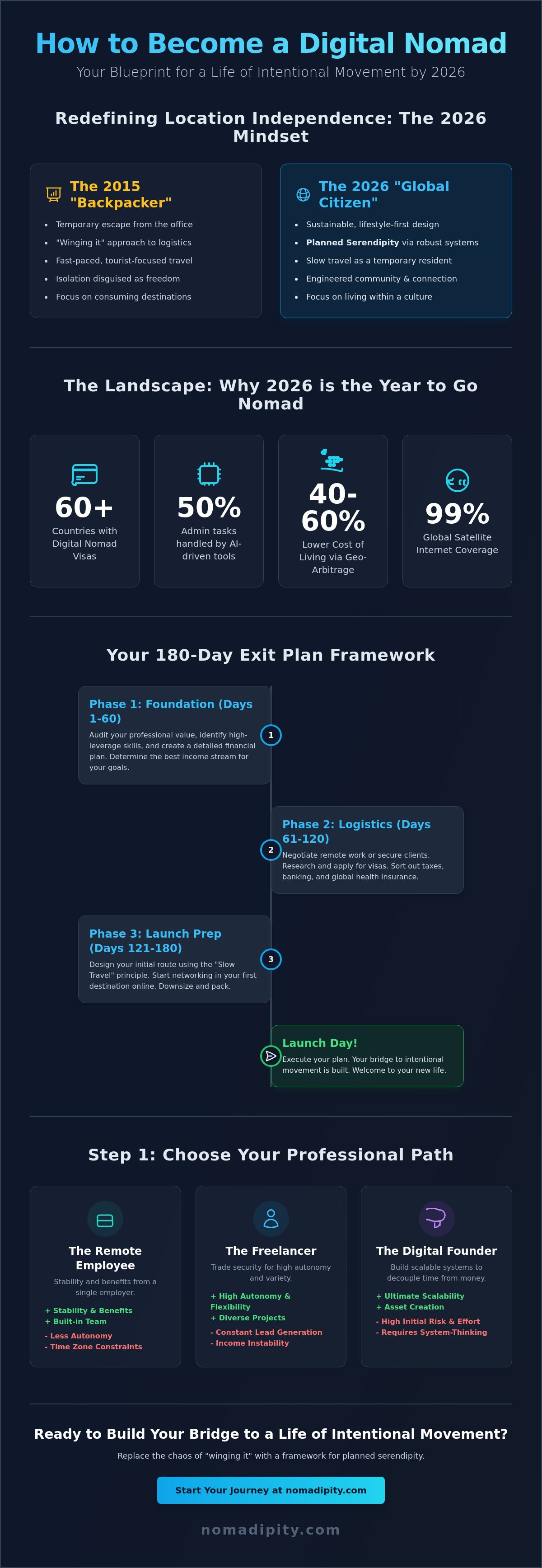
The barrier to entry has crumbled. By 2026, AI-driven tools handle approximately 50 percent of the administrative tasks that used to overwhelm solo entrepreneurs, from managing complex time-zone scheduling to basic bookkeeping. Infrastructure has finally caught up with the dream. There are now over 60 countries offering specific digital nomad visas, and dedicated nomad villages in places like Madeira and Bansko provide built-in communities of like-minded peers.
- Geo-arbitrage: This remains your greatest financial lever. By earning in a strong currency while living in a region where the cost of living is 40 to 60 percent lower, you effectively buy back your time.
- Connectivity: Satellite internet has reached a 99 percent global coverage rate, making "off-grid" work a viable reality rather than a logistical nightmare.
- Community Hubs: Coliving spaces have evolved into professional ecosystems that prioritize networking and skill-sharing over late-night parties.
This financial margin and technological ease provide the foundation of how to become a digital nomad in a way that lasts. You are no longer just a backpacker with a laptop; you are a global citizen with a plan. By setting up the right systems today, you open the door to the magical, unplanned moments that make this lifestyle so transformative.
Step 1: Auditing Your Professional Value and Income Streams
Before you pack a single bag, you must look inward. Success in this journey isn't about the destination; it's about the sustainability of your engine. In the 2026 economy, the answer to how to become a digital nomad starts with identifying high-leverage skills. The landscape has shifted. Companies now prize AI-orchestration, cross-cultural emotional intelligence, and complex problem-solving over simple task execution. You need to be more than a worker; you need to be a results-oriented system.
You'll likely follow one of three primary avenues to fund your travels. The Remote Employee enjoys the stability of a single paycheck and benefits. The Freelancer trades that security for high autonomy, though it requires constant lead generation. The Digital Founder builds scalable systems, such as SaaS platforms or content ecosystems, that eventually decouple time from money. Each path requires a different mindset, but all demand a high degree of self-discipline.
The Remote Pitch Framework
If you're already employed, don't quit. Propose a three-month "Work from Anywhere" trial instead. Write a proposal that ignores your desire for travel and focuses entirely on employer benefits. Highlight how deep-work sessions without office distractions will boost your output. To prove reliability, set up asynchronous communication systems. Use tools like Notion or Loom to document your progress without needing a live meeting. Negotiate an "Overlap" strategy where you commit to being online for 4 specific hours that align with your team's core time. This ensures you're reachable while allowing you to explore your new environment during the day.
Building Your Financial Runway
Financial anxiety is the quickest way to kill the magic of travel. You need a "Runway" that covers your basics plus an emergency flight home. A 2024 study by MBO Partners indicated that 45% of nomads feel significantly more secure with at least six months of living expenses saved. Redefining Location Independence means realizing that your bank account is your greatest safety net against the unexpected. Without this cushion, a broken laptop or a missed flight becomes a catastrophe rather than a minor detour.
Diversifying Your Income
Relying on one client is a risk you shouldn't take while moving across borders. Diversification is the only way to achieve true planned serendipity. While passive income is often sold as a low-effort dream, the 2026 reality involves digital products that require consistent maintenance and community engagement. Think of niche memberships or specialized templates that solve specific problems. As you cultivate these streams, remember that Mastering Work-Life Balance for Nomads is much easier when your income isn't tied to every single hour you spend at a desk. If you want to learn more about keeping your sanity while managing these streams, explore our guide on sustainable freedom.
Step 2: Navigating the "Boring" Logistics (Visas, Taxes, and Tech)
Freedom requires a sturdy scaffold. To understand how to become a digital nomad, you have to embrace the paperwork that makes the poetry of travel possible. By 2026, the global landscape has shifted from "digital nomadism as a loophole" to a regulated, structured industry. Over 60 countries now offer dedicated pathways for remote workers, turning what used to be a legal gray area into a streamlined welcome mat.
The Digital Nomad Visa Revolution
The days of "border runs" to reset tourist stamps are fading as governments seek stable, tax-paying residents. When Navigating Visas, you must distinguish between a simple entry permit and a work-authorized residency. In 2026, five countries stand out for their nomad-friendly infrastructure and tax incentives:
- Spain: Offers a 15% flat tax rate for the first four years under the Enchanteur law.
- Japan: A recently refined six-month visa that targets high-earning tech professionals.
- Portugal: The D8 visa remains the gold standard for those seeking long-term European residency.
- Costa Rica: Provides a total exemption from local income taxes for remote earners.
- Greece: Features a 50% income tax reduction for nomads who stay at least two years.
Don't wait until your flight is booked to start this process. Application timelines currently average 120 days due to the surge in global applicants. You'll need apostilled background checks and proof of recurring income, usually starting at $3,000 USD per month depending on the destination.
Tax Residency and Virtual Foundations
Living out of a suitcase doesn't mean you're exempt from the taxman. You risk the "Double Taxation" trap if you don't establish a clear tax home. Most countries trigger tax residency after 183 days. To stay mobile, set up a virtual office back home using a digital mailbox service like Anytime Mailbox. This provides a physical address for banking and official government correspondence while you're exploring the Andes or the Alps.
Health insurance is your most critical safety net. Standard travel insurance usually only covers emergency evacuations or short-term accidents. As a nomad, you need global health insurance that includes routine care and chronic conditions. Services like SafetyWing or PassportCard have become the 2026 standard for those who treat the world as their permanent home.
Essential Tech Stack for 2026
Your office is only as reliable as your gear. The "Minimum Viable Kit" includes a high-performance laptop, noise-canceling headphones for loud cafes, and a universal power adapter. However, the true secret to how to become a digital nomad with zero downtime is the hardware-software hybrid.
A dedicated travel router is now a non-negotiable tool for security. It creates a private, encrypted "bubble" for all your devices, shielding you from the vulnerabilities of public hostel Wi-Fi. Pair this with an eSim provider like Airalo to ensure you have data the second you touch down. Security protocols, including a privacy-focused VPN and hardware security keys like YubiKey, ensure your professional life remains untraceable and protected, no matter where the serendipity of the road takes you.
Step 3: Designing Your Route and Your First 90 Days
Learning how to become a digital nomad is less about the act of fleeing and more about the art of landing with intention. Your first 90 days will set the rhythm for your entire journey. Many beginners fall into the trap of "fast travel," moving every week and treating their new life like a perpetual vacation. This is a recipe for professional exhaustion. The "One-Month Rule" is your most valuable safeguard. By staying in one location for at least 30 days, you allow yourself to build a routine, find your favorite grocery store, and actually finish your work projects. Data from nomad community surveys in 2025 indicates that travelers who move every 14 days or less report 45% higher stress levels than those who practice slow travel.
Your first "Base" needs to balance three pillars: cost of living, internet reliability, and community. In 2026, the "One-Bag" philosophy is no longer just for minimalists; it's a logistical necessity. Limiting yourself to a single 40-liter carry-on backpack eliminates baggage fees and the anxiety of lost luggage during tight connections. It forces you to curate your life down to the essentials that truly serve your productivity and well-being.
Choosing Your First Destination
Think of cities like Lisbon, Bali, and Mexico City as "Nomad Universities." These hubs are ideal because they offer a dense infrastructure of high-speed fiber internet, often averaging over 200 Mbps, and established social networks. When evaluating a city, look for a "Walkability Score" of 80 or higher. You want a neighborhood where your "Third Place"—a coworking space or a reliable cafe—is within a 15-minute walk of your front door. For a deeper dive into managing these early logistics, explore The Solo Travel Guide to master the nuances of location independence.
The First 48 Hours Strategy
Success on the road is often determined in the first two days. Your priority is to eliminate friction immediately. Don't wait until you land to figure out connectivity. Install a local eSIM before your flight and download the region's dominant transport app, like Grab or Uber. By the 24-hour mark, you should have physically visited your chosen "Third Place" to verify the Wi-Fi speeds and seating ergonomics. To protect your professional output, implement a strict jet lag recovery protocol: get direct sunlight exposure before 10:00 AM and avoid deep work for the first 36 hours. This intentional pause ensures you don't drop the ball on your first week of remote work.
Ready to build your foundation? Design your intentional nomad route today.
Step 4: Engineering Community and Finding Your People
The "Lonely Nomad" myth is a persistent shadow in the remote work world. It suggests that choosing freedom means choosing solitude. That's a mistake. True location independence is about designing your social ecosystem with the same precision you use for your Wi-Fi setup. Community isn't something you stumble upon; it's a system you build. In 2026, finding your tribe requires moving beyond the "Expat Bubble" to create authentic connections that sustain your mental health.
Isolation is the hidden tax of independence. Data from 2024 indicated that 35% of remote workers cited loneliness as their primary challenge. You can avoid this by practicing planned serendipity. This means putting yourself in environments where meaningful encounters are statistically likely to happen. It involves a shift from being a passive observer to an active architect of your social life.
Finding Your Tribe with Nomadipity
Shared values are the foundation of any travel partnership. If you're wondering how to become a digital nomad without losing your social circle, start by matching your logistics. Discrepancies in budget or work hours often lead to friction. Use travel matchmaking tools to filter for companions who share your professional rhythm. If you're a night-owl developer, you shouldn't pair with a sunrise-yoga enthusiast unless your schedules overlap intentionally. You can Find a Travel Buddy who understands that deep work comes before afternoon adventures.
- Match by Budget: Ensure your daily spending habits align to avoid awkward financial tension.
- Match by Schedule: Find partners who respect the "laptop down" hours.
- Match by Interest: Connect over specific hobbies like kite-surfing or local culinary history.
The Social Network for Modern Explorers
Networking doesn't only happen in co-working spaces. By 2025, 62% of high-earning nomads utilized airport lounges as primary networking hubs. These spaces are no longer just for free snacks; they are the boardrooms of the sky. Turning a three-hour layover in Doha or Singapore into a strategic meeting is a hallmark of the sophisticated traveler. Explore The Best Social Network for Frequent Flyers to leverage loyalty programs for more than just upgrades. Join niche forums dedicated to your specific intersections, such as tech-focused nomad groups or crypto-equity circles.
Remember to integrate with local cultures rather than just hovering above them. Research shows that nomads who spend at least 90 days in one location report 45% higher life satisfaction than those who move every two weeks. This is the heart of how to become a digital nomad who thrives: build a life, not just a trip. Engage with local shopkeepers, attend neighborhood events, and learn the language. This depth of connection transforms a temporary stay into a meaningful chapter of your global story.
Design Your Journey Beyond the Map
Living as a global citizen in 2026 is a deliberate act of design. You now have the framework to audit your professional value and navigate the 50 plus digital nomad visas currently offered by nations worldwide. By engineering your community before you even land, you transform a solo trip into a shared experience. Learning how to become a digital nomad isn't just about the flight you book; it's about the systems you build to let serendipity in. Your first 90 days will set the tone for a lifestyle that values depth over distance and connection over checklists.
Don't navigate the transition alone. You can access advanced matchmaking based on your specific budget and travel style through a platform built for intentional explorers. Join Nomadipity today and find your perfect travel companion for your first nomad adventure! You'll gain exclusive access to frequent flyer networking within an ad-free community of verified travelers who value authenticity as much as you do. The world is ready for you. It's time to start your story.
Frequently Asked Questions
Do I need a lot of money to start being a digital nomad?
You don't need a fortune to start, but having a three to six month emergency fund is essential for peace of mind. In 2024, data from Nomad List showed that popular hubs like Chiang Mai or Buenos Aires allow for a comfortable lifestyle on less than $1,500 per month. By choosing your first destination strategically, you can lower your cost of living while building your remote career and professional network.
How do I handle my taxes if I am traveling to multiple countries?
You generally remain liable for taxes in your home country unless you qualify for specific exemptions like the Foreign Earned Income Exclusion in the US. This requires spending at least 330 full days in a foreign country during a 12 month period. Navigating tax laws is a core part of learning how to become a digital nomad without legal headaches. Always consult a specialized expat accountant to manage your specific obligations.
What is the best job to have as a digital nomad in 2026?
Specialized roles in AI implementation and cybersecurity are currently the most resilient and lucrative options for remote workers. LinkedIn’s 2024 Jobs on the Rise report highlighted that 70 percent of high growth roles now offer remote or hybrid flexibility. Whether you're a prompt engineer or a data privacy consultant, focusing on high demand technical skills ensures you have the leverage to design your own schedule and travel freely.
Is it safe to be a solo digital nomad?
Solo travel is remarkably safe when you prioritize destinations with high safety rankings, such as Portugal or Iceland, which topped the 2024 Global Peace Index. You can cultivate safety by staying in coliving spaces where 85 percent of residents report feeling more secure than in private rentals. Trusting your intuition is vital, but backing it up with real time data from local community forums adds an extra layer of protection.
How do I find high-speed internet in developing countries?
You can secure reliable connections by checking the Speedtest Global Index, which showed average mobile speeds in countries like Vietnam exceeding 50 Mbps in 2024. Many nomads now carry a Starlink Mini kit to ensure 100 Mbps speeds even in remote coastal villages. Always ask your host for a screenshot of a current speed test before confirming a long term stay to avoid connectivity surprises that disrupt your workflow.
Can I become a digital nomad if I have a family or pets?
You can certainly travel with a family, as evidenced by the 2023 MBO Partners report which found that 11 percent of digital nomads now travel with children. Families often adopt a slow travel approach, staying in one location for at least 90 days to provide stability and community for their kids. This lifestyle choice is a powerful way to teach your children about global citizenship and adaptability through direct experience.
What happens if I get sick while working abroad?
It's best to carry specialized international health insurance that provides global coverage, including emergency evacuation and routine care. Researching how to become a digital nomad involves planning for the unexpected, like a 2024 study showing that 1 in 5 travelers requires some form of medical assistance abroad. Providers like SafetyWing offer monthly subscriptions that function like a global safety net, ensuring you receive quality care without facing catastrophic costs.

Disclaimer
Nomadipity Blog Disclaimer
The content on Nomadipity is provided for general informational and inspirational purposes only. While we strive for accuracy and timeliness, Nomadipity does not guarantee that any information is complete, current, or suitable for your specific needs. Use your judgment and verify details before making travel plans, meeting with other users in person, or making any purchases influenced by the article.


