

What if the secret to a perfect trip isn't the destination, but the shared financial philosophy of the person sitting across from you at dinner? You've likely felt that sinking feeling when a companion suggests a $200 tasting menu while you were eyeing local street food. The process of finding a travel partner with a similar budget is no longer just about splitting costs; it's about aligning your values to avoid the resentment that stems from mismatched expectations. In a global market where solo travel is projected to reach $1.07 trillion by 2030, finding someone who respects your financial boundaries is the ultimate luxury.
You deserve a journey where every dollar spent feels intentional and every shared experience feels earned. You'll discover how to identify and vet companions who mirror your spending habits, ensuring your next adventure is defined by connection rather than cost-related friction. We'll explore the 2026 strategy for cultivating these relationships, from understanding the rise of value-driven travel to using modern tools that prioritize lifestyle design over simple logistics.
Key Takeaways
- Learn why "budget creep" is the silent killer of travel friendships and how to protect your journey from the resentment of mismatched spending priorities.
- Identify your unique travel spending archetype so you can clearly communicate your financial non-negotiables to potential companions.
- Master the 2026 strategy for finding a travel partner with a similar budget by moving away from generic forums toward high-quality, niche social networks.
- Use the "financial first date" framework to vet a partner's spending values through video calls before committing to shared expenses.
- Discover how to cultivate planned serendipity by matching with travelers who share your specific lifestyle goals and digital nomad values.
Why Budget Alignment is the "Silent Killer" of Travel Friendships
Travel friendships don't usually end over a single catastrophic event. They erode slowly through the friction of a thousand tiny choices. This is why finding a travel partner with a similar budget is the most critical step in your planning phase. When one person wants to walk forty minutes to save five dollars on a tuk-tuk while the other just wants to get to the museum before it closes, resentment begins to simmer. This "budget creep" happens when you constantly find yourself spending 15% or 20% more than you intended just to keep the peace. Over a month-long journey, those small concessions turn into a heavy weight of decision fatigue.
Splitting the bill isn't a strategy; it's a band-aid. It doesn't solve the fundamental issue of mismatched priorities. True harmony comes from planned serendipity. This is the art of setting up financial systems that allow for magical, unplanned moments without the awkwardness of checking a bank balance first. By aligning your financial values early, you create space for the unexpected to feel like a gift rather than a burden. You want to focus on the sunset, not the price of the cocktail in your hand.
The Psychology of Travel Spending
In 2026, we've moved past the old-fashioned binary of "shoestring" versus "luxury." Modern budget travel strategies are about value and intentionality. Money is a proxy for your comfort levels and your personal boundaries. If you value a quiet workspace with high-speed internet but your partner prioritizes the cheapest hostel bed available, the conflict isn't about the money. It's about your ability to maintain your location independence. Financial stress acts as a barrier, blocking you from having authentic local experiences because you're too busy calculating the exchange rate of a coffee.
The ROI of a Well-Matched Partner
There is a tangible return on investment when you find the right companion. Shared costs often unlock experiences that remain out of reach for solo travelers. You might find that a high-end villa in Bali, when split between two people with similar spending habits, costs less than two separate, mediocre hotel rooms. This effectively eliminates the "solo tax" that often plagues independent explorers. When finding a travel partner with a similar budget, you aren't just saving money. You're increasing your purchasing power to design a lifestyle that feels expansive rather than restrictive. You cultivate a partnership where the "how much" never overshadows the "why."
Defining Your Travel Spending Archetype
Traditional budget categories are too blunt for the nuances of 2026 travel. Saying you have a "mid-range" budget is like saying you like "music." It's far too vague to be useful for long-term planning. When you're finding a travel partner with a similar budget, you need to look at the way money is spent, not just the total sum. Are you someone who sleeps in a 12-bed dorm so you can afford a $300 cave-diving excursion? Or are you a "Luxury Minimalist" who demands a five-star bed but happily eats 50-cent street noodles for every meal? Identifying your non-negotiables is the first step toward a harmonious journey.
The rise of sophisticated travel rewards programs has created a new archetype: the "Points Pro." These travelers might have a modest bank balance but live a high-end lifestyle through strategic redemptions. If you're a Points Pro, pairing with a "Flashpacker" who values speed and convenience but pays cash for everything can lead to immediate friction. You'll want to find someone who understands the value of a lounge pass and doesn't mind a slightly longer layover to fly business class. This level of compatibility is what makes a trip feel effortless.
The "Points and Perks" Strategy
Matching with another rewards enthusiast changes the game entirely. When two people with elite status travel together, benefits like guest-of-honor stays or shared lounge access become force multipliers. It allows you to bridge the gap between two different income levels. If one person has the points and the other has the status, you can design a high-value trip that neither could achieve alone. This is where curated travel matchmaking on Nomadipity.com becomes essential, as it looks for these specific synergies that generic forums miss.
Allocating Your "Joy Dollars"
Every traveler has a "joy list." These are the categories where you refuse to skimp. While we previously discussed how financial stress blocks authentic experiences, the solution lies in aligning these specific priorities. For 65% of digital nomads, reliable high-speed internet and ergonomic workspaces are the top priorities. For others, it's the adrenaline of an unplanned paragliding trip. A similar budget really means similar priorities. You must also have the "Emergency Fund" talk. Agreeing on a safety net, perhaps a $1,000 reserve for unexpected changes, ensures that if things go sideways, you're both on the same financial page. This level of clarity is what makes finding a travel partner with a similar budget a strategy for peace of mind, not just cost-cutting.
Where to Find a Travel Partner with a Similar Budget in 2026
The digital landscape of 2026 has moved far beyond the "post and pray" method of old travel forums. You no longer need to sift through thousands of random posts to find someone who won't flinch at a $150 hotel room. The evolution of finding a travel buddy now favors precision over volume. Generic platforms often fail because they treat budget as a secondary filter rather than a foundational value. When you're finding a travel partner with a similar budget, you need to look where high-frequency travelers actually spend their time. This shift ensures your potential companion's reality matches your own before you even discuss a flight path.
Consider the power of affiliation-based matching. Professional groups, alumni networks, and even specific loyalty tiers offer a pre-vetted environment. If you meet someone in a premium airport lounge or through a specialized industry group, you already share a baseline of lifestyle expectations. These niche spaces act as a natural filter, ensuring that you aren't explaining the value of a mid-trip laundry service or a safe neighborhood to someone who only prioritizes the absolute lowest price. It is about finding people who speak your financial language fluently.
Niche Communities vs. Mass Platforms
Nomadipity.com leads this shift by using advanced matchmaking that focuses on specific spending styles and nomad values. While mass platforms show you everyone, social networks for frequent flyers allow you to connect with people who understand the nuances of mileage redemptions and upgrade certificates. For those committed to long-term travel, location independence groups are far superior to holiday-focused forums. These communities prioritize the logistical reality of remote work, ensuring your partner won't resent the cost of a high-speed co-working space.
The Role of Verification and Profiles
Your traveler profile has become your financial resume. In 2026, a well-crafted profile is more than just a list of bucket-list destinations; it's a declaration of your travel values. Look for platforms like Nomadipity.com that offer social proof through reviews from past companions. Did they stick to the agreed budget? Were there hidden costs? Verified loyalty program integration is the ultimate trust signal. When you see a specific status badge on a profile, you know exactly what kind of travel experience that person expects. This transparency is the cornerstone of finding a travel partner with a similar budget who won't leave you holding an unexpected bill.
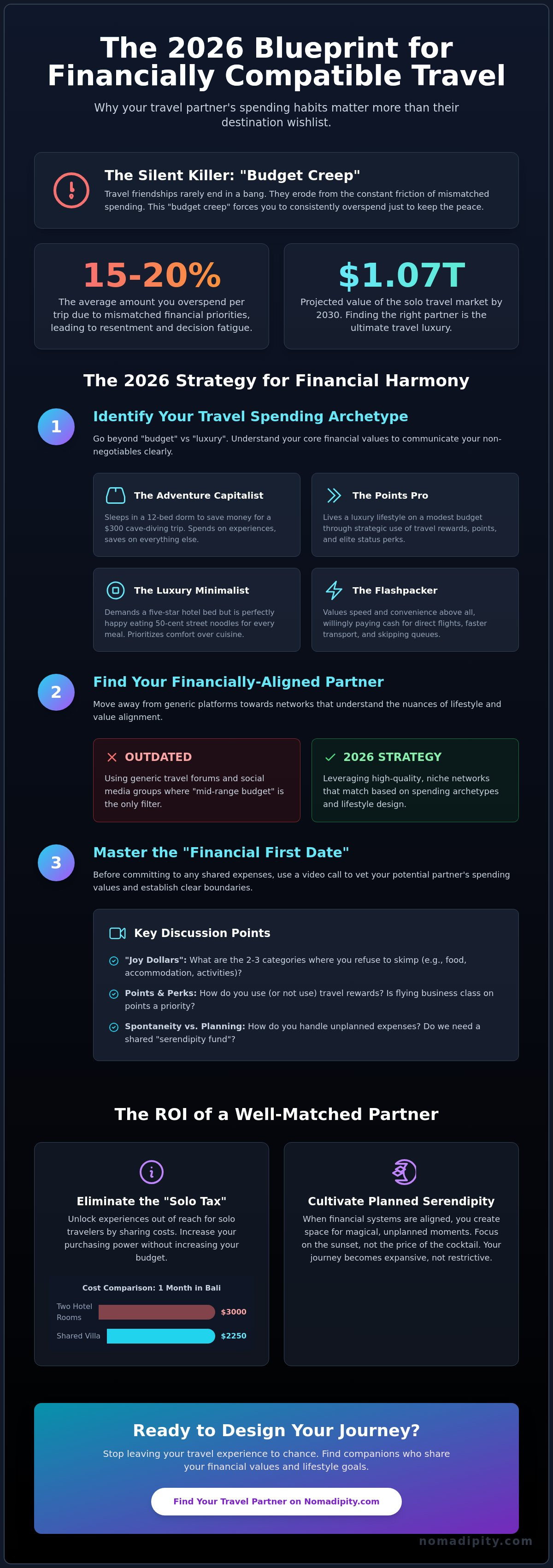
The "Financial First Date": Vetting Your Potential Partner
Before you ever discuss whether to visit the beaches of Albania or the mountains of Kyrgyzstan, you must have the "money talk." Most travelers make the mistake of picking a destination first, only to realize halfway through a flight booking that their financial realities are worlds apart. Finding a travel partner with a similar budget requires a structured approach that treats financial transparency as a prerequisite for friendship. You're looking for alignment in the logistical reality of daily life, not just a shared dream of a sunset. It's about ensuring your rhythms match before the stakes get high.
Move your conversation from text to a video call as soon as possible. It's much harder to be vague about finances when someone is looking at you. Pay attention to the "unspoken" financial lines. Does their environment suggest they value the same level of comfort you do? Do they hesitate when you mention the specific cost of a co-working pass or a reliable data plan? These small cues are often more telling than a written message. Once you feel a spark of connection, propose a "Trial Trip." A simple weekend getaway to a nearby city can reveal more about a person's spending rhythm than six months of digital chatting.
5 Essential Questions to Ask
- "What was your most expensive travel mistake and how did you handle it?" This reveals their resilience and whether they'll panic when an unexpected $200 fee arises.
- "How do you feel about splitting bills vs. taking turns?" Clarify if you're using an app or if you're comfortable with a more relaxed approach.
- "What is your daily target spend for food and drink?" In 2026, 42% of travelers cite food as their primary variable expense; knowing if they expect street food or sit-down meals is vital.
- "Do you prefer to save on the bed to spend on the experience, or vice versa?" This identifies if they are a "Luxury Minimalist" or a "Flashpacker," helping you avoid the "silent killer" of mismatched priorities.
Red Flags in Budget Conversations
Watch for vagueness. If a potential partner says they "have enough" but won't give a ballpark figure for their monthly runway, proceed with caution. A major red flag is resistance to using shared expense-tracking apps. These tools are the backbone of harmonious adventures; avoiding them often signals a lack of organization or a desire to avoid financial accountability. Finally, be wary of the "we'll figure it out when we get there" attitude toward major expenses like flights or month-long rentals. This mindset is the primary driver of decision fatigue and resentment on the road.
Setting boundaries early ensures that if one person wants to splurge on a hot air balloon ride, it doesn't create pressure for the other to follow suit. You can find travel companions who respect your financial boundaries by using a system that prioritizes values over just destinations. This clarity allows for the planned serendipity we value, where you both know exactly when you can afford to say "yes" to the unexpected without checking your bank balance in a panic.
Designing Your Journey with Nomadipity.com
Once you've mastered the vetting process and identified your spending archetype, the next step is moving from theory to the tarmac. Nomadipity.com isn't just another directory; it's a platform built to facilitate the "planned serendipity" we've discussed. By setting up the right systems, you open the door to magical, unplanned moments with a companion who is already on your financial wavelength. Finding a travel partner with a similar budget shouldn't feel like a high-stakes negotiation. It should feel like the first step in designing a life that balances professional ambition with global curiosity.
Our matchmaking service focuses on the nuances that generic apps ignore, connecting you with travelers based on a complex web of mutual interests and affiliations. This is particularly vital for those embracing the digital nomad lifestyle, where your "office" might be a cafe in Lisbon today and a beach club in Bali next month. Whether you're looking for someone to join an itinerary already in progress or you want to co-create a journey from scratch, the platform does the heavy lifting of vetting for financial compatibility so you don't have to.
Advanced Search Filters for the Modern Traveler
The strength of Nomadipity.com lies in its granularity. You can filter potential partners by specific budget ranges, travel styles, and even loyalty program affiliations. This ensures that a "Points Pro" finds another rewards enthusiast who values a business-class upgrade as much as they do. Beyond individual matches, our group forums allow you to find niche budget-compatible pods. These small, intentional communities are perfect for sharing the costs of high-end coliving spaces or private transport, effectively reducing your individual expenses without compromising your standard of living.
Your Next Adventure Starts Here
In 2026, the travel landscape is defined by collaboration and intentionality. With the travel app market generating $1.1 trillion in 2025, the tools to find your tribe have never been more sophisticated. Transitioning from a digital connection to a real-world partnership is a leap of faith, but on Nomadipity.com, it's a calculated one. The psychological peace of mind that comes from knowing your partner respects your financial boundaries is priceless. It allows you to move through the world with quiet confidence, focusing on personal growth rather than the stress of an unbalanced bill. Design your life with intention, find your person, and let the adventure begin.
Step Into Your Next Shared Adventure
Your journey shouldn't be defined by the stress of an unbalanced bill or the resentment of missed experiences. By identifying your spending archetype and mastering the "financial first date," you've already bypassed the pitfalls that derail many explorers looking for companionship. Finding a travel partner with a similar budget is the ultimate act of lifestyle design; it allows you to split the "solo tax" while doubling your purchasing power. You've learned that true compatibility lies in shared priorities, from the way you use travel rewards to the daily target spend for your joy dollars.
With the global solo travel market projected to reach $1.07 trillion by 2030, you're part of a massive movement toward intentional, shared exploration. Ready to cultivate your own version of planned serendipity? Find your budget-compatible travel soulmate on Nomadipity today. Our community of verified digital nomads uses advanced filters for budget and loyalty perks to ensure every connection is authentic. The world is vast and welcoming when you're walking beside someone who values the same sunsets and spending habits as you do. Your person is out there, waiting to design the next chapter with you.
Frequently Asked Questions
How do I bring up the budget conversation without it being awkward?
Lead with your own non-negotiables and spending priorities during the first few messages. By being transparent about what you value, such as a $50 daily food cap or a preference for boutique hotels, you invite your potential companion to do the same. This shifts the focus from a personal interrogation to a collaborative design of your shared lifestyle. It's about how you want to live, not just what you have in the bank.
What is the best way to track shared expenses during a trip in 2026?
Use a dedicated expense-sharing app like Splitwise or Tricount to log every transaction in real time. These tools handle currency conversions automatically, which is essential since 70% of digital nomads move between countries with different currencies. It keeps the "who owes what" conversation out of your daily interactions, allowing you to focus on the experience rather than the math. Real-time logging prevents any surprises at the end of the month.
Is it better to find a partner with a slightly higher or lower budget than mine?
Aim for a partner whose budget is slightly higher rather than lower if an exact match is not possible. This prevents the "budget creep" where you are forced to downscale your experience to accommodate their limits. However, the most important factor is finding a travel partner with a similar budget for your non-negotiable items, such as high-speed internet or safe neighborhoods. Consistency in your "joy dollars" matters more than the total sum.
Can I find a travel partner if I am traveling on a very tight budget?
Yes, because 37% of solo travelers in 2026 identify as "budget-conscious" and prioritize value over luxury. You'll find many companions who are happy to split hostel rooms or cook communal meals to extend their travel runway. The key is to be upfront about your daily limits from the very first interaction. There is a massive community of travelers looking to share costs without sacrificing the authenticity of their journey.
What happens if my travel partner runs out of money during the trip?
You should agree on a "contingency plan" during your financial first date. If a partner can no longer afford the shared lifestyle, it's often best to part ways amicably rather than funding their journey. Having this conversation before you leave prevents resentment from poisoning the friendship when bank balances hit zero. You aren't responsible for their financial runway, and a pre-planned exit strategy protects both your friendship and your wallet.
How does Nomadipity ensure that budget preferences on profiles are accurate?
We use a combination of verified reviews from past companions and loyalty program integrations to validate a traveler's lifestyle claims. When a profile shows consistent 5-star ratings for financial reliability, you can trust their reported budget. This system is designed to create a transparent environment where everyone's expectations are grounded in reality. It's about finding a travel partner with a similar budget who has a proven track record of financial integrity.
Should we book everything separately or use a joint account for the trip?
Book major expenses like flights and long-term accommodation separately to maintain your financial independence. For daily costs like meals or local transport, use an expense-tracking app instead of a joint account. This method ensures that if you decide to part ways, you aren't entangled in a complicated banking situation. Separate bookings also allow you to use your own credit cards to maximize individual travel rewards and points.
Is finding a travel partner with a similar budget safer than solo travel?
Having a companion provides an extra layer of security, especially for the 72% of women travelers who have explored solo. When you're together, you have a second set of eyes to navigate unfamiliar territory and share the responsibility of vetting transport. A budget-compatible partner also ensures you both agree on the cost of safety, such as taking a verified taxi at night rather than walking through an unfamiliar area to save money.

Disclaimer
Nomadipity Blog Disclaimer
The content on Nomadipity is provided for general informational and inspirational purposes only. While we strive for accuracy and timeliness, Nomadipity does not guarantee that any information is complete, current, or suitable for your specific needs. Use your judgment and verify details before making travel plans, meeting with other users in person, or making any purchases influenced by the article.


