

What if the moment you and your partner stop seeing eye-to-eye in a bustling Hanoi market is actually the most valuable part of your journey? We've all felt that sinking sensation when a dream vacation hits a wall of conflicting desires. You want the sunrise hike while they want the extra two hours of sleep. The tension builds, and suddenly, you're more focused on the awkward silence than the stunning view. It's exhausting to feel like you're wasting precious time and money on experiences that don't resonate with your soul. Understanding what to do when you disagree with your travel partner is the key to saving your trip and your sanity.
In a 2026 landscape where geopolitical anxieties are already heightening our stress levels, interpersonal friction can feel even more heavy. You aren't failing at travel because you have different goals; you're simply navigating the beautiful reality of two distinct paths crossing. This guide promises to transform those uncomfortable moments into opportunities for personal growth and deeper connection. We will explore a framework for structured spontaneity that validates your unique travel style and provides actionable steps to ensure every future mile is traveled with peace and purpose.
Key Takeaways
- Master immediate de-escalation techniques like the "20-minute Solo Reset" to clear the air without creating lasting social awkwardness.
- Navigate your next conflict with confidence by learning exactly what to do when you disagree with your travel partner using the HALT framework to identify underlying needs.
- Protect your personal travel goals and budget by adopting the "solo-togetherness" model, allowing for independence within a shared itinerary.
- Establish a "Pre-Departure Summit" to align on essential logistics like social batteries and trip missions before you ever leave home.
- Learn how to find a friction-free match by connecting with travelers who share your specific interests and lifestyle through Nomadipity's subscription matchmaking.
The Reality of Travel Friction: Why Even Great Matches Clash
Travel friction isn't a sign that your trip is doomed or that your choice of companion was a mistake. It is the natural consequence of moving through high-stakes environments where every decision feels weighted with the cost of time and currency. When you're navigating a labyrinthine alley in Marrakech or trying to find a reliable signal in a Bali cafe, your patience threshold drops. Decision fatigue is a real physiological state. By the time you're choosing a dinner spot, your brain has already processed a thousand foreign stimuli. This is often when the realization hits that you need to know what to do when you disagree with your travel partner before a minor preference turns into a major rift. This tension applies whether you are traveling with a lifelong friend, a professional peer, or a new acquaintance from a nomad cohort.
The Psychology of the Traveling Mind
Stripping away your daily routine does more than just change your view; it alters your internal chemistry. Without the familiar anchors of home, the brain often defaults to a subtle "fight or flight" mode. This heightened state makes us hypersensitive to cultural overstimulation and logistical hiccups. We often misplace our frustration, directing it toward the person standing next to us rather than the delayed train or the language barrier. Common triggers like exhaustion or being "hangry" are magnified tenfold on the road. Utilizing established conflict resolution methods helps in recognizing that these outbursts are usually about the environment, not the person. Disagreement is actually a sign of an authentic partnership. It means you both feel safe enough to express your true needs instead of performing a "vacation version" of yourselves.
Common Friction Points in 2026
Modern travel brings new layers of complexity to the table. In 2026, the divide between "slow-mads" who value deliberate pacing and "checklist" tourists who want to see it all is sharper than ever. Friction points often include:
- Budget Disparities: One person seeks a street-food immersion while the other craves a high-end culinary experience.
- Digital Nomad Needs: The tension between someone who needs four hours of deep work and a partner who wants to explore during daylight hours.
- Geographic Autonomy: The struggle to balance shared activities with the individual desire for solo exploration.
Understanding these triggers allows you to approach the situation with grounded, practical wisdom. You aren't failing at your journey. You are simply learning what to do when you disagree with your travel partner so you can return to the joy of discovery. By framing these moments as necessary friction that polishes the experience, you open the door to a more intentional way of moving through the world.
5 Immediate Steps to Take When a Disagreement Erupts
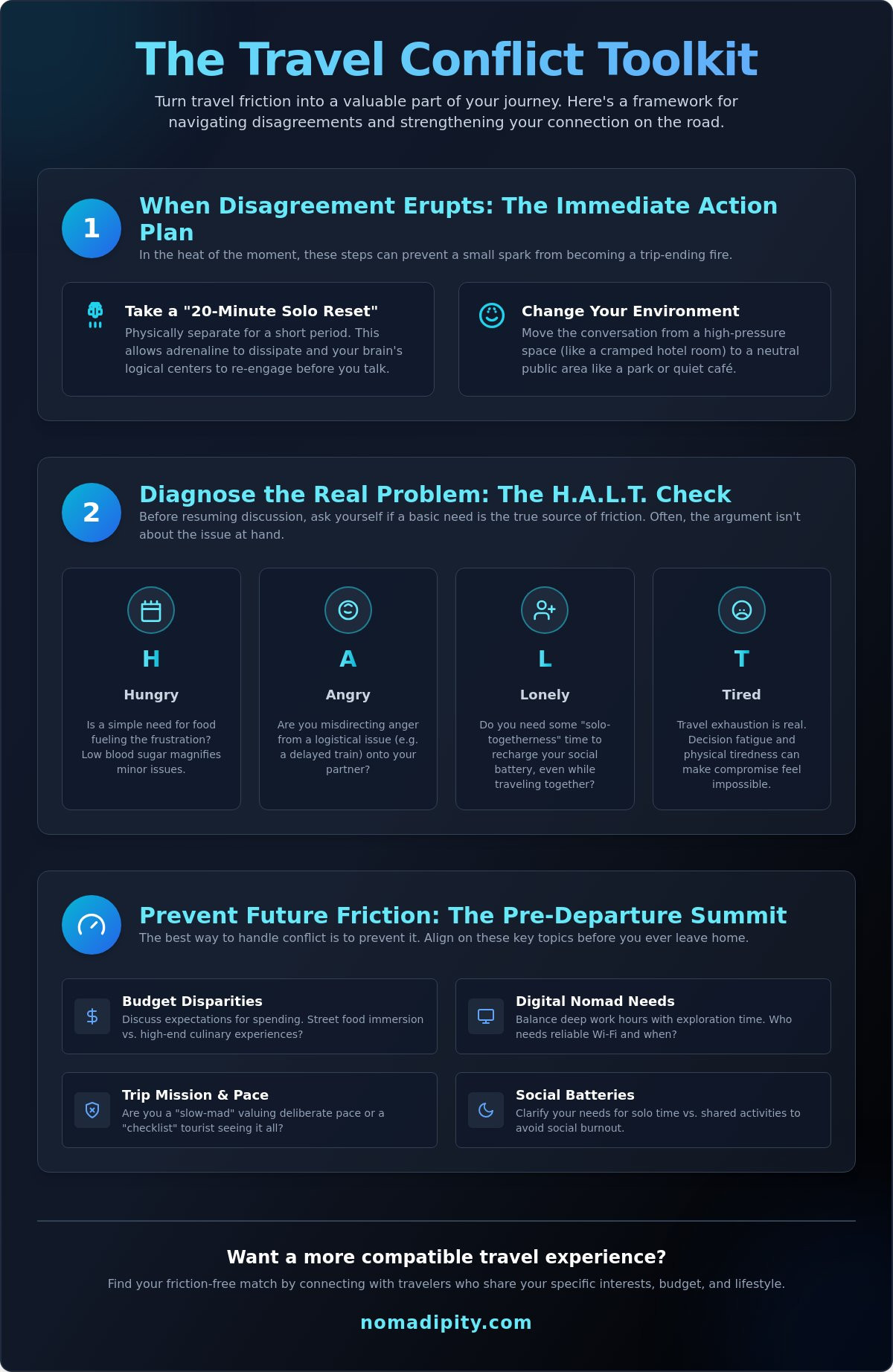
When the humidity of a Bangkok afternoon collides with a missed train connection, the resulting spark is rarely about the logistics themselves. It's about the friction of two distinct wills trying to occupy the same space. Knowing exactly what to do when you disagree with your travel partner in the heat of the moment can save your entire itinerary. The first and most effective tool is the 20-minute "Solo Reset." Step away. Physically removing yourself from the immediate vicinity, even if it's just to the other side of a plaza, allows the adrenaline to dissipate and gives your brain the necessary space to re-engage its logical centers.
Before you resume the conversation, perform a "HALT" check. Ask yourself if you are Hungry, Angry, Lonely, or Tired. More often than not, a disagreement over a museum fee is actually a cry for a sandwich or a nap. If the basic needs are met and the tension remains, change your environment. Moving from a cramped, high-pressure hotel room to a neutral public space, like a local park or a quiet cafe, can reset the social dynamic. Learning the nuances of traveling with your complete opposite can turn these moments into a masterclass in compromise rather than a trip-ending conflict.
During the discussion, practice active listening without the urge to formulate an immediate rebuttal. Use the "I hear you" technique to validate your partner's perspective before sharing your own. To prevent circular arguments that lead nowhere, implement the "Veto Power" rule. This is a pre-agreed mechanism where either person can call a temporary halt to a specific debate, with the understanding that you will revisit the topic only after a cooling-off period. Finding a partner who naturally aligns with your rhythm is easier when you use matchmaking for similar travelers to skip the initial friction and focus on the joy of the journey.
The Art of the Strategic Pause
Exiting a conversation gracefully requires a gentle touch. You might say, "I value our time together too much to argue while we're tired, so let's take an hour for ourselves and meet back here." Utilizing airport lounges or local libraries as neutral ground provides a dignified space to cool off. The Strategic Pause is a tool for preserving long-term travel bonds.
Communicating Your Needs Clearly
Shift your language toward "I" statements to express frustration without assigning blame. Instead of saying "You always rush me," try "I feel anxious when we don't have enough time to linger at the exhibits." This helps identify the "Need behind the Want." You might realize that your partner's desire for a fancy dinner is actually a need to feel pampered after a long day of budget travel. Once the core need is identified, set a specific time to revisit the topic after a meal or a rest, ensuring you both approach the resolution with a clear mind.
The Power of Solo-Togetherness: Navigating Different Styles
The secret to a harmonious journey often lies in a paradox: the more autonomy you grant each other, the closer you become. We often enter trips with the unspoken assumption that shared experiences must be constant to be valid. However, spending 24/7 with even your favorite person is a recipe for sensory and social exhaustion. This is where the concept of "Solo-Togetherness" becomes a vital pillar of modern travel. It's the intentional practice of pursuing individual interests during the day while maintaining a shared home base and evening connection. Knowing what to do when you disagree with your travel partner often starts with the humble "Solo Day."
Pitching time apart shouldn't feel like a rejection. It's an act of preservation for the relationship. Frame it as an opportunity to recharge your own batteries so you can be more present when you reunite. Instead of saying "I need a break from you," try "I'm really craving some quiet time at that local gallery, and I know you've been dying to see the stadium." When you rejoin for dinner, you aren't just eating together; you're exchanging stories from two different worlds. This enriches the shared journey, turning a potential conflict into a source of fresh conversation and mutual inspiration.
Dividing and Conquering the Itinerary
To make this work, you must identify your "Non-Negotiables" versus your "Nice-to-Haves." If your partner's non-negotiable is a four-hour hike and yours is a slow morning in a cafe, don't force a compromise that leaves both of you resentful. Create a "Parallel Play" schedule. This means you might travel to the same neighborhood together but part ways at the subway exit. You can find more inspiration for these independent excursions in our solo travel guide, which masters the art of planned serendipity. Setting specific touchpoints, like meeting at a certain landmark at 4 PM, provides the structure needed for spontaneity to flourish.
- Non-Negotiables: The three to five activities that define the trip's success for you personally.
- Nice-to-Haves: Experiences you're happy to share but won't feel slighted if they're skipped.
- Touchpoints: Pre-planned times and locations to regroup, ensuring neither party feels abandoned.
Managing the Guilt of Going Solo
Many travelers hesitate to strike out on their own because they feel responsible for their companion's entertainment. You must release this burden. Your partner is responsible for their own joy. When you embrace geographic autonomy, you stop being a caretaker and start being a peer. Establishing a "no-questions-asked" solo afternoon policy removes the need for elaborate justifications. It normalizes the idea that what to do when you disagree with your travel partner is simply to honor your individual rhythms. This intentional cultivation of your own path ensures that when you are together, you are there by choice, not by obligation.
Building a Framework for Planned Serendipity
True freedom on the road isn't the absence of a plan; it's the presence of a strong one. By establishing a "Pre-Departure Summit," you create a safe container for the unexpected to unfold. This meeting isn't about micromanaging every hour of your itinerary. Instead, it's about aligning on the big three: budget, sleep schedules, and social batteries. If you're a night owl traveling with an early riser, acknowledging that reality now prevents a week of quiet resentment later. Defining the "Mission of the Trip" is equally vital. Are you traveling for deep relaxation, professional networking, or high-octane adventure? When the mission is clear, deciding what to do when you disagree with your travel partner becomes a simple matter of checking back with your original intent.
Establishing a "Conflict Resolution Protocol" before you even reach the airport is a total game-changer. Agree on how you'll handle disagreements while you're still in a calm environment. Will you use the 20-minute reset? Will you have a specific "safe word" for when cultural overstimulation becomes too much? Having these rules in place removes the emotional guesswork when tension eventually rises. It allows you to navigate friction with the grace of a seasoned explorer rather than the frustration of a tourist caught off guard.
Setting the Logistical Foundation
Resentment often grows in the soil of small, unplanned expenses. Create a "Daily Budget Buffer" to cover that extra round of tapas or a sudden taxi ride in the rain without needing a formal debate. For those of us balancing remote work, clearly defined "Work Windows" are essential to separate professional obligations from shared exploration. It is a simple truth that 90% of travel conflict is prevented by 10 minutes of honest pre-trip planning.
Vetting for Compatibility
Prevention is always more effective than a cure. Compatibility isn't about being identical; it's about having complementary travel styles and shared core values. Before you commit to a long-haul journey, ask the hard questions about cleanliness, risk tolerance, and social needs. You can find a comprehensive vetting checklist in our guide to choosing a travel partner. To skip the guesswork entirely, subscribe to Nomadipity's travel matchmaking to connect with companions whose professional backgrounds and lifestyle designs already mirror your own. Vetting through a platform that prioritizes geographic autonomy ensures that your framework for serendipity is built on solid ground. This proactive approach helps you understand exactly what to do when you disagree with your travel partner before the first flight even takes off.
Finding Your Friction-Free Match with Nomadipity
While mastering the skills of compromise is essential, the most effective way to handle travel friction is to choose a companion whose rhythm already mirrors your own. Nomadipity isn't just another social network. It's a specialized matchmaking platform designed to connect you with travelers based on deep-seated affiliations, specific budgets, and shared travel styles. By aligning your journey with someone who understands the nuances of a remote professional life or a slow-mad pace, you significantly reduce the likelihood of a clash. When you move through the world with a "Nomadipitian" who shares your background, the question of what to do when you disagree with your travel partner shifts from a crisis to a minor, manageable adjustment.
The platform’s algorithm prioritizes geographic autonomy and intentional living. It helps you find niche communities that match your specific pace, whether you're looking for a high-energy adventure or a month of deep work in a coastal village. This better initial matching turns potential "unexpected disagreements" into "planned serendipity." By establishing a shared framework from the start, you facilitate those meaningful, unplanned moments that define a truly great trip. You aren't just finding a body to fill a spare room; you're cultivating a path with a peer who respects your independence as much as you respect theirs.
Beyond Random Matchmaking
Success on the road often comes down to the smallest logistical details. Nomadipity profiles allow you to set clear expectations regarding hotel rewards, lounge access, and daily spending habits before you ever book a flight. This level of transparency ensures a smoother bond because the major friction points are addressed upfront. Before committing to a long-term journey, you can leverage the social network's group forums to "test the waters." Engaging in these digital communities allows you to observe a potential partner's communication style and values in a low-pressure environment, making it much easier to decide what to do when you disagree with your travel partner in the future.
Your Next Adventure Starts Here
The world is vast and unpredictable, but it becomes far more manageable when you have a reliable companion by your side. There is a profound peace of mind that comes with knowing your travel buddy is a true match rather than a random acquaintance. Don't let the fear of social awkwardness or wasted money keep you from the global exploration you crave. Take the first step toward a more harmonious, soul-nourishing journey by choosing a partner who values depth over speed. Find your perfectly matched travel buddy on Nomadipity today.
Mastering the Art of Shared Exploration
Navigating the world is an act of vulnerability, and doing so with a companion requires both grace and a solid framework. By embracing the concept of solo-togetherness and establishing clear protocols before you even pack your bags, you turn potential conflict into a catalyst for deeper connection. You've learned that immediate de-escalation and honest communication are your best tools on the road. Understanding exactly what to do when you disagree with your travel partner ensures that your focus remains on the beauty of the destination rather than the weight of the disagreement.
The most seamless journeys often begin with the right person by your side. Nomadipity provides an exclusive social network for frequent flyers, allowing you to bypass the guesswork of random pairings. Through advanced traveler search filters and matchmaking based on mutual interests and affiliations, you can connect with peers who respect your pace and professional needs. Join Nomadipity to find travel partners who share your style and pace. The world is vast and welcoming; approach it with a compatible partner and an open mind to find the value in every unexpected moment.
Frequently Asked Questions
How do I tell my travel partner I want to spend the day alone?
Frame your request as a personal need for a "recharge" rather than a rejection of their company. You might say, "I'm feeling a bit overstimulated and would love to spend the afternoon wandering the botanical gardens solo to clear my head." Emphasize that having separate experiences during the day will give you both fresh stories to share over dinner. It's about preserving your energy so you can be a more present and engaged companion for the rest of the journey.
What is the most common cause of travel disagreements?
Misaligned expectations and decision fatigue are the primary culprits behind most friction on the road. In 2026, external stressors like geopolitical anxiety also play a significant role, with 72% of travel advisors reporting that clients feel a higher baseline of stress due to global events. When you're already on edge, small choices like where to eat or which train to take can feel monumental. This is why knowing what to do when you disagree with your travel partner before the stress peaks is so vital.
Should we split all travel costs 50/50 even if our budgets are different?
Equality doesn't always mean equity when it comes to travel finances. If one person craves luxury while the other is on a strict "slow-mad" budget, a strict 50/50 split will lead to resentment. Instead, agree to split shared essentials like base accommodation and transportation, then allow each person to fund their own "extras" like high-end meals or private tours. This approach respects individual financial boundaries while keeping the shared journey accessible for both parties.
What if my travel partner and I have completely different energy levels?
Embrace the "early bird and night owl" dynamic by scheduling your shared activities for the midday overlap. If you have a high-energy partner who wants to hike at dawn, let them go while you enjoy a slow morning at a local cafe. Meeting at a pre-arranged "touchpoint" for lunch allows you to enjoy the best of both rhythms. Forcing a match in energy levels usually leads to one person feeling exhausted and the other feeling held back.
Is it okay to end a trip early if we cannot stop arguing?
Ending a trip early is a valid choice if the alternative is permanently damaging a long-term bond. Sometimes, the most mature decision is to finish the itinerary in different cities or head home ahead of schedule. If you find yourself constantly wondering what to do when you disagree with your travel partner and no compromise works, it's a sign that your travel styles are fundamentally incompatible for this specific journey. Protecting the relationship is more important than checking off every landmark.
How can I stay calm when my travel partner is stressed or panicking?
Become the "anchor" by maintaining a low, steady vocal tone and avoiding the urge to match their frantic energy. Move them to a low-stimulation environment, like a quiet side street or a hotel lobby, before trying to solve the logistical problem. Focus on one immediate, actionable step at a time rather than the entire situation. Your calm presence acts as a grounding force, helping their nervous system reset so you can both think clearly again.
How do I handle a travel partner who is constantly on their phone?
Address the issue by focusing on "intentional presence" rather than assigning blame. Suggest "phone-free windows" during specific moments, such as when you're at a sunset viewpoint or sitting down for a local meal. Remind them that while digital connectivity is a tool, the purpose of the trip is the physical experience you're sharing. If they are working remotely, agree on specific "work hours" so their screen time doesn't bleed into your shared exploration.
What should I do if my travel buddy wants to do something dangerous or illegal?
Safety and legal boundaries are non-negotiable and require a firm, clear "no." You are never obligated to participate in activities that compromise your safety or violate local laws, regardless of the social pressure. If a partner persists in risky behavior, it may be time to separate and continue your journey independently. This is why vetting companions through platforms like Nomadipity is so helpful; it ensures you're matched with people who share your core values and risk tolerance.

Disclaimer
Nomadipity Blog Disclaimer
The content on Nomadipity is provided for general informational and inspirational purposes only. While we strive for accuracy and timeliness, Nomadipity does not guarantee that any information is complete, current, or suitable for your specific needs. Use your judgment and verify details before making travel plans, meeting with other users in person, or making any purchases influenced by the article.


