

What if the secret to a perfect shared journey isn't finding the right destination, but learning how to walk away from your partner for a few hours? We often assume that traveling together means being tethered at the hip. However, the most seasoned explorers know that setting boundaries with a travel companion is actually the highest form of respect you can show for a friendship. With 74% of Millennials and Gen Z viewing travel as a non-negotiable expense in 2026, the stakes for these shared experiences have never been higher. You want the magic of a shared sunset without the resentment of a forced itinerary.
It's exhausting to compromise on every meal or budget decision until your own sense of wonder starts to fade. We understand that the fear of travel drama often keeps people from booking the flight. This article will teach you how to establish healthy boundaries that preserve your friendship and your freedom while exploring the world. We'll provide a clear framework for pre-trip discussions and scripts for communicating your needs in real-time. If you haven't found your perfect match yet, our travel matchmaking subscription connects you with similar travelers who share your values and travel style to ensure your next adventure is built on a foundation of mutual understanding.
Key Takeaways
- Discover why establishing clear "rules of the road" actually invites more spontaneity and joy into your shared adventures.
- Learn the five non-negotiable conversations to have before you pack, including specific strategies for daily budget caps and scheduled solo time.
- Master the delicate art of setting boundaries with a travel companion when it comes to shared workspaces and the fair use of travel perks.
- Gain access to real-time communication scripts, like the "safe word" for social exhaustion, to help you reset the vibe when things get tense.
- Understand how specialized matchmaking filters can pair you with companions who naturally align with your pacing and personal boundaries from the start.
Redefining Boundaries: Why They Are the Secret to Shared Freedom
Think of boundaries as the silent architecture of a great adventure. They aren't meant to restrict you; instead, they act as the agreed-upon "rules of the road" that keep the journey moving forward. When we talk about setting boundaries with a travel companion, we are really talking about creating a shared language for the trip. It's about deciding, before you even reach the airport, how you will handle the inevitable friction of 24/7 proximity. By defining these expectations early, you build a safety net that catches the small frustrations before they turn into trip-ending drama.
There is a beautiful paradox at play here. While structure often sounds like the enemy of adventure, it is actually the catalyst for it. When you have a solid framework, you stop wasting mental energy on small anxieties. You aren't constantly wondering if your friend is secretly resentful because you wanted to sleep in until noon. You already know the plan. This clarity allows for "Planned Serendipity," the art of being so well-prepared that you have the emotional space to embrace the unexpected moments that make travel so transformative.
We generally divide these into two categories. Logistical boundaries cover the tangible stuff: daily budgets, check-in times, and who handles the navigation. Emotional boundaries are more subtle. They involve your social battery, your energy levels, and your need for solitude. A foundational understanding of personal boundaries reminds us that these limits are essential for mental health. They ensure you return from your trip feeling refreshed rather than depleted by the needs of others.
The Myth of the "Inseparable" Duo
The idea that you must spend every waking second together is a fast track to travel burnout. It is perfectly normal to want different things. Maybe you want to browse a quiet local bookstore while your companion wants to hike a nearby trail. Choosing separate paths for an afternoon doesn't signal a rift in the friendship. In fact, it preserves it. Travel autonomy is the ability to choose your own pace without guilt.
Boundaries as a Form of Respect
Early honesty is a gift to your relationship. By stating your needs clearly, you show that you value the bond more than a rigid itinerary. This shifts the focus from a "me vs. you" struggle for control to an "us vs. the logistics" partnership. When you both know the expectations, you can navigate the world with a sense of quiet confidence. This alignment is exactly what we look for in our travel matchmaking subscriptions, where we pair travelers based on shared styles and boundary frameworks to avoid friction before the first bag is packed.
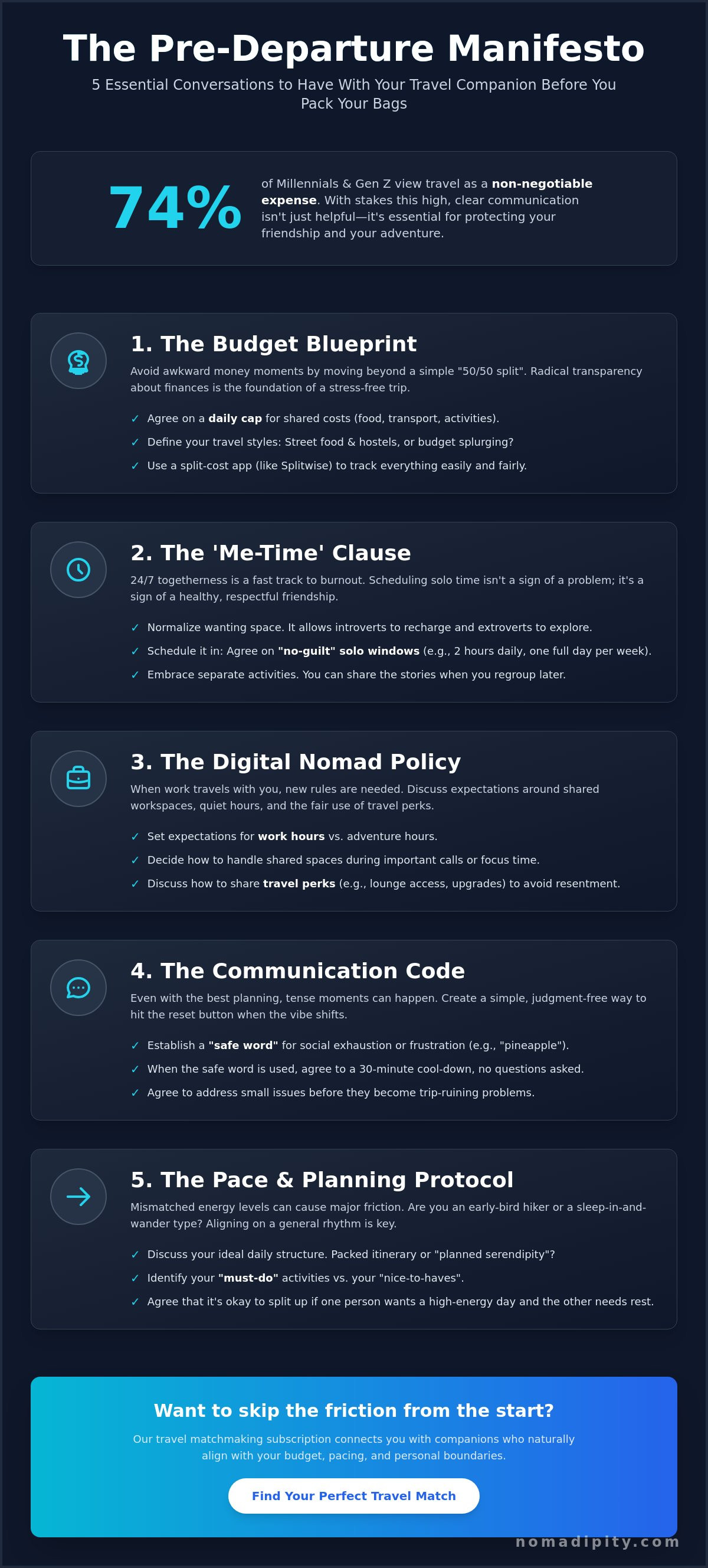
The Pre-Departure Manifesto: 5 Essential Conversations to Have Now
Before you zip the suitcase, you need to open the dialogue. Setting boundaries with a travel companion starts with a "Pre-Departure Manifesto," a series of candid talks that prevent small frictions from becoming major fractures. Vague promises to "just split everything" or "play it by ear" usually lead to silent resentment. Instead, aim for radical transparency. Maintaining psychologically healthy relationships on the road requires this level of preemptive honesty. It's about protecting the friendship as much as the trip.
Start with the Budget Blueprint. Move beyond the fifty-fifty split and discuss specific daily caps for food, transport, and activities. Research shows that while travel remains a priority for 74% of younger generations in 2026, many are increasingly price-sensitive. Are you planning for street food and hostels, or are you looking for "budget-conscious splurging" on a few high-value experiences? Agreeing on a ceiling for shared costs prevents the awkwardness of one person feeling priced out of their own vacation.
Next, establish the "Me-Time" Clause. Normalize the idea that you won't spend every hour together. Whether it's two hours every afternoon or one full solo day a week, scheduling these windows removes the guilt from wanting space. It allows the introvert to recharge and the extrovert to find new social circles without feeling like they've abandoned their partner. If you find it hard to balance this independence, our solo travel guide offers deeper insights into maintaining your autonomy while abroad.
Financial Transparency and Shared Costs
Uneven budgets don't have to be a dealbreaker if you address them early. Use real-time tracking tools like Splitwise to avoid the "who-owes-what" mental math at the end of every meal. We also recommend establishing a "slush fund" for shared incidentals. Tossing a set amount into a digital pot for Ubers, tips, and communal groceries keeps the flow of the day smooth and avoids petty tallying. This level of organization is a core pillar for those using our travel matchmaking to find companions with compatible spending habits.
The Rhythm of the Day: Early Birds vs. Night Owls
Mismatched biological clocks can cause significant stress. If you need "first coffee" silence while your partner is a morning chatterbox, say so now. Negotiate wake-up times and decide on a "base camp" accommodation that offers enough physical space for one person to sleep while the other works or gets ready. Acknowledge your conflict resolution style too. Do you need to talk through stress immediately, or do you need twenty minutes of silence to cool down? Knowing these triggers before the flight takes off is the ultimate travel hack.
Navigating the Nomad Nuance: Work, Perks, and Digital Boundaries
The blurred line between professional life and global exploration is no longer a niche experience. With 81% of business travelers extending their international trips for personal leisure in 2026, the "bleisure" reality requires a new level of communication. Setting boundaries with a travel companion in this context isn't just about where to eat dinner; it's about protecting your livelihood. When your office is a backpack and your boardroom is a shared Airbnb, the traditional rules of engagement don't apply. You need a framework that respects both the deadline and the destination.
Start by establishing "Deep Work" zones. When the laptop is open, consider yourself mentally "away." It's a relocation of focus that your companion must respect. Use a physical signal, like a specific pair of noise-canceling headphones or a designated workspace, to indicate that you're in a flow state. This prevents the "quick questions" that shatter productivity. Similarly, agree on a "Digital Sunset." Since 82% of travelers believe learning a new skill makes a trip more memorable, you need time away from screens to actually engage with the local culture. Put the phones away at 7:00 PM to ensure you're present for the sunset, not just photographing it.
The Professional Boundary
Working from a sun-drenched cafe in Lisbon looks like a dream, but it's still a job. Define your "Office Hours" clearly, especially if you're navigating different time zones. Make sure your companion understands that even if you're sitting in a beautiful setting, you aren't available for spontaneous sightseeing until the tasks are done. Successfully balancing these demands is the core of the digital nomad lifestyle. It requires a partner who values your professional autonomy as much as your shared wanderlust.
Loyalty Perks and the "Plus One" Dilemma
Elite status can create an accidental hierarchy. If one of you has lounge access and the other doesn't, discuss the etiquette before you reach the terminal. Is "guesting in" an expectation or a treat? Negotiating these perks fairly prevents one person from feeling like a second-class traveler. Using a social network for frequent flyers can help you find companions who already hold similar status, removing this friction entirely. When everyone is on the same page regarding upgrades and lounge guesting, the focus stays on the adventure ahead.
Finally, manage the inevitable "Travel Jealousy." It's difficult to stay focused on a spreadsheet when your partner is sending photos from a local vineyard. Acknowledge these feelings. Set a boundary where the "exploring" partner saves their highlights for a dedicated catch-up over dinner. This protects the working partner's focus and makes the eventual shared time feel more rewarding.
The Mid-Trip Reset: How to Communicate When the Vibe Shifts
Even the most harmonious journeys hit a plateau where the initial sparkle of a new destination starts to dim under the weight of shared exhaustion. Jet lag, missed connections, and the simple reality of 24/7 proximity can fray even the strongest bonds. This is why the mid-trip reset is your most valuable tool. Successfully setting boundaries with a travel companion requires more than just a pre-trip talk; it demands an ongoing commitment to honesty as the trip evolves and your energy levels shift.
One of the most effective ways to manage this is through a "Safe Word" for travel fatigue. Choose a low-stakes, humorous word that signals you've reached your social limit. When one of you says "Pineapple," it means "I love you, but I need two hours of silence right now." No questions asked. No feelings hurt. It’s a shortcut to solitude that bypasses the need for a long, potentially defensive explanation. It acknowledges that your social battery isn't a reflection of the friendship, but a biological reality of travel.
For deeper tensions, implement the 24-Hour Rule. If a conflict arises when you're tired or hungry, agree to give it a full day to breathe before addressing it. Often, a good night’s sleep and a solid meal reveal that the "problem" was actually just low blood sugar. To keep small issues from festering, establish a weekly "Check-In" Dinner. Use this time to celebrate what’s working and gently recalibrate what isn’t. If you want to avoid these friction points from day one, consider a travel matchmaking subscription to find a partner whose communication style already aligns with your own.
Scripts for Graceful Boundary Setting
Saying "no" to an activity is not a rejection of the person. It is a preservation of your own experience. Try these phrases to pivot without causing friction:
- "I'm feeling a bit socially drained today. I'm going to skip the group tour and meet you for dinner at 7:00 PM instead."
- "That museum looks incredible, but I need a slower pace this afternoon to actually enjoy the city. I'll catch up with you later tonight."
- "I'm not feeling up for the hike, but I'd love to hear all about it over a glass of wine when you get back."
When Boundaries Are Broken
Sometimes, despite your best efforts, boundaries are repeatedly ignored. It’s important to distinguish between minor annoyances and deal-breakers that ruin the spirit of travel. If the vibe has shifted beyond repair, don't be afraid to trigger the "Divorce" Protocol. It is far better to finish a trip solo and preserve the friendship than to stay together and let resentment destroy it. Choosing your own path mid-trip is a brave act of self-care that often leads to the most profound personal growth and mental clarity.
Matchmaking for Harmony: Choosing a Companion Who Shares Your Framework
The most elegant way to handle setting boundaries with a travel companion is to choose someone who already speaks your language. While you can negotiate with anyone, there is a profound ease that comes from pairing with a partner who naturally aligns with your rhythm. Our matchmaking subscriptions are designed to bypass the traditional trial and error phase of travel. By filtering for specific travel styles and deliberate pacing, we ensure that the foundational framework is already in place before you book your first flight. It is no surprise that 70% of solo travelers in 2026 are seeking experiences designed to connect them with like-minded people. They aren't looking for just anyone; they are looking for the right fit.
It isn't enough to just want to visit the same city. With searches for secondary, less-crowded destinations across Asia growing 15% faster than traditional hubs in 2026, travelers are clearly seeking specific, intentional experiences. If you want a quiet, "anti-tourism" retreat in a remote village while your partner wants the high-energy pulse of a capital city, the friction is inevitable. Matching on "Pace" and "Style" is the key. Are you a "Budget-Conscious Splurger" or a "Milestone Celebrator"? Knowing these answers beforehand makes boundary setting a collaborative process rather than a confrontational one.
We also prioritize "Rewards-Compatible" matching. If you both hold elite status or similar frequent flyer perks, the "Plus One" dilemma mentioned earlier disappears. You can enjoy the lounge together, navigate the priority lanes as a team, and share the benefits of loyalty without one person feeling left behind. This synergy allows you to focus on the destination rather than the logistics of who gets which perk. It transforms the airport experience from a point of tension into a shared benefit of your travel lifestyle.
The Power of Mutual Affiliations
Shared values often stem from shared backgrounds. Whether it's a mutual professional affiliation or a similar history of remote work, these commonalities provide a shorthand for trust. You can find your "Nomadipitian" tribe through our niche group forums, where travelers discuss everything from deep work setups to hidden local gems. Be aware that travel dating requires even more explicit boundary setting. The emotional stakes are higher, making early honesty about your need for space and autonomy even more vital for the health of the relationship.
Your Next Adventure Starts with a Connection
Before committing to a major international journey, we recommend a "Trial Weekend." It is a low-stakes way to vet your match and see how your boundaries hold up under real-world conditions. Use your Nomadipity profile to highlight your needs clearly. Mention your "Digital Sunset" times or your preference for silence during your morning coffee. When your itinerary sharing aligns with your personal values, you aren't just finding a roommate. You're finding a co-author for your next great story. Join Nomadipity today to find your perfect travel companion and start designing a journey defined by freedom, not friction.
Designing Your Shared Horizon
Travel is far too precious to be weighed down by unspoken expectations or the exhaustion of constant compromise. We've explored how a pre-departure manifesto and intentional mid-trip resets can transform your journey from a series of logistical hurdles into a truly restorative experience. Ultimately, setting boundaries with a travel companion is the highest form of respect you can offer both to yourself and to the person beside you. It creates the necessary space for those unplanned, serendipitous moments that define a truly great adventure.
You don't have to navigate these waters alone or settle for a mismatched partner. If you're ready to find a co-explorer who values independence as much as you do, find a travel partner who respects your boundaries on Nomadipity. Our platform uses advanced traveler search filters and mutual interest matchmaking to connect you with an exclusive community of frequent flyers who share your travel style and professional values. The world is waiting, and it’s much more welcoming when you're walking alongside someone who truly understands your pace.
Frequently Asked Questions
How do I tell my travel partner I need a "solo day" without hurting their feelings?
Frame your request as a way to recharge your social battery so you can be a better companion later. Use phrases like, "I've loved our time today, but I need a few hours of quiet to process everything we've seen." Most travelers value their own independence and will appreciate the honesty. It's about shifting the focus from "leaving them" to "caring for yourself" to ensure the rest of the trip stays joyful.
What should I do if my travel companion has a much higher budget than I do?
Establish a "shared floor" for mutual expenses like accommodation and meals that fits the lower budget comfortably. If your partner wants a five-star dining experience that you can't afford, they can choose to go solo or cover the difference as a gift. Honest financial transparency prevents the power imbalance that often leads to resentment. It's better to address the gap early than to feel priced out of your own vacation.
Is it normal to feel annoyed by a close friend while traveling together?
It is absolutely normal and expected to feel occasional irritation when sharing a small space 24/7. Even the best of friends have different habits that become magnified under the stress of jet lag or language barriers. Acknowledge the feeling without judgment. Usually, a few hours of physical distance or a solid meal is all it takes to reset the vibe and restore the friendship to its natural state.
How do we handle shared costs if one person has a points-heavy travel style?
Agree on a fair cash value for the "points" being used or have the points-heavy traveler cover specific shared perks like lounge access. If one person uses miles for a business class upgrade, the other shouldn't feel obligated to pay cash for the same seat. Setting boundaries with a travel companion regarding loyalty rewards ensures that both parties feel they are contributing fairly to the overall experience without depleting their savings.
What are the biggest red flags to look for in a potential travel partner?
Watch out for a lack of transparency regarding finances or an unwillingness to discuss "what-if" scenarios before booking. If someone avoids the hard conversations about budgets and personal space during the planning phase, they'll likely avoid them on the road too. A rigid "my way or the highway" attitude is a major signal that your boundaries won't be respected. Look for someone who values communication as much as the destination.
Can I set work boundaries if I am traveling with someone who is on a full vacation?
You can and should establish clear "office hours" to protect your professional focus even while abroad. Make it clear that while you are in your "work zone," you are effectively in another city. Your companion needs to find their own morning rhythm or solo activities during these windows. This prevents you from falling behind on deadlines and keeps them from feeling ignored or bored while you handle your business.
How do we decide who gets the "good" bed or the window seat fairly?
Use a simple "alternating" system or a coin toss to decide the first choice for the initial leg of the trip. If you get the window seat on the flight out, your companion gets it on the way back. For accommodations, the person who did the bulk of the booking or research might get first pick of the room. The goal is to ensure that over the course of the trip, the perks feel evenly distributed.
What happens if we realize we have completely different travel paces after we arrive?
Pivot to a "hub and spoke" strategy where you share a base camp but explore the city independently. You might meet for a late dinner to share stories of your day, but spend the daylight hours moving at your own speed. Setting boundaries with a travel companion about pacing allows you to see the world through your own lens without feeling rushed or held back by someone else's rhythm.

Disclaimer
Nomadipity Blog Disclaimer
The content on Nomadipity is provided for general informational and inspirational purposes only. While we strive for accuracy and timeliness, Nomadipity does not guarantee that any information is complete, current, or suitable for your specific needs. Use your judgment and verify details before making travel plans, meeting with other users in person, or making any purchases influenced by the article.


