

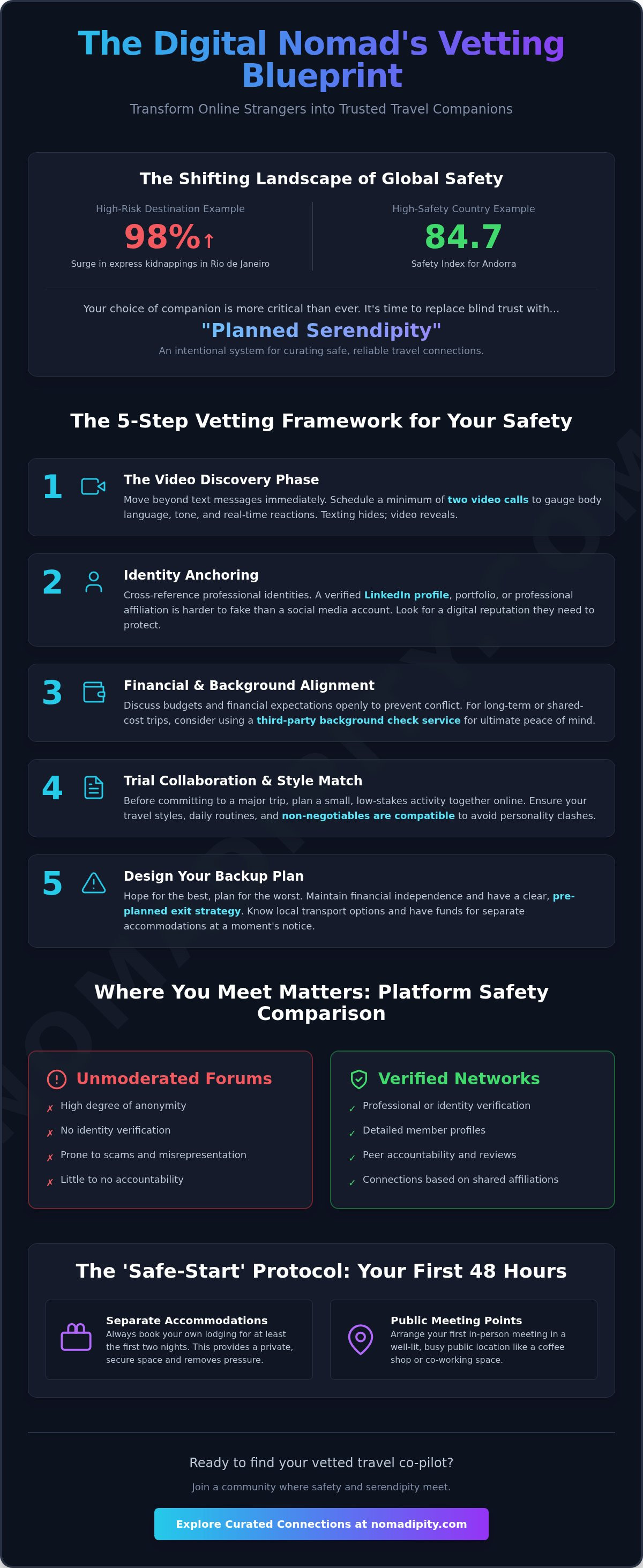
What if the greatest risk to your solo journey isn't the stranger you meet online, but the rigid walls you build to avoid them? You've likely stared at a profile on a travel forum and wondered, is it safe to travel with a stranger from the internet, only to feel a sudden wave of anxiety about scams or personality clashes in a remote location. It's a valid fear. In 2026, the landscape of global safety is shifting rapidly. While countries like Andorra boast a safety index of 84.7, destinations like Rio de Janeiro saw a 98 percent surge in express kidnappings last year, making your choice of companion more critical than ever.
We agree that your physical safety and peace of mind are non-negotiable. This guide will show you how to move past that fear by using "planned serendipity" to transform a digital connection into a reliable, vetted co-pilot. You'll learn how to navigate a professional vetting process, understand the real costs of background checks, and design a backup plan that keeps you in control. We are going to bridge the gap between digital nomad dreams and grounded, practical reality so you can cultivate connections that actually last. Let's turn that digital uncertainty into a shared adventure you can trust.
Key Takeaways
- Move beyond simple text messages by implementing a multi-step vetting framework that prioritizes video discovery calls and professional identity verification.
- Learn how to answer the question, is it safe to travel with a stranger from the internet, by shifting your strategy from blind trust to a system of "planned serendipity."
- Protect your independence with the "Safe-Start" protocol, ensuring you have separate accommodations and public meeting points during the first 48 hours of any shared trip.
- Understand the critical safety differences between unmoderated public forums and verified travel networks that offer peer accountability and detailed member profiles.
- Discover how matching with companions based on specific travel styles and shared affiliations can eliminate personality clashes and ensure a more harmonious journey.
The Reality of Traveling with Someone You Met Online in 2026
The word "stranger" carries a heavy weight. It often conjures images of shadowy figures and cautionary tales from the early days of the web. But as we move through 2026, the definition of a travel companion is shifting. With millions of people embracing location independence, the person you meet in a digital community often shares your professional values, your budget, and your thirst for authenticity. You aren't just meeting a random person; you are connecting with a peer who operates in the same global circles.
Is it safe to travel with a stranger from the internet? The answer depends entirely on the systems you use to vet them. While the risks of scams or physical danger are real, the massive growth of the digital nomad lifestyle has forced the industry to innovate. We now have tools that prioritize verification over anonymity. When you ask yourself, is it safe to travel with a stranger from the internet, you are really asking if you can trust your vetting process. Your intuition is a powerful compass in this journey, but it shouldn't be your only tool. You need a structure that validates your gut feelings with hard data.
The Evolution of Modern Travel Companionship
Travel matchmaking has evolved far beyond the era of sketchy classified ads. We have moved into a space of interest-based connections where shared affiliations provide a layer of accountability. This global connectivity reduces the isolation often felt on the road while increasing our collective security. Before you book a flight with someone new, it helps to consult a comprehensive guide to internet safety to understand how to protect your digital footprint. Within this shift, we find the core of our philosophy. Planned serendipity is the intentional curation of unexpected human connections. It is the art of setting the stage so that magic can happen without the chaos of total uncertainty.
Why Solo Travel Isn't Always the Safest Alternative
Many believe that going it alone is the only way to stay secure. However, solo travel has its own unique vulnerabilities. In high-traffic areas or remote destinations, there is a distinct safety-in-numbers advantage. Having a partner offers several practical layers of protection:
- Emergency Support: Someone is there to assist during a sudden illness or a late-night transit issue.
- Logistical Backup: A companion can help navigate complex language barriers or watch your belongings in crowded spaces.
- Risk Mitigation: Two sets of eyes are always better than one when assessing the safety of a new neighborhood or transport option.
Beyond physical logistics, a companion protects your emotional safety. Long-term movement can lead to profound mental fatigue and decision burnout. If you are struggling with the isolation of the road, our solo travel guide explores these challenges in depth. Having a trusted partner allows you to share the cognitive load of travel. It makes the journey more sustainable, more vibrant, and ultimately, more secure.
A 5-Step Vetting Framework to Ensure Your Safety
You have moved past the initial hesitation and found a potential companion. Now, you need a system to verify that the person behind the screen is exactly who they claim to be. When people ask, is it safe to travel with a stranger from the internet, they are usually looking for a checklist that removes the guesswork. A logical framework replaces anxiety with agency. Trusting your gut is a necessary start, but a structured framework provides the evidence your intuition needs to make a final decision.
This five-step vetting process is designed to move you from digital curiosity to grounded confidence:
- The Video Discovery Phase: Move away from text-based messaging as quickly as possible. Schedule a minimum of two video calls. Texting allows people to curate a persona, but a live conversation reveals body language, tone, and immediate reactions.
- Identity Anchoring: Cross-reference professional affiliations. A stranger with a verified LinkedIn profile or a long-standing loyalty program status has a digital reputation to protect. These professional anchors are much harder to fake than a basic social media profile.
- Budget Alignment: Discussing finances early is a proxy for stability. Mismatched spending habits create resentment and vulnerability. Ensure you are on the same page regarding accommodation standards and daily expenses.
- Social Proof: Review their shared travel history or community badges. On our travel matchmaking platform, these markers provide social proof from other travelers who have already shared the road with them.
- The Trial Run: If you are in the same region, set a "trial date" like a local hike or a coffee meetup. If you are meeting abroad, treat the first 48 hours as a probationary period before merging your itineraries completely.
The Digital Footprint and Verification Check
A person's digital footprint should tell a consistent story. Use professional networks like LinkedIn to anchor a stranger's identity to a real-world career and location. Look for shared itineraries or past reviews that highlight their travel style. Red flags often hide in the details of early communication. If a potential partner creates a sense of extreme urgency, remains vague about their background, or flatly refuses to hop on a video call, it is time to walk away. In 2026, there is no excuse for remaining a digital ghost.
Assessing Emotional and Tactical Compatibility
Physical safety is the baseline, but emotional compatibility determines the quality of your journey. A "safe" person can still be a bad partner if your sleep cycles or crisis management styles clash. Ask specific, tactical questions. What happens if one of you loses a passport? How do they react to a missed flight? Identifying shared interests ensures the connection is built on more than just a desire to split the bill. When you ask, is it safe to travel with a stranger from the internet, remember that "safe" also includes your mental well-being and the harmony of your trip.
Public Forums vs. Verified Networks: Where Safety Starts
Where you begin your search for a companion often dictates the level of risk you invite into your journey. Many travelers start on massive, unmoderated platforms like Reddit or Facebook Groups, hoping to find a quick match for a weekend trip. However, these spaces often fail to provide a clear answer to the question: is it safe to travel with a stranger from the internet? While these groups offer a wide net, they lack the structural vetting required for true peace of mind. Without verification, you are essentially rolling the dice on a stranger's intentions and identity.
Contrast this with the security benefits of a social network for frequent flyers. These niche communities use "pay-to-play" subscription models that act as a natural filter. Scammers and low-intent individuals rarely spend money to join a curated community; they prefer targets of opportunity on free sites where they can remain anonymous. By choosing a verified network, you are interacting with people who have already demonstrated a commitment to a specific lifestyle and level of accountability. It shifts the dynamic from a random match to an affiliation-based connection.
The Danger of the 'Free' Travel Buddy Site
Zero-barrier platforms attract high-risk individuals because there is no accountability. On public social media, your data privacy is often non-existent, and sharing your itinerary can expose you to unwanted attention before you even leave home. Dedicated platforms solve this by using algorithms that prioritize mutual interests and safety over mere proximity. Consider these risks of free forums:
- Lack of Verification: Anyone can create a profile in seconds without any identity checks.
- Public Exposure: Your travel plans are often visible to thousands of unvetted users.
- Low Intent: Users may not be serious about the trip, leading to last-minute cancellations.
When the barrier to entry is non-existent, the quality of the connection often follows suit. You want a partner who is as invested in the journey as you are, not someone just looking for a free ride.
Leveraging Affiliations for Trusted Connections
Connecting with someone who shares your professional background or travel status creates a layer of psychological safety. If you are both members of the same professional organization or hold similar loyalty program statuses, you already have a shared language and a baseline of expected behavior. Using loyalty program integration serves as a secondary layer of identity verification that a simple Facebook profile cannot match. Ultimately, finding a travel buddy through an interest-based network leads to deeper, more authentic friendships because the foundation is built on shared values rather than just a shared destination. It is the difference between a random encounter and a well-designed connection.
The 'Safe-Start' Protocol: Managing Your First In-Person Meetup
The moment you step off a plane to meet a digital connection in the physical world is where theory meets reality. Even with the most rigorous vetting, you might still find yourself asking, is it safe to travel with a stranger from the internet as you scan the arrivals hall. This transition is the most critical phase of your journey. It requires a blend of openness and tactical caution. We call this the 'Safe-Start' protocol; it is a system designed to protect your autonomy while allowing room for genuine connection to grow.
Your first rule of engagement is the separate accommodation mandate. Always book separate rooms for at least the first 48 hours of a shared trip. This provides a necessary sanctuary where you can decompress and process your impressions without the pressure of a shared space. Combine this with the 'Public First' rule. Meet in a high-traffic airport lounge, a bustling local café, or a hotel lobby before heading to any private or remote location. These public spaces offer a natural layer of oversight and allow you to assess the person's energy in a low-stakes environment.
Digital safety nets are equally essential in 2026. Share your full itinerary and 'Live Location' with a trusted friend at home. Apps like Life360, which currently serves 33 million monthly active users, offer premium plans starting at $14.99 per month that provide sophisticated tracking and safety features. Finally, maintain an 'Emergency Escape Fund' in a separate account. This is your 'get out' money, inaccessible to your companion and sufficient to cover a last-minute flight or a week of solo lodging if the situation changes.
Designing Your First 48 Hours for Maximum Security
Think of the first two days as a probationary period. This isn't about being guarded; it's about being intentional. Use this time to set clear boundaries regarding personal space and shared expenses before the first large bill arrives. Establish a check-in schedule with family members via encrypted messaging. If you don't send your 'all clear' by a pre-arranged time, your contact at home should have a specific plan of action. This structure allows you to relax into the experience, knowing your safety is managed.
Creating a No-Guilt Exit Strategy
A truly successful journey requires the freedom to leave it. You must be willing to have the "awkward conversation" about what happens if the match doesn't work out. Pre-plan alternative routes or solo itineraries so you aren't stranded if you decide to split. If you need to end the partnership, use a polite but firm script: "I've really valued our time together, but I've realized our travel styles are leading us in different directions, so I'm going to continue with my solo itinerary starting tomorrow." To connect with travelers who respect these boundaries, join our curated travel community and start designing your next adventure with confidence.
Nomadipity: Elevating Safety Through Curated Serendipity
The concept of a "stranger" is fundamentally different when you are part of a curated ecosystem. We designed Nomadipity to replace the uncertainty of the open internet with a system of high-trust connections. When you ask, is it safe to travel with a stranger from the internet, the answer changes when that person has been vetted through a lens of shared affiliations and professional status. Our detailed traveler profiles act as a bridge, turning a digital icon into a multi-dimensional human with a documented history within our community. You aren't just looking for a body to fill a seat; you are looking for a partner whose travel style mirrors your own.
This intentionality extends to your personal goals. Whether you are seeking a platonic co-pilot or exploring travel dating, our platform ensures that your intentions are aligned before the first "hello." We facilitate this through community forums and scheduled lounge meetups in high-traffic airports. These environments provide a safe, public space for initial interactions, allowing you to test the waters of a new connection without the pressure of a committed itinerary. Our premium membership model serves as the ultimate filter, cultivating a community of "Nomadipitians" who value their reputation and the collective safety of their peers.
Beyond the Search Bar: How Matchmaking Works
Our matchmaking process isn't a random search. It is an algorithm that prioritizes three pillars: safety, budget alignment, and travel style. Sharing an itinerary on a public board is a security risk, but doing so within Nomadipity keeps your plans inside a verified circle. You gain the peace of mind that comes from knowing every potential match is a frequent flyer with a verified digital footprint. By shifting the focus from "who is available" to "who is compatible," we solve the core anxiety behind the question: is it safe to travel with a stranger from the internet? This system removes the guesswork, allowing you to focus on the experience rather than the vetting.
Your Next Adventure Starts with a Trusted Connection
Location independence is more than just a work style. It is a way to design your life around human connection and global exploration. We invite you to step into a network where serendipity is no longer a gamble, but a planned outcome. You have the agency to cultivate a lifestyle that values authenticity and security in equal measure. The world is vast, but it doesn't have to be lonely. Join Nomadipity and find your vetted travel companion today.
Design Your Journey with Confidence
The transition from solo exploration to shared adventure doesn't have to be a leap of faith. By replacing blind trust with a structured vetting framework and the "Safe-Start" protocol, you reclaim control over your travel experience. We've explored how moving beyond unmoderated forums and embracing verified networks allows you to find partners who share your professional status and travel values. Ultimately, deciding is it safe to travel with a stranger from the internet depends on the intentionality of your systems and the quality of the community you join.
You deserve a companion who is as invested in the journey as you are. Our platform provides community-vetted traveler profiles, integration with major airline loyalty programs, and niche forums designed for high-intent travelers. These tools ensure that your next connection is rooted in reality rather than digital anonymity. It's time to stop leaving your safety to chance and start embracing the power of planned serendipity.
Start your journey with a vetted Nomadipitian companion today. The world is waiting, and it's much more welcoming when you navigate it with a trusted friend by your side.
Frequently Asked Questions
Is it safe to meet a travel buddy at the airport?
Meeting at the airport is one of the safest options because it is a high-traffic, monitored environment. You should choose a specific, well-lit landmark like a branded coffee shop or a premium airline lounge. These spaces provide a natural layer of security and oversight. It allows you to gauge their energy before you ever leave the terminal or head toward a private vehicle together.
What are the biggest red flags when talking to a potential travel partner online?
Watch for a sense of extreme urgency or a persistent refusal to hop on a video call. If a potential partner is vague about their professional life or avoids sharing a social footprint, they are likely hiding something. Genuine travelers are usually eager to share their past adventures and professional backgrounds. Trust your intuition if their story feels inconsistent or if they push for financial commitments early on.
How do I verify someone's identity before traveling together?
Use professional networks like LinkedIn to anchor their identity to a real career and location. You can also utilize identity verification services which typically cost between $5 and $20 in 2026. If you want more peace of mind, a basic criminal record search generally ranges from $15 to $30. Cross-referencing these data points ensures you aren't just trusting a curated profile.
Should I share my hotel room with a stranger from the internet?
You should avoid sharing a room for at least the first 48 hours of your journey. Booking separate accommodations ensures you have a private sanctuary to retreat to if the dynamic feels off. It's much easier to transition into a shared space later than it is to navigate an awkward exit from a shared room. This boundary is a cornerstone of answering the question, is it safe to travel with a stranger from the internet.
What happens if my travel companion turns out to be a scammer?
Execute your pre-planned exit strategy immediately and move to a secure, public location. You should have an emergency fund in a separate account to cover a last-minute hotel or flight. Report the individual to the platform where you met to protect other members of the community. Having a "no-guilt exit" means you can walk away without hesitation if your safety or finances are at risk.
Is there a safe way to find a travel buddy for solo female travelers?
Verified, niche networks are the most secure option for solo female travelers because they offer peer accountability. Look for platforms that use community-vetted profiles and social proof from other women. Using safety apps like OtoZen or Life360, which offers premium tracking starting at $14.99 per month, adds an extra layer of digital protection. These tools help you cultivate connections within a high-trust environment.
Can I use travel matchmaking sites for professional networking?
Yes, many travel matchmaking sites are designed specifically for the digital nomad community. Connecting with people who share your professional affiliations or location independence goals creates natural networking opportunities. It's a way to combine your career growth with your wanderlust. You are often meeting peers who understand the balance of remote work and slow travel, making the connection both personal and professional.
How much money should I have in an emergency fund when traveling with a stranger?
Your emergency fund should cover a last-minute international flight and at least seven days of private accommodation. This ensures you are never financially tethered to a bad situation. When people ask, is it safe to travel with a stranger from the internet, having this financial cushion is the ultimate safety net. It gives you the agency to make decisions based on your well-being rather than your bank balance.

Disclaimer
Nomadipity Blog Disclaimer
The content on Nomadipity is provided for general informational and inspirational purposes only. While we strive for accuracy and timeliness, Nomadipity does not guarantee that any information is complete, current, or suitable for your specific needs. Use your judgment and verify details before making travel plans, meeting with other users in person, or making any purchases influenced by the article.


