
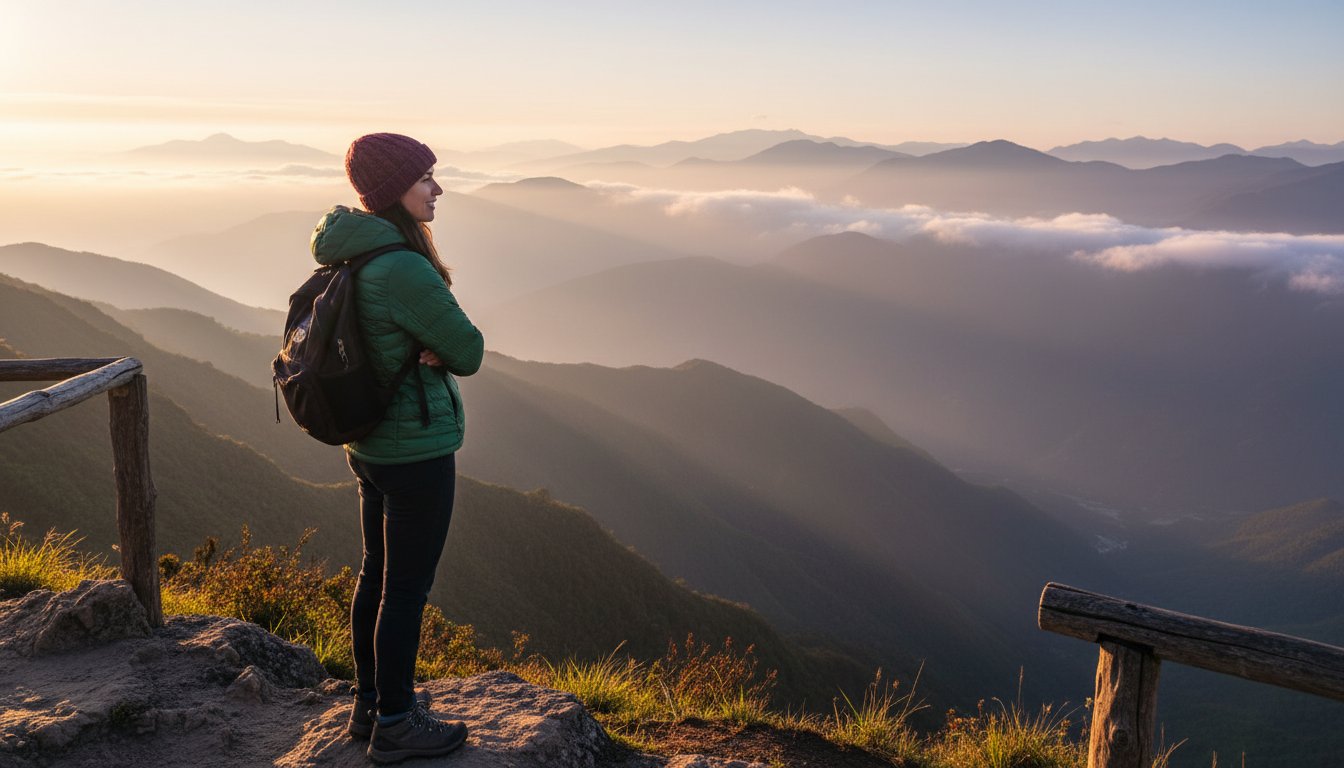
What if the only thing standing between you and the sunrise over Machu Picchu isn't your own bank account, but your social circle's budget? It's a heavy, quiet frustration to feel ready for the world while your closest friends are tethered by financial constraints. You're likely searching for how to travel when your friends have no money because you're tired of watching your dreams stall in a group chat that can't reach a consensus. It's a common ache; 74% of travelers now report that their primary motivation for going solo is the desire to see the world without waiting for others to catch up.
You probably feel a mix of guilt for leaving friends behind and a restless wanderlust that refuses to be ignored. We believe your horizons shouldn't be limited by someone else's balance sheet. This guide will teach you how to navigate income disparities and find the right companions to fulfill your travel goals without compromise. You'll learn a clear strategy for compromising with your current circle, a method for finding new travel buddies with matching budgets, and how to cultivate the confidence to join the 18.1 million Americans currently designing their own global adventures through planned serendipity.
Key Takeaways
- Adopt the "Hybrid Trip" model to balance shared accommodations with personal, high-value experiences that match your specific travel style.
- Uncover the secret to how to travel when your friends have no money by leveraging travel rewards and companion passes to make global exploration accessible to your inner circle.
- Embrace the agency of solo travel to invite more "planned serendipity" into your journey, turning solitary moments into opportunities for unexpected connections.
- Use the Nomadipity network to find travel partners who mirror your budget and loyalty tiers, ensuring your next itinerary is built on shared expectations rather than compromise.
The Friendship vs. Finance Dilemma: Why You Feel Stuck
Friendship is an anchor. Usually, that's a good thing, but sometimes anchors keep you from sailing when the wind is just right. You're likely wrestling with a specific type of internal friction. On one hand, you have a deep loyalty to your social circle; on the other, a restless wanderlust that won't stop whispering. Learning how to travel when your friends have no money is rarely just a math problem. It's an emotional puzzle that involves navigating the guilt of the frequent flyer and the fear that your personal growth might leave your peers behind.
This tension often stems from "Travel Style Misalignment." It isn't just about the total dollar amount in a bank account. It's about how we value luxury versus experience. While you might see a $600 Inca Trail trek as a non-negotiable investment in your soul, your friend might see it as three months of groceries. This gap creates a "guilt of the frequent flyer," where you feel like you're bragging just by living. We must remember that travel is a vital tool for personal evolution. To understand the deeper roots of this drive, looking into the history and definition of travel reveals that humans have always moved for more than just survival; we move for trade, discovery, and the expansion of the self.
The Psychology of Income Disparity in Travel
Every traveler has a "comfort baseline." For a backpacker in Laos, this might be a $14 daily budget, while someone in Thailand might feel restricted on $35. When friends have vastly different baselines, friction is inevitable. You might feel tempted to "subsidize" a friend's trip to ensure their company, but this often backfires. It creates a power imbalance where you feel like a benefactor and they feel like a project, leading to resentment on both sides. The budget-expectation gap is the primary source of travel friction, turning a dream vacation into a series of awkward negotiations over appetizers.
When "Wait for Me" Becomes a Barrier to Growth
The phrase "maybe next year" is a dangerous one. In 2025, over 18.1 million Americans identified as digital nomads because they realized that waiting for a group consensus is a recipe for a stagnant life. If you delay your adventures, you aren't just missing a flight; you're missing the mental clarity and the "planned serendipity" that only comes from movement. There is a profound difference between traveling for the destination and traveling for the company. As you cultivate location independence, your social needs will shift, and you'll realize that your growth shouldn't be held hostage by someone else's financial timeline.
4 Ways to Travel With Budget-Conscious Friends Without Compromise
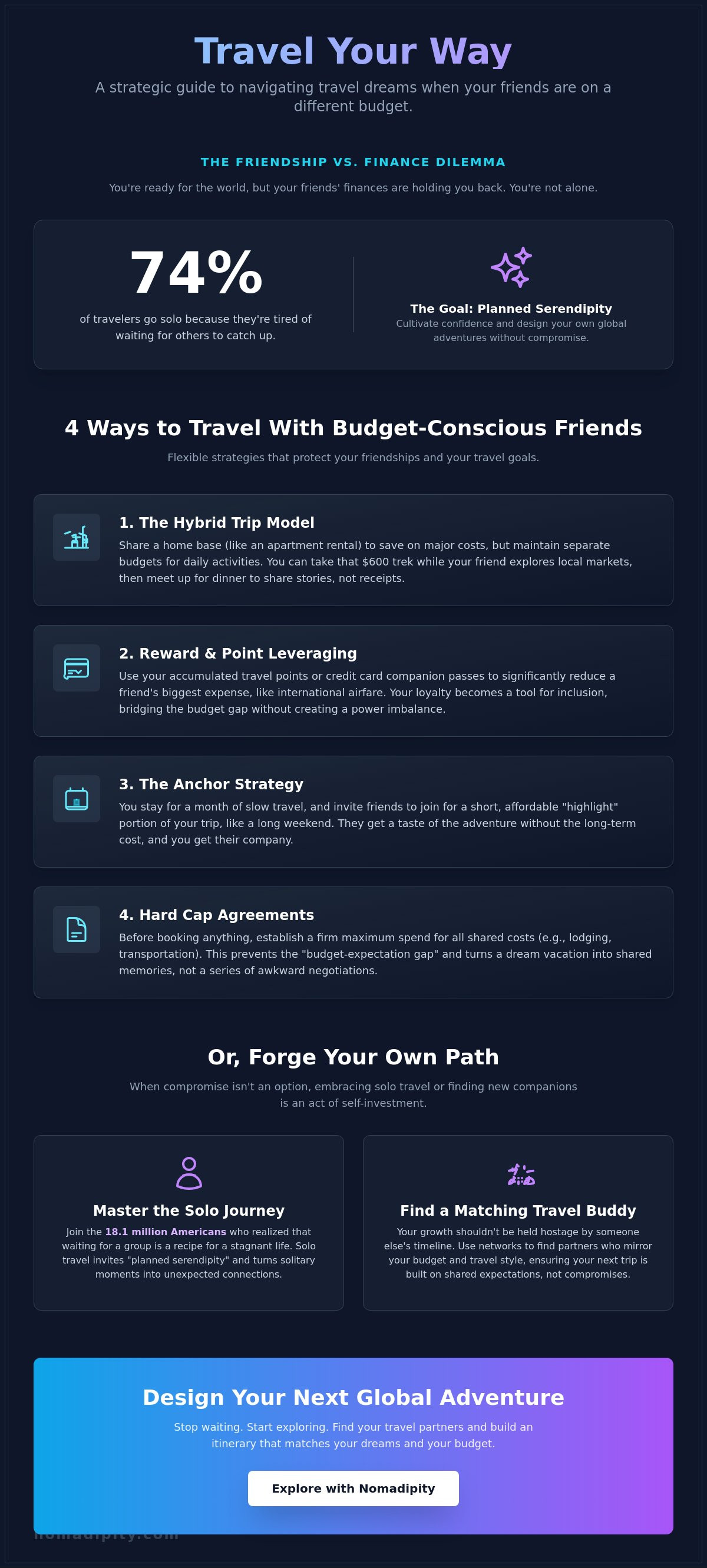
You don't need to choose between your bank account and your best friends. Figuring out how to travel when your friends have no money is an exercise in modular planning rather than total sacrifice. Instead of a rigid group itinerary where everyone does everything together, consider a more flexible design. This allows you to maintain your friendship while still pursuing the high-value experiences you crave. Success lies in these four strategies:
- The Hybrid Trip: Share a home base, like a comfortable apartment in Da Nang, but maintain separate budgets for daily activities.
- Reward Leveraging: Use accumulated points or companion passes to offset a friend's largest expenses, such as international airfare.
- The Anchor Strategy: Invite friends to join for a short "highlight" weekend while you remain for a month of slow travel.
- Hard Cap Agreements: Establish a maximum spend for shared costs (lodging and transit) before any bookings occur.
By agreeing on the big-ticket items early, you protect the friendship from the friction of hidden costs. You might spend $250 on a round-trip transit and admission to Machu Picchu while your friend chooses to explore the local markets in Cusco for the cost of a few soles. You meet in the middle for the sunset, sharing stories rather than just receipts. This approach ensures that no one feels like a burden and no one feels held back. If you're looking for more ways to optimize your journey, you can explore our latest destination guides to find the perfect middle ground.
Maximizing Rewards to Bridge the Gap
Your loyalty doesn't just earn you upgrades; it's a tool for inclusion. Using travel rewards programs allows you to bridge the gap between your reality and your friend's budget. If you have a stash of points from a card like the Chase Sapphire Preferred, which as of April 2026 offers a sign-up bonus of 75,000 points, you can gift a flight or use hotel status for free breakfasts. This isn't about being a benefactor. It's about using the systems you've built to design a shared experience that feels equitable for everyone involved.
The Art of the Low-Cost, High-Experience Itinerary
Embracing slow travel principles means you prioritize depth over expensive, fast-paced tours. Choose destinations where the dollar stretches furthest, such as Peru, Ecuador, or Bolivia, where a monthly budget of $1,200 was feasible in early 2026. You can find excellent advice on how to travel on a budget that emphasizes local markets and free walking tours. These activities maintain social cohesion without draining anyone's savings. When you focus on the "why" of the trip, the "how" becomes much easier to navigate together.
Mastering the Solo Journey: The Ultimate Act of Planned Serendipity
Solo travel is not a consolation prize for those who couldn't find a partner. It's the ultimate act of agency. When you stop waiting for the group chat to reach a consensus, you reclaim your most valuable asset: time. If you've been searching for how to travel when your friends have no money, you've likely realized that the bottleneck isn't your desire, but your dependence on others. Stepping out alone transforms travel from a shared compromise into a personal reset. It allows you to move at your own pace, eat when you're hungry, and change your destination on a whim without a single committee meeting.
This independence is the fertile ground where "planned serendipity" takes root. When you're part of a group, you're often insulated from your surroundings. You look inward toward your friends rather than outward toward the world. Solo travelers, by contrast, are magnets for the unexpected. You're more likely to be invited to a local's table or to join a spontaneous hike with fellow nomads because you're approachable. By setting up the right systems, like choosing a well-regarded coworking space in Da Nang or a social hub in Medellin, you create the conditions for magic to happen.
Overcoming the Loneliness Myth
There's a vital distinction between being alone and being lonely. Being alone is a physical state that offers clarity; being lonely is an emotional one that stems from a lack of connection. On the road, you'll find that solo travelers represent 75% to 84% of the global community, meaning you're never truly solitary unless you choose to be. You'll find yourself more open to deep, authentic conversations with strangers precisely because you don't have the safety net of a friend group. For those ready to dive deeper into this mindset, our solo travel guide provides the framework for mastering the art of being your own best companion.
Designing Your First Solo Itinerary
Start with low-friction destinations that offer robust infrastructure and welcoming cultures. Thailand and Vietnam are perennial favorites for a reason. As of March 2026, a 90-day E-visa for Vietnam costs just $25, making the logistics of entry simple and affordable. Use "social anchors" like airport lounges or boutique hostels to ground your journey. These spaces provide a sense of familiarity while you navigate new landscapes. Keep your plan loose. Leave room for the unplanned coffee date or the extra day in a village that captured your heart. This is how you cultivate a global network that matches your energy and your budget.
How to Find a Travel Buddy Who Matches Your Budget
The most liberating realization you can have is that your best friend doesn't have to be your only travel partner. If you've spent months researching how to travel when your friends have no money, you've likely hit a wall of polite declines and "maybe next year" promises. Stop waiting. Expanding your global network means looking beyond your immediate circle to find people whose financial baselines and "Travel Personas" align with yours. Finding a companion is an act of lifestyle design; it requires intentionality and a willingness to be blunt about your expectations.
To find a partner who won't flinch at the cost of a private tour or a boutique stay, follow these five steps:
- Step 1: Define your persona. Are you an "Adventure Seeker" willing to spend on gear or a "Luxury Nomad" who prioritizes five-star comfort?
- Step 2: Be explicit about the numbers. State your daily budget upfront. If you plan to spend $150 a day on food and activities, say it before the first booking.
- Step 3: Join niche networks. Look for communities where members already invest in travel, such as frequent flyer forums or rewards-based social groups.
- Step 4: The Vibe Check. Never commit to a month-long trip without a video call or a short weekend "trial" meetup to test compatibility.
- Step 5: Filter by affiliation. Use platforms that allow you to filter by interests or loyalty tiers, ensuring you start on the same page.
By shifting your focus from "convincing" to "connecting," you open the door to planned serendipity. You might find a partner who also holds a Chase Sapphire Preferred card and wants to maximize their 75,000-point bonus on the same luxury hotels in Tokyo as you. This alignment removes the friction of the "budget-expectation gap" entirely. Find your next adventure partner by looking where the frequent flyers hang out.
Vetting for Financial and Lifestyle Alignment
The "money talk" should happen long before you reach the airport. Ask specific questions: "What is your stance on fine dining versus street food?" or "Are we splitting a $250 train ticket to Machu Picchu or taking the bus?" Discussing your "Splurge vs. Save" priorities ensures you won't feel guilty for wanting a nice meal while your partner eyes a grocery store sandwich. Shared affiliations, such as both holding Marriott Bonvoy status or a TrustedHouseSitters membership (which cost between $129 and $259 in early 2026), serve as a reliable shorthand for a person's travel values and comfort requirements.
Moving Beyond Your Immediate Social Circle
Your best friend might be the person you call at 2:00 AM, but they could be a nightmare travel companion if your budgets don't match. Seeking a "Travel Match" allows you to find someone with a specific skill set or budget level that complements your own. This isn't a betrayal of your current friendships; it's a way to protect them from the resentment that income disparity often breeds. For a deeper dive into the tools and platforms available today, check out our guide on how to find a travel buddy and start designing a journey that requires no apologies.
Designing Your Global Network with Nomadipity
You've navigated the emotional friction of leaving friends behind and explored the profound agency of solo travel. Now, it's time to build a community that matches your pace. Nomadipity isn't just another directory; it's the premier social network for frequent flyers designed to solve the very problem we've discussed. If you're tired of wondering how to travel when your friends have no money, our platform provides the precise filters needed to find "Nomadipitians" who share your rewards tiers, budget baselines, and thirst for authenticity.
Transitioning from a digital connection to a real-world travel companion is where the real magic happens. By using the platform's geolocation features, you can spot fellow members in airport lounges or local coworking hubs in real time. This is the heart of planned serendipity. You aren't just hoping to meet someone; you're setting up a system where meeting the right person becomes inevitable. We recommend starting with a video call or a public meetup at a known nomad hotspot to ensure your travel styles truly align before you commit to a long-haul journey together.
Leveraging Your Loyalty for Connection
Your loyalty status is a social asset that facilitates deeper human connection. On Nomadipity, you can find matches based on mutual airline affiliations or hotel rewards programs. Imagine organizing a meetup in a lounge or guesting a new connection into a hotel club for breakfast. These shared perks reduce individual costs while elevating the overall experience for everyone. Over time, you'll cultivate a global rolodex of friends in major cities from Tbilisi to Bogotá, ensuring you always have a local "anchor" who understands your lifestyle and your budget.
The Nomadipity Membership: Your Ticket to New Horizons
Our platform removes the budget guesswork that often plagues traditional group trips. By joining specific digital nomad lifestyle groups, you can find peers who understand that a $1,200 monthly budget in Peru or Ecuador is a strategic choice, not a constraint. This community is built on the principles of agency and intention. It's about designing a life where your wanderlust is never held hostage by someone else's financial timeline. Stop waiting for the group chat to reach a consensus. Start exploring with people who are already at the gate, ready to fly, and eager to share the journey at your level.
Your Passport to Uncompromised Exploration
You now have the blueprint to stop waiting for "someday." By embracing the hybrid trip model or stepping into the agency of solo travel, you ensure your personal growth isn't stalled by a stagnant group chat. We've explored how to travel when your friends have no money without losing those cherished connections; it's about setting boundaries and designing experiences that reflect your true travel persona. Remember that 74% of solo travelers now choose this path specifically to see the world without waiting for others to catch up.
The world is too vast to view through the lens of a compromised itinerary. You deserve a community that speaks your language of loyalty points and slow travel. Find your perfect travel match on Nomadipity today. Our safe, vetted community of frequent flyers allows you to match by budget, interests, and loyalty programs. This platform is built for the planned serendipity that turns a simple trip into a life-defining journey. The horizon is waiting. It's time to meet it on your own terms and cultivate the connections that match your ambition.
Frequently Asked Questions
What do I do if I want to go on a luxury trip but my friends can only afford hostels?
You should utilize the "Split-Stay" strategy where you share daytime activities but book separate accommodations that match your individual comfort baselines. This prevents the resentment that builds when one person feels cramped in a hostel while the other feels guilty for wanting a resort. By meeting at a local landmark at 10:00 AM, you preserve the social connection while honoring your personal travel style and financial reality.
Is it rude to travel without my best friend because they can’t afford it?
It is not rude to pursue your own growth and experiences, even if your friends cannot join you. In fact, 74% of solo travelers report that they go alone specifically because they don't want to wait for others to be ready or able. Your friendship is built on shared values and history, not on a matched bank account. Taking a trip solo or with a new partner is an act of lifestyle design that protects your friendship from financial strain.
How do I find a travel partner who has the same budget as me?
You can find budget-aligned partners by joining specialized social networks like Nomadipity that allow you to filter by loyalty tiers and spending habits. When you're searching for how to travel when your friends have no money, the answer often lies in expanding your circle to include those who already value high-tier experiences. Be explicit about your daily spending goals during the vetting process to ensure total alignment before any flights are booked.
Should I pay for my friend’s travel if I can afford it and they can’t?
You should avoid subsidizing a friend's entire trip, as this often leads to a "benefactor-project" dynamic that ruins the social experience. Instead, use your travel rewards to gift specific components, like a flight or a hotel room earned through points. This feels more like a gift and less like a loan. It keeps the relationship equitable and prevents the "budget-expectation gap" from turning into a source of long-term resentment.
How do I stay safe when traveling with someone I met online?
You stay safe by implementing a rigorous vetting process that includes multiple video calls and a public "vibe check" meeting before the trip begins. Share your itinerary and your partner's contact details with a trusted person back home. Using a platform with a verified, peer-reviewed community adds an extra layer of security. Always have an "exit strategy" and enough funds to stay independently if the partnership doesn't feel right after the first 24 hours.
What are the best destinations for travelers on a mismatched budget?
Destinations like Thailand, Vietnam, and Colombia are ideal because they offer a wide spectrum of price points within the same neighborhood. In these regions, a luxury hotel might sit just blocks away from a high-quality hostel. This allows you to indulge in high-end dining while your friend enjoys world-class street food, meeting in the middle for shared adventures. These hubs make it easier to navigate how to travel when your friends have no money without feeling socially isolated.
Can solo travel really be as fun as traveling with friends?
Solo travel is often more fulfilling than group travel because it provides total agency over every single decision. You aren't just visiting a destination; you're cultivating your own independence and opening the door to planned serendipity. Without the "social bubble" of a group, you're 80% more likely to engage with locals and other nomads. This creates a narrative that is entirely yours, free from the compromises that often dilute group experiences.
How do I tell my friends I’m going on a trip without them?
You should communicate your plans with transparency and warmth, emphasizing that your decision is about your personal timing rather than their financial situation. Use "I" statements, such as "I've realized I need to take this trip now for my own mental clarity." Offer to do something local and budget-friendly together when you return. This frames the trip as a personal necessity rather than an exclusion, preserving the bond while you pursue your wanderlust.

Disclaimer
Nomadipity Blog Disclaimer
The content on Nomadipity is provided for general informational and inspirational purposes only. While we strive for accuracy and timeliness, Nomadipity does not guarantee that any information is complete, current, or suitable for your specific needs. Use your judgment and verify details before making travel plans, meeting with other users in person, or making any purchases influenced by the article.


