

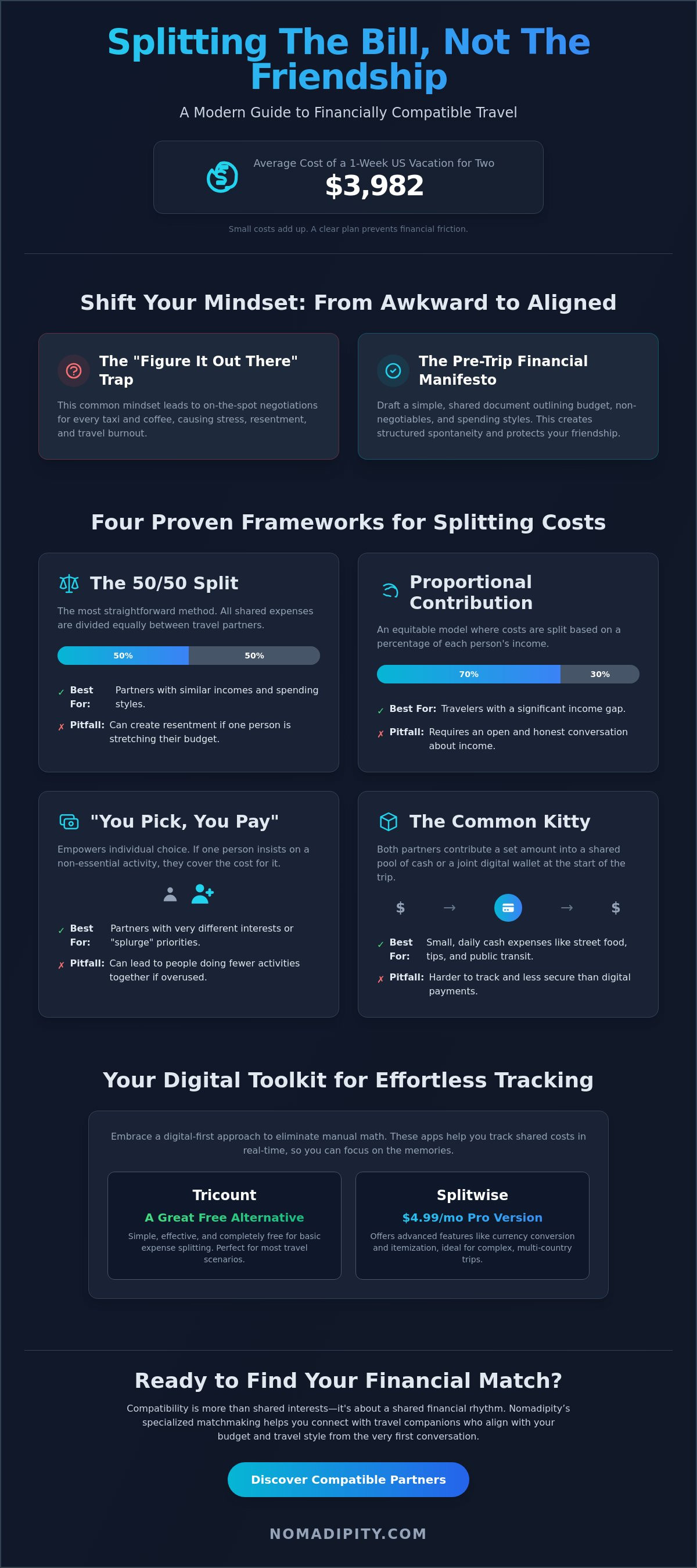
What if the most adventurous part of your next trip wasn't the sunset dinner, but the conversation you had before you even packed a bag? Most of us fear that talking about money will kill the magic of a getaway. We worry about the awkwardness of uneven budgets or the resentment that builds when one person ends up footing the bill for every artisan coffee. With the average one-week vacation for two people in the U.S. now costing approximately $3,982, those small "I'll get the next one" promises can quickly turn into significant financial friction.
Learning how to split expenses with a travel partner doesn't have to be a clinical exercise in accounting. In fact, establishing a clear framework is what allows for true, structured spontaneity. This guide will show you how to maintain your connection while navigating multi-currency costs and income gaps. We will explore modern tools like Tricount, which remains a free alternative to the $4.99 monthly Pro version of Splitwise, and provide the exact conversation starters you need. You'll gain a clear financial agreement before departure and a frictionless way to track costs, ensuring your journey is defined by shared memories rather than shared debts.
Key Takeaways
- Shift your focus from bank balances to spending styles. Learn why setting boundaries early prevents the burnout that often ends friendships on the road.
- Master multiple frameworks for how to split expenses with a travel partner, including proportional models that account for income gaps without creating resentment.
- Navigate the complexities of reward points and lounge access. We'll show you how to value a "free" stay so both travelers feel the exchange is equitable.
- Embrace a digital-first approach to logistics. Use modern banking and tracking tools to eliminate the manual math that often clutters your mental space.
- Connect with travel companions who already align with your financial rhythm through our specialized matchmaking subscriptions.
The Art of Financial Compatibility in Travel
Financial compatibility is the silent engine of every successful journey. While we often focus on shared interests like hiking or museum-hopping, the way you value a dollar dictates the daily rhythm of your exploration. It isn't just about having identical bank balances. It's about whether you both see a $200 tasting menu as an investment in culture or a waste of funds. When you understand how to split expenses with a travel partner, you aren't just managing math; you're protecting the emotional integrity of your trip.
The "we will figure it out there" mindset is a common trap that leads directly to travel burnout. It forces you to negotiate every meal, taxi ride, and entrance fee while you should be soaking in the scenery. This friction is particularly sharp with new connections, where the social contract isn't yet written. Money friction isn't just about the cost. It's about the perceived value and the power dynamics that shift when one person feels they are subsidizing the other's lifestyle. By leaning into collaborative consumption and clear frameworks, you create the foundation for structured spontaneity. This is the idea that by handling the logistics early, you leave room for the magic of the unplanned.
Why Budgeting is a Form of Vetting
Think of money talk as a high-stakes compatibility test. A "budget traveler" might prioritize street food to afford a longer stay, while a "luxury seeker" wants the boutique hotel experience. Neither is wrong, but they are often incompatible in the same itinerary. Nomadipity.com’s matchmaking subscriptions allow you to filter for these specific travel styles and budget ranges before you even send a message. This allows you to find someone whose financial mindset mirrors your own. Watch for red flags during your initial chats. If a potential partner is vague about their limits or dismissive of cost discussions, it's a sign that the "figure it out there" chaos is coming. Trust your gut. If the financial conversation feels heavy now, it will feel like a lead weight once you're on the ground.
The "Pre-Trip Financial Manifesto"
Before you book the first flight, draft a simple shared document. This doesn't need to be a formal contract, but it should be a clear "manifesto" of your shared expectations. List your non-negotiables, like private rooms or direct flights, and identify your planned splurges. To keep things fluid, include a daily "buffer" for those unplanned moments, like a sudden boat tour or a local craft market. Finally, establish a "no-questions-asked" personal spending limit for individual items like souvenirs or solo treats. This ensures that while you know how to split expenses with a travel partner for shared costs, your individual autonomy remains untouched. It's the difference between a trip that feels like a compromise and one that feels like a shared win.
Four Proven Frameworks for Splitting Travel Costs
Choosing the right framework is like picking the right gear for a trek. If it doesn't fit your stride, you'll feel every mile. When deciding how to split expenses with a travel partner, you need a system that feels invisible once the trip begins. There isn't a single "correct" way to do this. Instead, there's the method that respects both your bank account and your relationship. Whether you're planning a week in a domestic city or a month-long international escape, these four frameworks provide the structure needed for a seamless experience.
- The 50/50 Split: This is the most intuitive choice. It works perfectly when your financial situations and travel styles are nearly identical. However, it can quickly create resentment if one person is stretching their budget while the other is holding back.
- The Proportional Contribution: This is the more equitable sibling of the 50/50 split. If one traveler earns significantly more, they might cover 60% or 70% of the shared costs. This allows both people to enjoy a higher standard of travel without the lower earner feeling financial strain.
- The "You Pick, You Pay" Method: This method empowers individual choice. If you insist on a specific activity that your partner is indifferent toward, you foot the bill. It prevents one person from feeling pressured into expensive experiences they didn't really want.
- The Common Kitty: A traditional approach where both partners contribute a set amount to a shared pot at the start. This is especially helpful for Navigating group expenses or long-term trips where small, recurring costs like bus tickets can become a tracking nightmare.
The 50/50 Split vs. Proportional Splitting
Calculating a fair percentage doesn't have to be an interrogation. It's about looking at your disposable income or the size of your specific travel fund. While the 50/50 rule is excellent for fixed costs like a $259-per-night hotel room, it might fail when it comes to daily dining. Maintaining a sense of equality is vital. Even when the math isn't even, the goal is to ensure both travelers feel like valued contributors rather than guests or sponsors. If you're looking for someone who shares your financial philosophy, exploring Nomadipity.com matchmaking subscriptions can help you find a partner who values equity as much as you do.
Category-Based Allocation
Another effective strategy is assigning specific categories to each person. Perhaps Partner A pays for all transport while Partner B covers the food. This avoids the need to split every single receipt. If one category becomes unexpectedly expensive, like a sudden hike in domestic flight costs, you can rebalance the scales mid-trip by shifting a few dinners to the other person's tab. Ultimately, choosing a travel partner with similar category preferences reduces friction because you're starting from a place of shared values and expectations. When you both agree that local street food is a priority over fine dining, the math naturally follows the mood.
Navigating Income Inequality and Reward Point Disparity
Travel is rarely a meeting of identical bank accounts. Often, one person arrives with a stash of airline miles and hotel points, while the other relies on hard-earned cash. This "Points vs. Cash" dilemma can quietly erode a trip if you don't assign a value to those non-cash assets. Is a room booked on points truly "free" for the partner who didn't earn them? Not necessarily. Without a framework for keeping finances fair, the person paying cash may feel the weight of every transaction while the points-spender feels they are gifting a luxury experience. Both perspectives are valid, but they require a shared vocabulary to coexist.
The complexity grows when you consider that travel rewards programs are built for individual loyalty, not shared logistics. If your partner has an American Express Platinum card with its $895 annual fee or a Chase Sapphire Reserve at $795, they likely expect certain perks that you might not have access to. Discussing these disparities before you reach the airport gate is essential for maintaining dignity and preventing one person from feeling like a "guest" on someone else's vacation. Learning how to split expenses with a travel partner in these scenarios means looking beyond the receipt to the total value brought to the table.
Valuing Loyalty Perks in a Shared Budget
Assigning a fair market value to points-based bookings is the cleanest way to balance the scales. If a hotel room normally costs $259 per night but is covered by points, the partner not providing the points might cover all the dining or local transport to compensate. It's a trade of assets. You can also navigate "upgraded" perks with transparency. For instance, as of early 2026, Capital One Venture X cardholders are charged $45 for guests at Capital One Lounges. Deciding who covers that fee before you're standing at the lounge entrance prevents a small charge from becoming a big mood-killer. Trading points for other fixed expenses, like car rentals or tours, keeps the contribution levels feeling equitable even when the payment methods differ.
The "Upgrade" Conversation
What happens when one partner wants a five-star boutique stay and the other is perfectly happy in a high-end hostel? The "pay the difference" model is a graceful solution. If the budget-conscious traveler is comfortable with a $100-a-night limit, but the high-earner insists on a $300-a-night resort, the high-earner pays the $200 difference. This ensures the lower-budget partner doesn't feel like a charity case or a financial anchor. It allows both people to experience the trip they want without compromising their financial health. By centering the conversation on personal comfort and agency, you ensure that how to split expenses with a travel partner becomes a tool for connection rather than a source of division.
The Digital Toolkit: Managing Expenses in Real-Time
Gone are the days of scribbling in a notebook or debating over a crumpled receipt. In 2026, manual tracking is more than just a chore; it's a liability that invites human error and creates unnecessary labor during what should be a period of rest. When you're mastering how to split expenses with a travel partner, the goal is to spend less time in a spreadsheet and more time in the moment. Digital efficiency allows for a level of transparency that keeps the vibe light and the focus on the horizon. By leaning on an automated tech stack, you ensure that the math stays in the background while your experiences take center stage.
Digital banking is the backbone of this modern approach. Platforms like Revolut or Wise allow for instant, fee-free transfers that bypass the predatory exchange rates of traditional banks. This is vital for multi-currency trips where losing 3% on every "settle up" transaction adds up fast. Establishing a "Settling Up" ritual is equally important. Rather than waiting for an end-of-trip marathon, try a weekly reconciliation. This prevents small discrepancies from snowballing into larger misunderstandings and keeps everyone's bank account balanced throughout the journey.
Essential Apps for Travel Partners
Splitwise remains a titan in the space, though its $4.99 monthly Pro fee has pushed many toward leaner alternatives. Tricount offers a completely free experience without paywalls, while Splid is the go-to for those venturing off-grid where data is scarce. For the ultimate friction-free experience, Cino uses a shared virtual card to split costs at the exact moment of purchase. You can also utilize social network for frequent flyers features to sync your itinerary and expected group costs before you even touch down. If you want to skip the trial-and-error of finding a tech-savvy companion, subscribe to our Nomadipity.com travel matchmaking service to find partners who already use these tools.
Automating the Boring Stuff
Setting up "auto-split" rules for recurring costs like co-working spaces or weekly apartment cleanings removes the mental load of repetitive entries. Modern AI-powered trackers can even predict your total trip cost based on early spending patterns, helping you adjust your pace before you hit your limit. Real-time reconciliation is the cure for end-of-trip resentment. It provides immediate clarity and ensures that both travelers are operating from the same set of facts. Setting up these systems early is the most effective way to learn how to split expenses with a travel partner without the friction of manual math.
Finding Your Financial Match with Nomadipity
Finding the right person to share a sunset with is easy. Finding the right person to share a $3,982 vacation bill with is where the real challenge lies. While the tools we’ve discussed handle the logistics, they cannot bridge a fundamental gap in financial values. This is why Nomadipity’s matchmaking algorithm prioritizes budget and travel style alongside mutual interests. We understand that a mismatch in spending habits is the fastest route to travel burnout. By subscribing to a service that filters for financial compatibility, you move beyond the "stranger danger" of shared costs and into a partnership built on transparency. Trust is the real currency of the road. Math is just the map.
Moving from a digital connection to a physical meetup requires a shift in how we discuss resources. The Nomadipity community fosters an environment where talking about money is seen as a sign of respect, not a vibe-killer. When you establish fair travel norms early, you protect the friendship from the resentment of unequal spending. Ultimately, the right partner is worth more than a perfectly balanced spreadsheet. They are the person who understands that a shared experience is an investment in personal growth, regardless of who paid for the last round of drinks. Learning how to split expenses with a travel partner is easier when you're starting from a place of shared vision.
Setting Your Financial Profile
Honesty is your greatest asset when building your traveler profile. Use our "Budget Style" tags to clearly signal whether you are a "Slow-Paced Nomad" or a "Luxury Seeker." Being upfront about your daily limits prevents the awkwardness of declining expensive outings later. You can also leverage travel dating filters to find someone whose lifestyle matches your own, whether that involves high-end lounges or local guesthouses. When your profile reflects your reality, you attract companions who are looking for the exact same level of comfort and cost.
Your Next Steps to a Shared Adventure
Before committing to an international trek, try the "Coffee Date" test. Discuss a micro-budget for a weekend trip or even a local afternoon out. This provides a low-stakes environment to see how your partner handles real-world transactions. If your financial goals don't align during this test, it's okay to gracefully exit the partnership. It is better to discover a mismatch over a $5 latte than a $500 flight. Every conversation you have now is a deposit into the success of your future journey. Join Nomadipity to find a partner who shares your travel, and financial, vision.
Step Into Your Next Shared Adventure
True travel freedom isn't found in a bottomless bank account; it lives in the clarity of a shared plan. By choosing the right framework and leaning on a modern digital stack, you transform money from a source of friction into a foundation for trust. You've learned that how to split expenses with a travel partner is less about the math and more about the mutual respect that allows for structured spontaneity. When the logistics are settled, you're free to focus on the sensory details of the journey rather than the balance of a spreadsheet.
You don't have to navigate the search for a companion alone. Join a community of over 100,000 frequent flyers who value intentional living and transparent communication. With vetted profiles and advanced budget-matching filters, you can find your financially compatible travel match on Nomadipity today.
The world is vast and manageable when you approach it with the right mindset and the right partner. Go find the person who shares your vision, and let the adventure begin.
Frequently Asked Questions
Is it better to split everything 50/50 or pay for what you individually consume?
Splitting fixed costs like a $259-per-night hotel room 50/50 is the most efficient approach, but individual consumption works better for variable costs. If one person orders steak and the other a side salad, forcing an even split creates immediate friction. Use an app to track shared transport and accommodation while letting individual meals or souvenirs stay on separate tabs. This balance ensures that no one feels like they are subsidizing another person’s lifestyle choices.
How do we handle shared meals if one person drinks alcohol and the other doesn’t?
The simplest solution is to split the food bill evenly and have the drinker pay for their beverages separately at the table. Most modern expense apps allow you to itemize receipts or exclude specific users from certain costs. By addressing this before the first round of drinks arrives, you prevent the non-drinker from feeling a quiet resentment over a bill that is 40% higher than their actual consumption. Transparency keeps the dining experience light.
What is the best app for splitting travel expenses in 2026?
Tricount is currently the best completely free option because it lacks the paywalls found in other popular tools. While Splitwise is a household name, its Pro version now costs $4.99 per month or roughly $50 per year, which may not be worth it for occasional travelers. If you want a friction-free experience, Cino is a fantastic choice that uses a shared virtual card to automatically split payments at the moment of purchase. Each tool offers a different way how to split expenses with a travel partner depending on your tech comfort.
How do you bring up a budget conversation without it being awkward?
Frame the conversation around "structured spontaneity" rather than cold accounting. Ask your partner what their "splurge" items are and where they prefer to save. Starting with a positive question about their dream experiences makes the subsequent talk about the $58 average daily food cost feel like a roadmap for success. When you treat budgeting as a tool to ensure you both have a great time, the awkwardness melts away into shared excitement for the journey ahead.
What happens if my travel partner runs out of money mid-trip?
Address the situation immediately with a compassionate but firm pivot to low-cost or free activities. You might need to swap the artisan dinners for local markets or cancel paid tours in favor of self-guided walks. Avoid lending large sums of money unless you have a clear, written repayment agreement, as financial debt is the fastest way to ruin a travel connection. Focus on maintaining the relationship by finding joy in the unexpected, affordable moments that don't require a credit card.
How do we value hotel points or airline miles when splitting costs?
Assign a fair market value to the booking based on what it would cost in cash at the time of the trip. If a flight costs $290 but is covered by miles, the partner who didn't provide the points should cover an equivalent shared expense, such as the car rental or several dinners. This trade ensures that the value of the points is recognized as a real financial contribution. It prevents the points-user from feeling taken advantage of while keeping the cash-user's budget balanced.
Should we settle the bill daily or at the end of the trip?
Weekly settlements are the gold standard for long-term adventures. Daily math can feel like a chore that interrupts your flow, while waiting until the end of the trip can lead to "sticker shock" and anxiety over a large pending balance. Settling up every seven days keeps everyone's bank account balanced and allows you to adjust your spending pace if you're hitting your limits too early. It provides a natural rhythm to your financial logistics without the constant administrative burden.
How do you handle tipping in countries where it is expected but not in the budget?
Factor tipping into your daily "buffer" fund as a non-negotiable operational cost. In many regions, tipping is a vital part of the local service economy and should be treated with the same necessity as a bus ticket or a museum entry. Discuss these cultural norms before you arrive so you can agree on a standard percentage. This prevents awkward moments at the table where one person wants to be generous and the other feels the pinch of an unplanned expense.

Disclaimer
Nomadipity Blog Disclaimer
The content on Nomadipity is provided for general informational and inspirational purposes only. While we strive for accuracy and timeliness, Nomadipity does not guarantee that any information is complete, current, or suitable for your specific needs. Use your judgment and verify details before making travel plans, meeting with other users in person, or making any purchases influenced by the article.


